A lead compound is a molecule identified early in development and taken forward for evaluation. The process that produces one starts with a collection of compounds, screens it against a target associated with the disease, and then narrows and refines the hits through successive rounds of testing and chemical modification until a development candidate is selected.
What a compound library actually is
A compound library is a physical collection of molecules held in plates, together with the data describing them. Sizes vary widely and are worth checking rather than assuming. Among publicly documented collections in the United States, the Genesis library maintained by the National Center for Advancing Translational Sciences holds 100,000 compounds, arranged in 1,536-well plates in dose-response format,[S1] and the Tox21 library holds 10,000 environmental chemicals and approved drugs.[S2] Commercial and internal corporate collections are not generally documented publicly, so no figure is given for them here. What matters for a screen is less the total size than whether the chemical space represented is relevant to the target.
The two collections above are not interchangeable, and the difference illustrates a general point. The Genesis library is built for finding activity against a target. The Tox21 library was assembled by three federal agencies to screen for disruption of biological pathways, which is a toxicology question rather than an efficacy one.[S1][S2] A library is designed for a purpose, and a screen run against the wrong collection produces hits that are difficult to progress.
Computational screening
Computational methods, including machine learning approaches, are used to prioritize which compounds to test physically. Contract organizations offer this as a service. It is a filtering step rather than a required one: a screening campaign can be run without it, and the reason to use it is throughput, since a computational pass can rank a collection far larger than any laboratory could screen in the same period.
What it produces
Given a structure for the target, these methods estimate how strongly each compound in a collection is likely to bind to it, and rank the collection accordingly. The output is a ranking, not a measurement. Every compound taken forward still has to be tested in an assay, because a predicted affinity is a hypothesis about binding and says nothing about solubility, stability, cell permeability or what the compound does once bound. This article makes no claim about how accurate such predictions are, because no source establishing that could be located.
Publicly available resources in the US
In the United States, the National Center for Advancing Translational Sciences, part of the National Institutes of Health, maintains compound collections and runs quantitative high-throughput screening against them.[S1] Its Tox21 programme, run jointly with the Environmental Protection Agency and the Food and Drug Administration, screens a defined 10,000-compound collection using robotic systems for effects on biological pathways.[S2] These are public resources with published documentation, which makes them a reasonable starting point for understanding what a screening campaign involves before commissioning one. This article does not name commercial providers.
Where screening output meets the nonclinical package
Screening data do not go into a regulatory submission in the form they are generated. The application to begin clinical work requires pharmacological and toxicological information supporting a conclusion that the proposed investigation is reasonably safe to start,[S3] and that comes from characterization studies on the selected candidate rather than from the campaign that found it. Screening work is also normally conducted outside the good laboratory practice regulation, which applies study by study to nonclinical laboratory studies supporting a submission.[S4] The practical consequence is that the transition from screening to development is a change in how the work is documented as much as a change in what is measured, and it is worth planning for rather than discovering late.
3 Recommended Contract Research Organizations
for Non-Clinical Studies
— by Target goal and Expertise
In non-clinical development, the choice of contract research organization shapes the quality of the data and the time it takes to reach the next decision. Below, three CROs are introduced by the type of study they support: pharmacology (efficacy) studies, safety studies, and pharmacokinetic (PK/PD) studies. Each summary describes the services the company offers so that you can match a provider to your target and development objective.
Pharmacology (Efficacy) StudiesDisease-Relevant Models for Translational Drug Evaluation
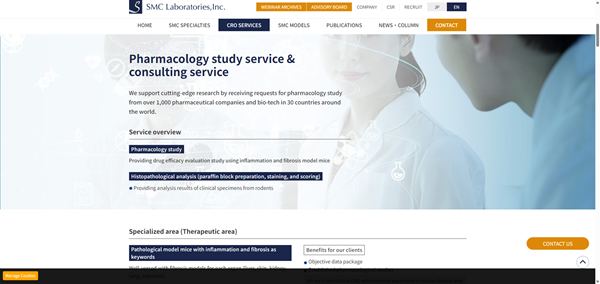
Reference: SMC Laboratories, Inc. official website (https://www.smccro-lab.com/)
SMC Laboratories, Inc.
SMC Laboratories is a specialized non-clinical CRO focused on in vivo pharmacology and efficacy studies using disease-relevant animal models, particularly in fibrosis, inflammation, metabolic diseases, and oncology.
Areas of Expertise
Disease-Relevant Model Portfolio
SMC Laboratories offers models covering the liver, lung, kidney, intestine, and oncology. Its portfolio includes the proprietary STAM™ model for MASH, fibrosis, and hepatocellular carcinoma.
Study Design Based on Target Biology
Study plans are developed around the target biology, mechanism of action, disease stage, and development objective. Pharmacological endpoints can be combined with histopathology, biomarkers, and disease-specific readouts.
Support from Target Validation to Proof of Concept
With experience from more than 1,000 studies for clients in 30 countries, SMC Laboratories supports programs from target validation and candidate selection through in vivo proof-of-concept studies.
Safety StudiesComprehensive Safety Assessment for Preclinical Development
Reference: Charles River Laboratories official website (https://www.criver.com/)
Charles River Laboratories
Charles River provides non-clinical toxicology and safety assessment services for programs ranging from exploratory safety studies to IND-enabling development.
Areas of Expertise
General Toxicology Across Study Designs
Services include single- and repeat-dose toxicology, dose-range finding, and general toxicology studies across multiple species and administration routes.
Non-GLP and GLP Study Support
Charles River supports both non-GLP and GLP studies, allowing sponsors to progress from early safety characterization to studies intended for regulatory submissions.
Integrated IND-Enabling Safety Assessment
Toxicology studies can be integrated with toxicokinetics, clinical pathology, histopathology, and safety pharmacology to support interpretation and IND-enabling safety packages.
Pharmacokinetic (PK/PD) StudiesConnecting Drug Exposure with Pharmacological Response
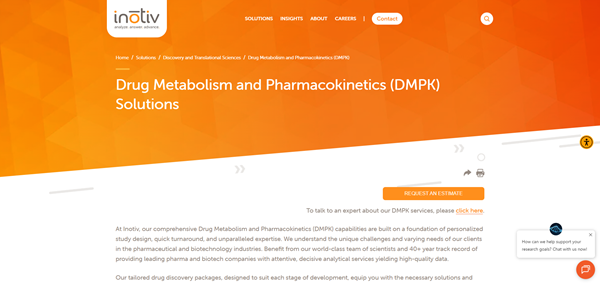
Reference: Inotiv official website (https://www.inotiv.com/)
Inotiv
Inotiv provides integrated PK/PD, DMPK, and bioanalytical services to characterize drug exposure and its relationship with pharmacological response.
Areas of Expertise
Pharmacokinetic Characterization
PK studies characterize exposure, half-life, clearance, and other pharmacokinetic parameters needed to understand how a candidate behaves in the selected model.
Exposure–Response Evaluation
Pharmacokinetic data can be combined with pharmacodynamic endpoints and bioanalysis to evaluate the relationship between drug exposure and pharmacological response.
Integrated DMPK and Development Support
Integrated DMPK, pharmacology, and safety information supports candidate comparison, dose selection, dosing-frequency optimization, and decisions about subsequent preclinical development.

 Japanese