Choosing a nonclinical contract research organization
What the choice actually determines
Drug development now spans modalities, from small molecules to biologics, gene therapy and cell therapy, each with its own methods and its own regulatory expectations. Few organizations hold every capability internally, so most programmes are assembled from work placed with several outside laboratories. That makes the selection question concrete rather than strategic: which laboratory will run this study, under whose quality system, and how will the sponsor know the result is sound.
What goes wrong when the choice is wrong
Three failure modes account for most of the damage, and they are worth naming because each has a different preventive step.
The first is a study that has to be repeated. A surgical model performed inconsistently, or a dosing route handled badly, produces variance that no analysis can remove, and the only remedy is to run it again. The cost is the study cost twice over plus the time, and it is not recoverable.
The second is delay. A study that slips pushes back the submission that depends on it, and for an investigational new drug application the sponsor cannot begin the clinical work until the application has been in the agency hands for 30 days without a clinical hold.[S5] Delay at the nonclinical stage therefore moves the whole downstream schedule. No figure for the cost of that delay is given here, because it depends entirely on the programme.
The third is data that cannot be relied on. This is the expensive failure, because it is often discovered late. A study whose raw data cannot be reconstructed, whose deviations were not documented, or which was represented as compliant with the good laboratory practice regulation when it was not, may have to be discarded entirely.[S2]
All three are more likely when price is the only criterion, which is the argument for the checks set out below rather than an argument against considering price.
Five things to establish before awarding
1. Relevant experience, stated specifically
A claim to be strong in a therapeutic area is not verifiable on its own. What is verifiable is narrower: how many times this laboratory has run this model, in this species and strain, with this route of administration, and what the historical control data look like. Peer-reviewed publications from the laboratory are useful corroboration because they expose the methods to review. Ask for the specific experience the study needs, not the general one.
2. The facility, and how it is run
The instruments the study needs have to be present, but the age of a building says little. What matters more is how the facility is operated: animal husbandry practice, backup power and environmental monitoring for the animal rooms, instrument calibration and maintenance records, and how electronic records are managed and validated. A laboratory that can produce calibration records on request is telling you something about the rest of its documentation.
3. Quality systems, and what the terms actually mean
Good laboratory practice compliance is determined study by study under the applicable regulation, not granted to a facility as a certificate.[S2] The regulation requires an independent quality assurance unit, and it requires the final report to carry the study director statement of compliance and the quality assurance unit statement.[S2] Ask which regulation a given study will follow, and ask to see the form those statements take. Three further points are worth separating. The Food and Drug Administration does not approve or certify laboratories, and registration with the agency does not denote approval.[S4] AAALAC accreditation is a voluntary evaluation of an animal care and use programme, reassessed every three years, and it is not a statement about study quality.[S3] And a laboratory that discloses past inspection findings together with what it changed is giving you more useful information than one that reports no findings at all.
4. Who you will actually be working with
Ask who the study director will be, what their background is, and whether they will be the person you speak to. A laboratory that responds to a draft protocol by proposing changes, and explaining why, is showing you the kind of engagement the study will get. A laboratory that agrees to everything is not necessarily easier to work with; it may simply mean the protocol will be run as written even where the design is weak. The corresponding obligation is on the sponsor, who has to stay engaged rather than hand the study over.
5. What the price actually covers
Quotations are comparable only if they cover the same scope, and they frequently do not. Establish what triggers a change order, whether animal costs and husbandry are included, whether the quoted price covers the pathology read and any peer review, what the report includes, and what happens if the study has to be repeated because of something the laboratory did. A low quotation with a broad change-order clause is not a low price.
Narrowing the field
The right laboratory depends on where the programme is. Early work, meaning screening, absorption and metabolism studies and efficacy in disease models, rewards specialist depth in the particular model. The studies that support an investigational new drug application, meaning the regulated toxicology and safety pharmacology package, reward a laboratory with the quality system and the inspection history to match. These are frequently not the same organization, and there is no obligation to use one laboratory for both.
This article does not rank laboratories or publish a comparison table. Capability claims of the kind such tables contain are almost always the companies own, and reproducing them side by side implies a comparison that the underlying information does not support. This site maintains separate profiles of US laboratories, each of which records what the company states about its own services and compliance, with the source and the date it was accessed, so that the claims can be checked rather than compared at face value.
Large organizations and specialist laboratories
The useful distinction in the United States is not domestic against foreign, since the agency is domestic here. It is breadth against depth. A large organization can run a whole package across several study types and sites under one contract and one quality system, which reduces the number of interfaces the sponsor manages. A specialist laboratory holds a particular model or technique in depth, often with more direct access to the scientists who will run the study. Programmes commonly use both, placing the specialist work where the model matters and the regulated package where the quality system matters.
When a specialist laboratory is the right choice
Some laboratories hold a proprietary disease model, or a technique that few others run, and for a programme that needs precisely that model there may be no alternative. The trade-off is worth stating. A proprietary model means the sponsor is dependent on one supplier for that endpoint, and it means the historical control data and the characterization of the model come from the same organization that sells access to it. Ask what has been published about the model by groups other than the laboratory itself, and what happens to the programme if that laboratory becomes unavailable.
From request for proposal to award
Step 1: define the requirement
The request for proposal should state the objective of the study, the timeline, the budget and the required data quality. Where the requirement is vague, each laboratory quotes against different assumptions and the responses cannot be compared. Specifying the deliverable in detail is what makes the proposals comparable.
Step 2: confidentiality agreement and shortlist
Put a confidentiality agreement in place before disclosing specifics, then hold initial discussions with several laboratories against the request for proposal. Establishing capability, approximate cost and schedule feasibility at this stage removes the laboratories that cannot meet the requirement, which is what makes the site visits worth the time.
Step 3: the site visit
Sponsors typically ask to see calibration labels on instruments, how raw data are stored and how they would be retrieved years later, training records for the staff who will run the study, and the standard operating procedures the study will follow. Two questions are worth asking directly: what was the most recent deviation on a study like this one, and what was done about it. A laboratory that answers that question specifically is describing a functioning quality system; a laboratory that says deviations do not occur is describing something else.
Step 4: award
Judge the proposals on the design as well as the price: whether the methods proposed answer the question, whether the group sizes support the intended analysis, and what the laboratory identified as the main risk to the study. Record the reasoning behind the award, because it is the document you will return to if the study runs into difficulty.
If the programme will be filed outside the United States
Sites and logistics
Where work will be run at more than one site, or samples will cross borders, the logistics are part of the schedule. Ask specifically about international shipment of biological samples, the permits involved, and what the laboratory has done when a shipment was held at customs. This is a common and under-planned source of delay.
Reports and regulatory questions
Ask what support the laboratory provides when the agency raises questions about a study it ran: whether it will draft responses, whether the study director will be available, and for how long after the report is issued. For filings outside the United States, ask which regulations the laboratory has worked to, since a study conducted under the OECD good laboratory practice principles and one conducted under the United States regulation are not automatically interchangeable.
Summary
Most of what a laboratory says about itself can be checked. Which regulation a study will follow, and what the compliance statements will look like, is in the protocol. Inspection history is in a public database.[S1] Model experience can be tested by asking for historical control data. Scope and change-order terms are in the quotation. The selection improves in proportion to how much of it rests on those checks rather than on capability claims.
3 Recommended Contract Research Organizations
for Non-Clinical Studies
— by Target goal and Expertise
In non-clinical development, the choice of contract research organization shapes the quality of the data and the time it takes to reach the next decision. Below, three CROs are introduced by the type of study they support: pharmacology (efficacy) studies, safety studies, and pharmacokinetic (PK/PD) studies. Each summary describes the services the company offers so that you can match a provider to your target and development objective.
Pharmacology (Efficacy) StudiesDisease-Relevant Models for Translational Drug Evaluation
Reference: SMC Laboratories, Inc. official website (https://www.smccro-lab.com/)
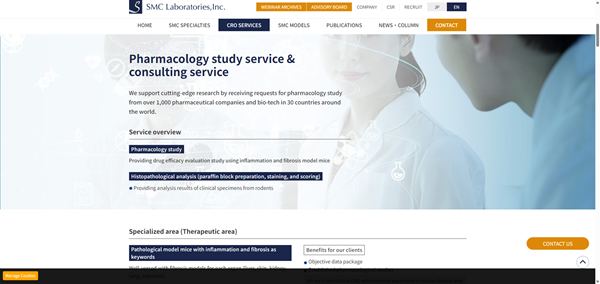
SMC Laboratories, Inc.
SMC Laboratories is a specialized non-clinical CRO focused on in vivo pharmacology and efficacy studies using disease-relevant animal models, particularly in fibrosis, inflammation, metabolic diseases, and oncology.
Areas of Expertise
Disease-Relevant Model Portfolio
SMC Laboratories offers models covering the liver, lung, kidney, intestine, and oncology. Its portfolio includes the proprietary STAM™ model for MASH, fibrosis, and hepatocellular carcinoma.
Study Design Based on Target Biology
Study plans are developed around the target biology, mechanism of action, disease stage, and development objective. Pharmacological endpoints can be combined with histopathology, biomarkers, and disease-specific readouts.
Support from Target Validation to Proof of Concept
With experience from more than 1,000 studies for clients in 30 countries, SMC Laboratories supports programs from target validation and candidate selection through in vivo proof-of-concept studies.
Safety StudiesComprehensive Safety Assessment for Preclinical Development
Reference: Charles River Laboratories official website (https://www.criver.com/)
Charles River Laboratories
Charles River provides non-clinical toxicology and safety assessment services for programs ranging from exploratory safety studies to IND-enabling development.
Areas of Expertise
General Toxicology Across Study Designs
Services include single- and repeat-dose toxicology, dose-range finding, and general toxicology studies across multiple species and administration routes.
Non-GLP and GLP Study Support
Charles River supports both non-GLP and GLP studies, allowing sponsors to progress from early safety characterization to studies intended for regulatory submissions.
Integrated IND-Enabling Safety Assessment
Toxicology studies can be integrated with toxicokinetics, clinical pathology, histopathology, and safety pharmacology to support interpretation and IND-enabling safety packages.
Pharmacokinetic (PK/PD) StudiesConnecting Drug Exposure with Pharmacological Response
Reference: Inotiv official website (https://www.inotiv.com/)
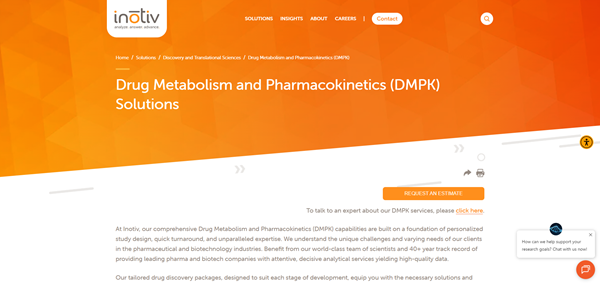
Inotiv
Inotiv provides integrated PK/PD, DMPK, and bioanalytical services to characterize drug exposure and its relationship with pharmacological response.
Areas of Expertise
Pharmacokinetic Characterization
PK studies characterize exposure, half-life, clearance, and other pharmacokinetic parameters needed to understand how a candidate behaves in the selected model.
Exposure–Response Evaluation
Pharmacokinetic data can be combined with pharmacodynamic endpoints and bioanalysis to evaluate the relationship between drug exposure and pharmacological response.
Integrated DMPK and Development Support
Integrated DMPK, pharmacology, and safety information supports candidate comparison, dose selection, dosing-frequency optimization, and decisions about subsequent preclinical development.

 Japanese