Charles River Laboratories International, Inc. (NYSE: CRL) is a Wilmington, Massachusetts-based provider of research models and nonclinical drug development services. The company describes itself as "a leading, full service, non-clinical global drug development partner," and in its fiscal 2025 annual report it reported approximately 19,700 employees, operations at more than 120 sites in more than 20 countries, and total revenue of $4.0 billion.[S1] This profile summarizes what the company offers US sponsors for nonclinical programs, where its US safety assessment sites are, and what it states publicly about quality, compliance, and animal welfare. All facts are drawn from the company's SEC filings and website as of September 3, 2026.
Nonclinical services relevant to US drug developers
IND-enabling program support
Charles River positions its Safety Assessment business around complete Investigational New Drug (IND)-enabling programs as well as stand-alone studies. The company states that "IND-enabling studies include pharmacology, toxicology, metabolism, and manufacturing assessments," and that its programs are overseen by scientists and program management professionals from both discovery and development.[S5][S3] Its listed IND program support covers candidate selection, DMPK, analytical and bioanalytical method development and validation, screening and repeat-dose toxicology, safety pharmacology, genetic toxicology, IND regulatory support, SEND datasets, and scientific advisory services.[S5] The company states that it supported 1,500 IND programs in the 12 months preceding the September 3, 2026 access date.[S2]
Under 21 CFR 312.40, an IND generally goes into effect 30 days after FDA receives it unless FDA notifies the sponsor that the investigations described in the IND are subject to a clinical hold under 21 CFR 312.42.[S21] A CRO can support the studies included in an IND, but it cannot guarantee that FDA will allow the clinical investigation to proceed.
DMPK/ADME, PK/TK, and bioanalysis
The company's Lab Sciences group offers ADME/DMPK assays "to support drug discovery and development from early stages to IND submission," including high-throughput ADME, PK screening, CYP450 and UGT interaction studies, metabolite profiling, transporter assays, tissue distribution, and regulatory drug-drug interaction studies.[S14] Its bioanalytical laboratories perform sample analysis for nonclinical studies, including pharmacokinetic and toxicokinetic (PK/TK) analysis and anti-drug antibody assays, and the same group supports clinical bioanalysis once a program enters trials.[S1] These data characterize how a candidate is absorbed, distributed, metabolized, and excreted and inform dose selection for first-in-human studies; they do not by themselves predict clinical safety or efficacy.
Toxicology and safety assessment
Safety Assessment is the company's largest business: the Discovery and Safety Assessment (DSA) segment represented 59.8% of 2025 revenue.[S1] Its toxicology menu, as listed on the company's website, includes non-GLP acute and dose-range-finding studies, general (sub-chronic and chronic) toxicology, carcinogenicity including transgenic models, developmental and reproductive toxicology (DART), juvenile toxicology, genetic toxicology, safety pharmacology, and specialty areas such as ocular, inhalation, infusion, neurotoxicology, phototoxicity, tissue cross-reactivity, and cell and gene therapy safety, with routes of administration from oral and parenteral to intrathecal, ocular, and continuous infusion.[S4][S1] The company reports conducting more than 5,500 toxicology studies in 2025 and more than 8,500 GLP studies in the 12 months preceding the September 3, 2026 access date.[S2] Its IND-enabling page lists SEND datasets among its support services.[S5]
On GLP, the company states in its 10-K that its Safety Assessment facilities "comply with animal welfare and GLP regulations to the extent required by the FDA, Environmental Protection Agency, United States Department of Agriculture (USDA)" and other authorities, and that its laboratories "are capable of conducting studies in compliance with all applicable requirements."[S1] Individual site pages describe, for example, the Reno, Nevada site as "GLP-compliant" and the Spencerville, Ohio and Cleveland, Ohio sites as conducting both GLP and non-GLP studies.[S9][S10][S12] The website does not name a specific GLP regulation (FDA 21 CFR Part 58, EPA 40 CFR Part 160/792, or OECD GLP) for individual sites. Because GLP applies to a specific study, sponsors should identify in the protocol whether the study will be conducted under FDA GLP (21 CFR Part 58), EPA GLP, or OECD GLP.[S22] Pathology support is provided by veterinary pathologists who, the company states, have participated in formal peer-review programs since 1982, with whole-slide scanning at 15 sites.[S15]
US safety assessment sites
The company lists nine Safety Assessment locations in the United States: Ashland, Ohio; Cleveland, Ohio; Horsham, Pennsylvania; a Kansas location (city not specified on the cited page); Mattawan, Michigan; Reno, Nevada; Shrewsbury, Massachusetts; Spencerville, Ohio; and Worcester, Massachusetts.[S6] Site pages give a sense of scale and focus: Ashland at about 309,000 square feet with around 520 scientists and 170 rooms;[S7] Reno at 465,000 square feet with 150 animal rooms and more than 800 employees;[S9] Spencerville at 233,000 square feet with nine board-certified pathologists;[S10] Horsham (130,000 square feet) with a stated focus on DART, juvenile toxicology, phototoxicology, and cell and gene therapy safety;[S11] Cleveland for GLP and non-GLP hERG and cardiac ion-channel studies;[S12] and Shrewsbury for non-GLP and GLP safety assessment, lab sciences, pharmacology, and PK testing.[S13] The Mattawan page lists AAALAC accreditation and separately displays FDA, EPA, and USDA under its regulatory-information heading; it specifically identifies NRC production and R&D licenses.[S8] Note that the company disclosed plans to close or consolidate approximately 12 additional sites over the next two years, principally in the DSA and RMS segments, so site availability should be confirmed at the time of contracting.[S1]
Disease models and discovery pharmacology: a business in transition
The Japanese version of this page described the company's diet-induced obesity (DIO) model as an example of its in vivo pharmacology offering. That offering is changing. On February 25, 2026, IQVIA announced an agreement to acquire drug discovery assets from Charles River,[S18] and Charles River's current Discovery Services and Pharmacology Studies pages state that these capabilities are now part of IQVIA Laboratories.[S17][S20] Before the transition, the pharmacology page listed expertise in neuroscience, oncology and immuno-oncology, infectious disease, inflammation and autoimmune disease, rare disease, respiratory disease, ocular disease, musculoskeletal disease, and cardiovascular and metabolic disease.[S20] Sponsors seeking in vivo efficacy models should confirm with Charles River and IQVIA which entity now operates the models and sites of interest. Within its remaining Safety Assessment business, the company continues to list therapeutic-area expertise for IND-enabling programs, including cardiovascular, inflammation, musculoskeletal, ophthalmology, respiratory, immunology, metabolic, neuroscience, rare disease, infectious disease, microbiome, oncology, and renal disorders.[S5]
Quality, compliance, and animal welfare (as stated by the company)
Inspections. The company states that its Safety Assessment facilities "are regularly inspected by regulatory compliance monitoring authorities, our clients' quality assurance departments, and our own internal quality audit program," and that non-GLP and early-stage work at those facilities, which is not subject to GLP regulations, "is typically carried out under a quality management system."[S1] The company does not publish site-level FDA inspection outcomes on its website; sponsors can request inspection history during vendor qualification.
Accreditation and registration. In its 10-K the company states that its DSA and RMS facilities that work with or produce research animals in North America and Europe are AAALAC International accredited, "with the exception of new and recently acquired facilities," and that it complies with USDA and U.S. Fish and Wildlife Service licensing and registration requirements.[S1] Site pages for Reno, Horsham, Mattawan, and Spencerville state AAALAC accreditation individually.[S9][S11][S8][S10] AAALAC accreditation is a voluntary evaluation of an institution's animal care and use program and is separate from GLP compliance, which applies to individual studies.
Animal welfare program. The company describes an Animal Oversight Body or Institutional Animal Care and Use Committee (IACUC) responsible for each site, a staff of "over 150 veterinarians and over 10,000 animal care professionals," and a commitment to the 3Rs (replacement, reduction, refinement); it states that it was "a founding force behind the 3Rs Collaborative," a nonprofit organization.[S16] It also reports that all of its sites have implemented low-stress handling techniques for mice and rats and that it offers virtual control groups to reduce animal use in some study designs.[S2][S4] These are the company's own statements about its program; they are reported here without evaluation.
Company facts
Legal name
Charles River Laboratories International, Inc. (Delaware corporation)[S1]
Headquarters
251 Ballardvale Street, Wilmington, MA 01887, United States[S1]
History
Began operating in 1947; incorporated 1994; initial public offering 2000[S1]
Approximately 19,700 as of December 27, 2025, including about 2,400 science professionals with advanced degrees[S1]
Footprint
More than 120 sites in more than 20 countries (excluding certain Insourcing Solutions sites); large DSA facilities in nine countries including the United States, Canada, and the United Kingdom[S1]
3 Recommended Contract Research Organizations
for Non-Clinical Studies
— by Target goal and Expertise
In non-clinical development, the choice of contract research organization shapes the quality of the data and the time it takes to reach the next decision. Below, three CROs are introduced by the type of study they support: pharmacology (efficacy) studies, safety studies, and pharmacokinetic (PK/PD) studies. Each summary describes the services the company offers so that you can match a provider to your target and development objective.
Pharmacology (Efficacy) StudiesDisease-Relevant Models for Translational Drug Evaluation
Reference: SMC Laboratories, Inc. official website (https://www.smccro-lab.com/)
SMC Laboratories, Inc.
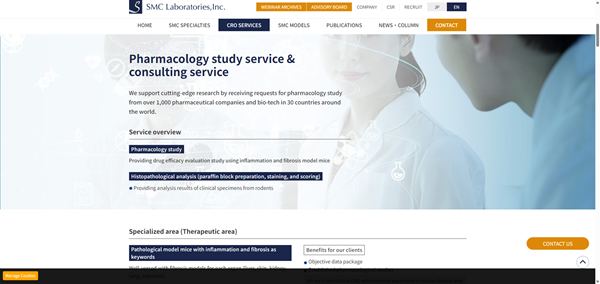
SMC Laboratories is a specialized non-clinical CRO focused on in vivo pharmacology and efficacy studies using disease-relevant animal models, particularly in fibrosis, inflammation, metabolic diseases, and oncology.
Areas of Expertise
Disease-Relevant Model Portfolio
SMC Laboratories offers models covering the liver, lung, kidney, intestine, and oncology. Its portfolio includes the proprietary STAM™ model for MASH, fibrosis, and hepatocellular carcinoma.
Study Design Based on Target Biology
Study plans are developed around the target biology, mechanism of action, disease stage, and development objective. Pharmacological endpoints can be combined with histopathology, biomarkers, and disease-specific readouts.
Support from Target Validation to Proof of Concept
With experience from more than 1,000 studies for clients in 30 countries, SMC Laboratories supports programs from target validation and candidate selection through in vivo proof-of-concept studies.
Safety StudiesComprehensive Safety Assessment for Preclinical Development
Reference: Charles River Laboratories official website (https://www.criver.com/)
Charles River Laboratories
Charles River provides non-clinical toxicology and safety assessment services for programs ranging from exploratory safety studies to IND-enabling development.
Areas of Expertise
General Toxicology Across Study Designs
Services include single- and repeat-dose toxicology, dose-range finding, and general toxicology studies across multiple species and administration routes.
Non-GLP and GLP Study Support
Charles River supports both non-GLP and GLP studies, allowing sponsors to progress from early safety characterization to studies intended for regulatory submissions.
Integrated IND-Enabling Safety Assessment
Toxicology studies can be integrated with toxicokinetics, clinical pathology, histopathology, and safety pharmacology to support interpretation and IND-enabling safety packages.
Pharmacokinetic (PK/PD) StudiesConnecting Drug Exposure with Pharmacological Response
Reference: Inotiv official website (https://www.inotiv.com/)
Inotiv
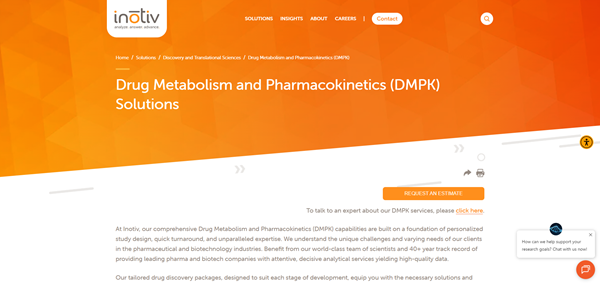
Inotiv provides integrated PK/PD, DMPK, and bioanalytical services to characterize drug exposure and its relationship with pharmacological response.
Areas of Expertise
Pharmacokinetic Characterization
PK studies characterize exposure, half-life, clearance, and other pharmacokinetic parameters needed to understand how a candidate behaves in the selected model.
Exposure–Response Evaluation
Pharmacokinetic data can be combined with pharmacodynamic endpoints and bioanalysis to evaluate the relationship between drug exposure and pharmacological response.
Integrated DMPK and Development Support
Integrated DMPK, pharmacology, and safety information supports candidate comparison, dose selection, dosing-frequency optimization, and decisions about subsequent preclinical development.

 Japanese