The Jackson Laboratory, known as JAX, is an independent nonprofit biomedical research institution headquartered in Bar Harbor, Maine. It describes itself as an "independent, 501(c)3 nonprofit biomedical research institution" with "a global team of nearly 3,000 people,"[S3] and states that it was "founded in 1929 in Bar Harbor, Maine."[S2] Alongside its research programs it supplies research mice and runs contract preclinical studies through JAX Mice and Services and JAX Preclinical Research Services.[S5][S8] This profile covers the US institution and the services a US sponsor would contract with; a separate Japanese subsidiary operates under its own name.[S4]
Nonclinical services relevant to US drug developers
Efficacy, pharmacokinetic, and safety studies
JAX states that "JAX Preclinical Services offers the most translational and predictive efficacy, pharmacokinetics (PK) and safety testing for therapeutics such as monoclonal antibodies, bispecifics, CAR-T, antibody-drug conjugates, and combination therapies."[S5] Named study types on that page are comprehensive efficacy studies, cytokine release syndrome (CRS) safety studies, Onco-Hu studies, HuPK studies for antibody therapeutics, and syngeneic studies.[S5] Beyond oncology, the page lists preclinical model and efficacy offerings by therapeutic area including neurobiology, metabolic disease, autoimmunity and immunology, rare disease, and cardiovascular disease.[S5]
Studies draw on the institution's own mouse resources. JAX states that it "offers the world's largest collection of spontaneous, targeted, and transgenic mutant mouse strains"[S5] and that sponsors can "access over 14,000 strains from our extensive repository or collaborate with our experts to develop a custom model designed to match your research needs."[S8] The Fast Facts page gives a different figure, "over 13,000 strains of genetically-specialized JAX® Mice."[S3]
Antibody pharmacokinetics
HuPK studies for antibody therapeutics are listed among the named study types on the preclinical services page.[S5] The Japanese version of this page described half-life comparisons in an FcRn humanized mouse model; that specific model was not found on the pages reviewed for this profile, so sponsors should confirm with JAX which humanized backgrounds are available for antibody PK work.
Humanized mouse platforms
JAX describes humanized NSG mice as "a gold-standard translational platform used for the evaluation of human immune cells in vivo," offered with either human peripheral blood mononuclear cell (PBMC) engraftment or CD34+ hematopoietic stem cell engraftment.[S6]
Named engineered backgrounds include NSG-DKO, described for long-term studies with reduced graft-versus-host disease, and NSG-SGM3-IL15, described as having elevated natural killer cell populations.[S6] Humanized models are used for immuno-oncology, infectious disease, graft-versus-host disease, and cell therapy studies.[S6] Sponsors should note that engraftment characteristics differ between platforms and should agree the model and readouts with JAX at the design stage.
Oncology models
PDX models with humanized hosts
For oncology, JAX offers low-passage patient-derived xenograft (PDX) tumor models, with verified growth characteristics and RNA-seq data available for many models.[S7] Combining these with immune-humanized hosts lets sponsors "test therapeutic efficacy in the presence of human immune cells and human tumors,"[S7] and JAX describes evaluating CAR and antibody-based therapeutics "using immune-humanized mice with characterized patient-derived xenograft tumours featuring characterized PDX tumors."[S5] A total PDX model count was not stated on the pages reviewed.
Quality, compliance, and animal welfare (as stated by the institution)
The quality team page states that "JAX is AAALACi accredited and OLAW assured" and that "our quality program has a deep focus on preventative action, to safeguard the high-quality standards in our operations."[S9] The pages reviewed for this profile do not state that JAX conducts studies under Good Laboratory Practice regulations, and they do not mention USDA registration, an Institutional Animal Care and Use Committee, or the 3Rs. The institution's website is large, so these may appear elsewhere; sponsors who need a GLP study or documented registrations should ask JAX directly. AAALAC International accreditation is a voluntary evaluation of an institution's animal care and use program, re-evaluated every three years,[R3] and USDA registration and an OLAW Animal Welfare Assurance relate to the Animal Welfare Act and the PHS Policy respectively;[R4][R5] none of these establishes GLP compliance, which applies to individual studies.[R2] FDA does not approve or certify laboratories; registration with FDA does not denote approval.[R6] This profile does not evaluate the institution's animal care program; the statements above are its own.
Institution facts
Name
The Jackson Laboratory (JAX); originally the Roscoe B. Jackson Memorial Laboratory[S2]
Headquarters
Bar Harbor, Maine, United States (street address not stated on the pages reviewed)[S4]
Independent 501(c)(3) nonprofit biomedical research institution[S3]
Staff
A global team of nearly 3,000 people; more than 60 faculty with independent research programs[S3]
Locations
Stated as 11 locations, including Bar Harbor, Ellsworth, Portland and Augusta in Maine; Farmington, Connecticut; Sacramento, California; New York, New York; Gainesville, Florida; and a wholly owned subsidiary in Japan with three production sites[S3][S4]
Mouse strains
Over 13,000 strains (Fast Facts) or over 14,000 strains (JAX Mice and Services)[S3][S8]
FDA — "Is It Really FDA Approved?" (FDA does not approve health care providers, including laboratories; registration does not denote approval); FDA Compliance Program 7348.808 (GLP inspections of nonclinical laboratories). https://www.fda.gov/consumers/consumer-updates/it-really-fda-approved (accessed 2026-09-03)
3 Recommended Contract Research Organizations
for Non-Clinical Studies
— by Target goal and Expertise
In non-clinical development, the choice of contract research organization shapes the quality of the data and the time it takes to reach the next decision. Below, three CROs are introduced by the type of study they support: pharmacology (efficacy) studies, safety studies, and pharmacokinetic (PK/PD) studies. Each summary describes the services the company offers so that you can match a provider to your target and development objective.
Pharmacology (Efficacy) StudiesDisease-Relevant Models for Translational Drug Evaluation
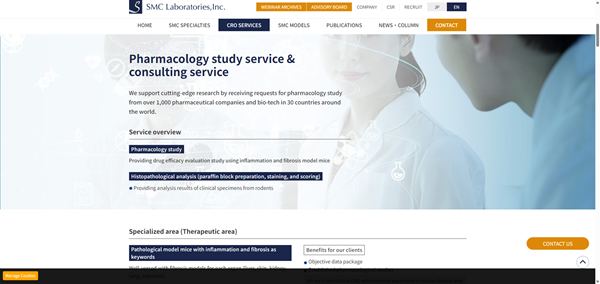
Reference: SMC Laboratories, Inc. official website (https://www.smccro-lab.com/)
SMC Laboratories, Inc.
SMC Laboratories is a specialized non-clinical CRO focused on in vivo pharmacology and efficacy studies using disease-relevant animal models, particularly in fibrosis, inflammation, metabolic diseases, and oncology.
Areas of Expertise
Disease-Relevant Model Portfolio
SMC Laboratories offers models covering the liver, lung, kidney, intestine, and oncology. Its portfolio includes the proprietary STAM™ model for MASH, fibrosis, and hepatocellular carcinoma.
Study Design Based on Target Biology
Study plans are developed around the target biology, mechanism of action, disease stage, and development objective. Pharmacological endpoints can be combined with histopathology, biomarkers, and disease-specific readouts.
Support from Target Validation to Proof of Concept
With experience from more than 1,000 studies for clients in 30 countries, SMC Laboratories supports programs from target validation and candidate selection through in vivo proof-of-concept studies.
Safety StudiesComprehensive Safety Assessment for Preclinical Development
Reference: Charles River Laboratories official website (https://www.criver.com/)
Charles River Laboratories
Charles River provides non-clinical toxicology and safety assessment services for programs ranging from exploratory safety studies to IND-enabling development.
Areas of Expertise
General Toxicology Across Study Designs
Services include single- and repeat-dose toxicology, dose-range finding, and general toxicology studies across multiple species and administration routes.
Non-GLP and GLP Study Support
Charles River supports both non-GLP and GLP studies, allowing sponsors to progress from early safety characterization to studies intended for regulatory submissions.
Integrated IND-Enabling Safety Assessment
Toxicology studies can be integrated with toxicokinetics, clinical pathology, histopathology, and safety pharmacology to support interpretation and IND-enabling safety packages.
Pharmacokinetic (PK/PD) StudiesConnecting Drug Exposure with Pharmacological Response
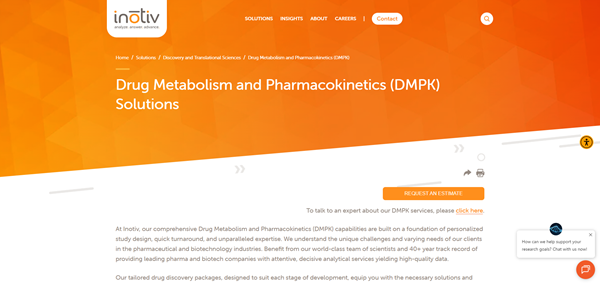
Reference: Inotiv official website (https://www.inotiv.com/)
Inotiv
Inotiv provides integrated PK/PD, DMPK, and bioanalytical services to characterize drug exposure and its relationship with pharmacological response.
Areas of Expertise
Pharmacokinetic Characterization
PK studies characterize exposure, half-life, clearance, and other pharmacokinetic parameters needed to understand how a candidate behaves in the selected model.
Exposure–Response Evaluation
Pharmacokinetic data can be combined with pharmacodynamic endpoints and bioanalysis to evaluate the relationship between drug exposure and pharmacological response.
Integrated DMPK and Development Support
Integrated DMPK, pharmacology, and safety information supports candidate comparison, dose selection, dosing-frequency optimization, and decisions about subsequent preclinical development.

 Japanese