Development timelines, and where nonclinical time goes
How long it takes, and what that is based on
The figure usually quoted is about ten years, and it holds up against a source. The Congressional Budget Office reports an average of about 31 months for the nonclinical phase followed by about 95 months for clinical trials, roughly 10.5 years from start to finish.[S1] On cost, the same report gives a range rather than a single number: estimates of average research and development cost per new drug run from less than one billion to more than two billion dollars, a spread that reflects different treatments of failed programmes and of the cost of capital.[S1][S2] No figure is given here for recent cost growth in the early phase, because none could be substantiated.
Part of what lengthens the nonclinical phase is the range of modalities now in development. A cell therapy, a radiopharmaceutical or a gene therapy raises questions a small molecule does not, and the study designs that answer them are less standardized, which means more time spent agreeing what to run before anything is run.
The three levers
Programmes are usually reviewed along three axes, which trade against each other rather than moving together.
Speed: shortening the interval from candidate selection to first administration in humans, which moves every subsequent milestone forward by the same amount.
Cost: how spending is allocated across the early phase, where the question is usually which studies earn their place rather than how to make each one cheaper.
Capacity: how much work can be run at once, which is often the binding constraint and is usually addressed by placing work with outside laboratories rather than by building internally.
Why the nonclinical phase is where time is usually found
The nonclinical phase averages about 31 months and precedes everything else, so time removed from it moves the whole programme.[S1] It is also the phase a sponsor controls most directly: clinical timelines depend on site activation and patient recruitment, while nonclinical timelines depend mostly on how the work is sequenced and who runs it. Specific figures are sometimes quoted for how much of this phase can be compressed. This article does not reproduce them, because the figures in circulation could not be traced to a source that publishes the underlying data.
What shortening the interval to first-in-human buys
Time removed before first administration in humans has a specific value: the patent clock runs from filing rather than from approval, so time saved before the clinical phase is time added to the period of exclusivity after it. It also brings forward the point at which the programme generates human data, which is when most of the remaining uncertainty is resolved. No percentage figure for typical compression is given here, for the reason set out above.
Where the time actually is
Compression comes from changing the sequence rather than from running each step faster. Three approaches account for most of it.
Running steps in parallel
The application to begin clinical work requires pharmacology and toxicology information, and the toxicology reports take weeks to finalize after the in-life phase ends.[S3] Drafting the application against audited draft reports, rather than waiting for signed final reports, removes that interval from the critical path, provided the final reports carry the study director and quality assurance statements the regulation requires and the application is updated to match.[S4] The saving is real but bounded: it is the report finalization interval, not the study duration. No specific number of weeks is given here, because it depends on the study and the laboratory.
Removing endpoints that will not change a decision
Early pharmacology studies accumulate endpoints and cell lines that were added for completeness rather than because a result would change what happens next. Removing them shortens the study and reduces the analysis burden. The test to apply is straightforward: for each endpoint, what decision would a positive result change, and what would a negative one change. Endpoints that fail that test in both directions are candidates for removal.
Using in vitro and computational methods where they answer the question
Early screening and some safety assessment can be done in vitro or computationally, which reduces the number and size of animal studies. Two qualifications matter. These methods substitute for animal work where they answer the same question, not universally, and the studies supporting an application to begin clinical work still have to satisfy the pharmacology and toxicology requirements set out in the regulation.[S3] What is gained is usually at the screening stage, where fewer candidates reach the animal studies, rather than in the regulated package itself.
Summary
Development takes about ten years on average, with roughly 31 months of that before any human is dosed.[S1] That nonclinical interval is the part a sponsor controls most directly, which is why it attracts attention, but the compression available in it comes from sequencing decisions rather than from any single technique or supplier.
Three practical steps carry most of the available gain: drafting the regulatory submission against audited draft reports rather than final ones, removing endpoints whose result would not change a decision, and using non-animal methods where they answer the same question. Each is a change to the sequence. None of them shortens a study that has to run for a fixed duration.
References
Congressional Budget Office — Research and Development in the Pharmaceutical Industry, April 2021. https://www.cbo.gov/publication/57126 (accessed 2026-09-03)
DiMasi JA, Grabowski HG, Hansen RW. Innovation in the pharmaceutical industry: New estimates of R&D costs. J Health Econ. 2016;47:20-33 (PMID 26928437; DOI 10.1016/j.jhealeco.2016.01.012). https://doi.org/10.1016/j.jhealeco.2016.01.012 (accessed 2026-09-03)
3 Recommended Contract Research Organizations
for Non-Clinical Studies
— by Target goal and Expertise
In non-clinical development, the choice of contract research organization shapes the quality of the data and the time it takes to reach the next decision. Below, three CROs are introduced by the type of study they support: pharmacology (efficacy) studies, safety studies, and pharmacokinetic (PK/PD) studies. Each summary describes the services the company offers so that you can match a provider to your target and development objective.
Pharmacology (Efficacy) StudiesDisease-Relevant Models for Translational Drug Evaluation
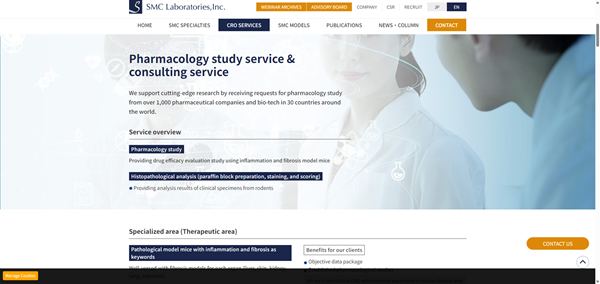
Reference: SMC Laboratories, Inc. official website (https://www.smccro-lab.com/)
SMC Laboratories, Inc.
SMC Laboratories is a specialized non-clinical CRO focused on in vivo pharmacology and efficacy studies using disease-relevant animal models, particularly in fibrosis, inflammation, metabolic diseases, and oncology.
Areas of Expertise
Disease-Relevant Model Portfolio
SMC Laboratories offers models covering the liver, lung, kidney, intestine, and oncology. Its portfolio includes the proprietary STAM™ model for MASH, fibrosis, and hepatocellular carcinoma.
Study Design Based on Target Biology
Study plans are developed around the target biology, mechanism of action, disease stage, and development objective. Pharmacological endpoints can be combined with histopathology, biomarkers, and disease-specific readouts.
Support from Target Validation to Proof of Concept
With experience from more than 1,000 studies for clients in 30 countries, SMC Laboratories supports programs from target validation and candidate selection through in vivo proof-of-concept studies.
Safety StudiesComprehensive Safety Assessment for Preclinical Development
Reference: Charles River Laboratories official website (https://www.criver.com/)
Charles River Laboratories
Charles River provides non-clinical toxicology and safety assessment services for programs ranging from exploratory safety studies to IND-enabling development.
Areas of Expertise
General Toxicology Across Study Designs
Services include single- and repeat-dose toxicology, dose-range finding, and general toxicology studies across multiple species and administration routes.
Non-GLP and GLP Study Support
Charles River supports both non-GLP and GLP studies, allowing sponsors to progress from early safety characterization to studies intended for regulatory submissions.
Integrated IND-Enabling Safety Assessment
Toxicology studies can be integrated with toxicokinetics, clinical pathology, histopathology, and safety pharmacology to support interpretation and IND-enabling safety packages.
Pharmacokinetic (PK/PD) StudiesConnecting Drug Exposure with Pharmacological Response
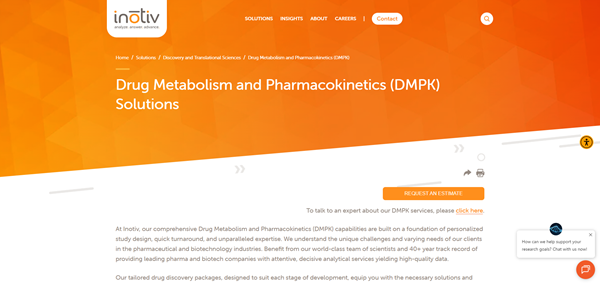
Reference: Inotiv official website (https://www.inotiv.com/)
Inotiv
Inotiv provides integrated PK/PD, DMPK, and bioanalytical services to characterize drug exposure and its relationship with pharmacological response.
Areas of Expertise
Pharmacokinetic Characterization
PK studies characterize exposure, half-life, clearance, and other pharmacokinetic parameters needed to understand how a candidate behaves in the selected model.
Exposure–Response Evaluation
Pharmacokinetic data can be combined with pharmacodynamic endpoints and bioanalysis to evaluate the relationship between drug exposure and pharmacological response.
Integrated DMPK and Development Support
Integrated DMPK, pharmacology, and safety information supports candidate comparison, dose selection, dosing-frequency optimization, and decisions about subsequent preclinical development.

 Japanese