The condition is fat accumulation in the liver accompanied by inflammation, occurring in the context of metabolic dysfunction rather than alcohol intake. It sits at the more advanced end of a spectrum that begins with fat accumulation alone. The naming changed recently, and both sets of terms remain in circulation, which matters when searching literature or writing a protocol.
The regulatory position changed in March 2024, when the Food and Drug Administration approved resmetirom, a new molecular entity, in this indication.[S3] The approval followed a phase 3 trial published the same year.[S4] That is recorded here as a fact about the regulatory landscape, because it changes what a development programme in this area is measured against. This site does not discuss the efficacy of approved products or compare treatments, and nothing here is medical advice.
What a nonclinical program in this area has to settle
The difficulty in this indication is that the human disease develops over years against a background of metabolic disease, while a model has to produce the lesion in weeks. That gap shapes every design decision. A model that produces fat accumulation is not a model of steatohepatitis, and a model with inflammation is not necessarily a model with established fibrosis. Since the stage of disease a candidate is intended to act on determines which of those is required, the model choice follows from the mechanism rather than from the disease name.
One widely used approach combines low-dose streptozotocin given to neonatal male mice with a high-fat diet, which the original report describes as producing liver steatosis with diabetes one week after the diet begins.[S5] Models of this kind have been used in programmes that reached clinical trials; two such trials are registered publicly.[S6] This article names no supplier for any model, and the presence of a model in a clinical-stage programme says nothing about whether that programme succeeded.
References
Rinella ME, et al. A multisociety Delphi consensus statement on new fatty liver disease nomenclature. Hepatology. 2023 (PMID 37363821)。https://pubmed.ncbi.nlm.nih.gov/37363821/ (accessed 2026-09-03)
Harrison SA, et al. A Phase 3, Randomized, Controlled Trial of Resmetirom in NASH with Liver Fibrosis. N Engl J Med. 2024;390:497-509 (PMID 38324483). https://pubmed.ncbi.nlm.nih.gov/38324483/ (accessed 2026-09-03)
Fujii M, et al. A murine model for non-alcoholic steatohepatitis showing evidence of association between diabetes and hepatocellular carcinoma. Med Mol Morphol. 2013. https://pubmed.ncbi.nlm.nih.gov/23430399/ (accessed 2026-09-03)
3 Recommended Contract Research Organizations
for Non-Clinical Studies
— by Target goal and Expertise
In non-clinical development, the choice of contract research organization shapes the quality of the data and the time it takes to reach the next decision. Below, three CROs are introduced by the type of study they support: pharmacology (efficacy) studies, safety studies, and pharmacokinetic (PK/PD) studies. Each summary describes the services the company offers so that you can match a provider to your target and development objective.
Pharmacology (Efficacy) StudiesDisease-Relevant Models for Translational Drug Evaluation
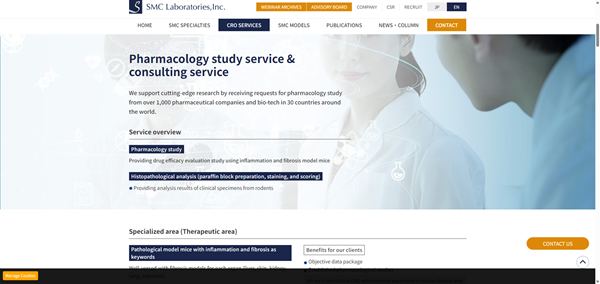
Reference: SMC Laboratories, Inc. official website (https://www.smccro-lab.com/)
SMC Laboratories, Inc.
SMC Laboratories is a specialized non-clinical CRO focused on in vivo pharmacology and efficacy studies using disease-relevant animal models, particularly in fibrosis, inflammation, metabolic diseases, and oncology.
Areas of Expertise
Disease-Relevant Model Portfolio
SMC Laboratories offers models covering the liver, lung, kidney, intestine, and oncology. Its portfolio includes the proprietary STAM™ model for MASH, fibrosis, and hepatocellular carcinoma.
Study Design Based on Target Biology
Study plans are developed around the target biology, mechanism of action, disease stage, and development objective. Pharmacological endpoints can be combined with histopathology, biomarkers, and disease-specific readouts.
Support from Target Validation to Proof of Concept
With experience from more than 1,000 studies for clients in 30 countries, SMC Laboratories supports programs from target validation and candidate selection through in vivo proof-of-concept studies.
Safety StudiesComprehensive Safety Assessment for Preclinical Development
Reference: Charles River Laboratories official website (https://www.criver.com/)
Charles River Laboratories
Charles River provides non-clinical toxicology and safety assessment services for programs ranging from exploratory safety studies to IND-enabling development.
Areas of Expertise
General Toxicology Across Study Designs
Services include single- and repeat-dose toxicology, dose-range finding, and general toxicology studies across multiple species and administration routes.
Non-GLP and GLP Study Support
Charles River supports both non-GLP and GLP studies, allowing sponsors to progress from early safety characterization to studies intended for regulatory submissions.
Integrated IND-Enabling Safety Assessment
Toxicology studies can be integrated with toxicokinetics, clinical pathology, histopathology, and safety pharmacology to support interpretation and IND-enabling safety packages.
Pharmacokinetic (PK/PD) StudiesConnecting Drug Exposure with Pharmacological Response
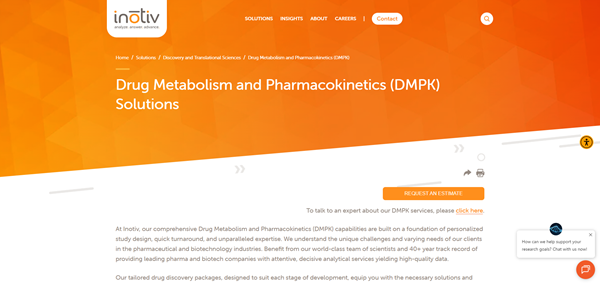
Reference: Inotiv official website (https://www.inotiv.com/)
Inotiv
Inotiv provides integrated PK/PD, DMPK, and bioanalytical services to characterize drug exposure and its relationship with pharmacological response.
Areas of Expertise
Pharmacokinetic Characterization
PK studies characterize exposure, half-life, clearance, and other pharmacokinetic parameters needed to understand how a candidate behaves in the selected model.
Exposure–Response Evaluation
Pharmacokinetic data can be combined with pharmacodynamic endpoints and bioanalysis to evaluate the relationship between drug exposure and pharmacological response.
Integrated DMPK and Development Support
Integrated DMPK, pharmacology, and safety information supports candidate comparison, dose selection, dosing-frequency optimization, and decisions about subsequent preclinical development.

 Japanese