A site where you can find recommended contractors for non-clinical testing|effical " Non-Clinical CROs and Agencies " Food and Drug Safety Center (FDSC)

Food and Drug Safety Center (FDSC)

Table of Contents
Table of Contents

The Food and Drug Safety Center (FDSC) provides safety testing of pharmaceuticals, medical devices, health foods, and other related products.

This page provides detailed information about FDSC’s non-clinical studies, examples of disease models, and case studies.

We hope it serve as a useful reference when selecting a contract organization for your needs.

Features of the FDSC’s Non-Clinical Testing Services

Providing Safety Testing Based on Multiple Guidelines

FDSC provides high-quality safety testing in compliance with various guidelines.

In addition to the Ministry of Health, Labour and Welfare (MHLW) guidelines, they perform evaluations according to the recommendations by international standards such as ISO 10993, FDA, ASTM, and OECD.

Since 1970, FDSC has been engaged in a wide range of safety evaluations related to food, pharmaceuticals, and medical devices.

As of October 2024, the Center had conducted over 70,000 tests in total.

They have worked with numerous manufacturers for their biological safety testing of medical devices.

Beyond providing test results, FDSC offers comprehensive follow-up services, including consultations regarding inquiries from regulatory authorities based on study outcomes.

Reference: Food and Drug Safety Center official website —https://www.fdsc.or.jp

Extensive Range of Safety Tests

FDSC supports a broad spectrum of safety tests, including cytotoxicity, skin sensitization, local irritation, systemic toxicity, genotoxicity, pathological examinations, implantation, blood compatibility, extraction efficiency, and quality control tests and more.

Since 1980, they have provided many GLP compliant studies and can also perform quality control testing in accordance with GMP standards.

Partnered Organizations

No information regarding partnered organizations was found on the official website.

Example of a Non-Clinical Study at the FDSC

Single-Dose Toxicity (Acute Toxicity) Study

Extracts of pharmaceuticals, chemicals, or medical materials are administered once to animals (e.g., mice or rats) orally, intravenously, or dermally, to observe potential toxic effect.

Evaluation items include general condition, body weight change, and pathological examination.

Reference: Food and Drug Safety Center official website —https://www.fdsc.or.jp/contract/contract_service/medicine.html

Repeated-Dose Toxicity Study

This study aims to evaluate toxicological changes in animals administered daily or implanted with medical devices over periods ranging from two weeks to one year.

Mice, rats, and rabbits are used as test species, with evaluations including general condition, body weight change, food and water intake, urinalysis, hematology, ophthalmology, and pathological examination.

Reference: Food and Drug Safety Center official website —https://www.fdsc.or.jp/contract/contract_service/medicine.html

Company Information

The Food and Drug Safety Center conducts tests in accordance with international standards such as ISO 10993, FDA, ASTM, and OECD, as well as the guidelines of Japan’s Ministry of Health, Labour and Welfare (MHLW).

Address 729-5 Ochiai, Hadano City, Kanagawa Prefecture, Japan
Tel 0463-82-4751
Website https://www.fdsc.or.jp/
3 Recommended Contract Research Organizations for Non-Clinical Studies
— by Target goal and Expertise

In drug discovery, the quality and efficiency of non-clinical studies have a direct impact on clinical success rates, development costs, and overall length of time required in R&D. In recent years, there has been more demand for clinically relevant data, globally accepted reliability, and accurate early-stage screening. Thus, it is more important than ever to select the right CRO (Contract Research Organization) for strategic approach.
In this article, we highlight three CROs with proven technical capabilities, expertise, and long standing track records. These are our TOP 3 choices based on their capabilities and the specific target goals of the researchers for their non-clinical studies.

Pharmacology (Efficacy) Studies
Replicate unknown pathological models and
Discovery to clinically oriented drug evaluation
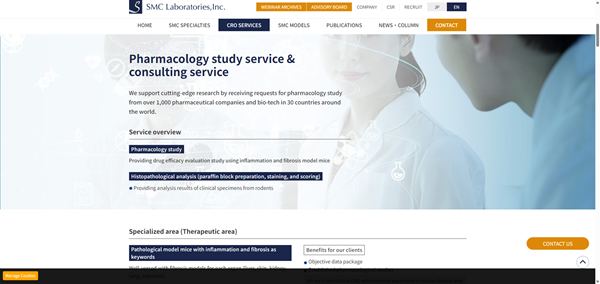
SMC Laboratories, Inc.
Reference: SMC Laboratories, Inc. official website (https://www.smccro-lab.com/jp/)
  • SMC Laboratories, Inc. has established a disease models using patented mouse technologies. The company has established proprietary pathological models—particularly in liver disease and fibrosis—and continues to expand their approach across a wide range of models in cancer, inflammation, and metabolic diseases.
  • From exploratory research to clinically oriented efficacy evaluation, SMC offers customized study designs, dosing strategies, and evaluation analysis tailored to each project. Their collaborative approachallows researchers to discuss and refine study plans together with SMC’s expert scientists.

  • With flexible small-scale study options and strong technical support, SMC Laboratories, Inc. is an ideal partner for start-ups, biotech ventures, and academic institutions alike.
Safety Studies
Comprehensive Safety Evaluation for FIH Applications
Labcorp Holdings Inc.
(Labcorp Drug Development)
Labcorp Holdings Inc.
Reference: Labcorp Holdings Inc. official website (https://jp.labcorp.com/)
  • Labcorp Holdings Inc. provides a fully integrated GLP testing system aligned with international regulatory standards, including FDA, EMA, and PMDA requirements. All studies are conducted under ICH-compliant quality assurance, making it ready for data submission.
  • The company has extensive expertise in long-term toxicity studies such as Segment I–III reproductive and carcinogenicity studies, as well as 2-year chronic toxicity assessments.
  • Labcorp Holdings Inc.’s comprehensive approach enables sponsors to efficiently outsource the entire preclinical package from toxicology, toxicokinetic (TK), and safety pharmacology study design to execution. This accelerates a path to First-in-Human (FIH) trials. For most of the global drug developers, this all-in-one service structure minimizes cost, risk, and expedite the time before advancing to clinical phase.
Pharmacokinetic (PK/PD) Studies
High-Precision Bioanalysis for Clinically Predictive PK/PD Evaluation
PhoenixBio Co., Ltd.
Source: PhoenixBio Co., Ltd. Official Website (https://phoenixbio.co.jp/)
  • PhoenixBio Co., Ltd.offers pharmacokinetic and hepatic metabolism studies using their proprietary PXB-mouse®, a humanized-liver chimeric mouse model. This platform enables the acquisition of data with high clinical correlation in ADME, drug–to-drug interaction studies, bridging the gap between preclinical and clinical stages.
  • With advanced LC-MS/MS-based bioanalysis, PhoenixBio Co., Ltd. provides aseamless workflow from plasma concentration measurement and metabolite identification to quantitative validation.

  • The company offersan integrated evaluation analysiscovering pharmacokinetics, hepatotoxicity, and safety with flexibility to accommodate complex modalities such as oligonucleotide and middle-molecule therapeutics. For compounds where hepatic metabolism is a development bottleneck—or where quantitative, reproducible exposure data are critical—PhoenixBio Co., Ltd. delivers unmatched analytical precision and consistency.

By region
list of animal models
Expertise & Track Record
3 Recommended Contract Non-Clinical Testing Services