NAMSA is a contract research organization in Northwood, Ohio, that describes itself as 100% focused on medical devices and in vitro diagnostics.[S4] It runs preclinical animal studies, biological safety testing under the ISO 10993 series, pathology, imaging and regulatory consulting, and it reports 1,650 medical device preclinical projects in the prior year.[S4] The company traces itself to 1967, when Dr. Theodore Gorski founded Science Associates in Toledo, Ohio, to test materials used in medical devices and pharmaceutical containers.[S1]
Services, as described by the company
Preclinical animal studies for devices
The named study categories are organized by anatomy and procedure rather than by drug development phase: cardiovascular and cardiothoracic, neurovascular, vascular, thrombosis and thromboresistance, hemostasis, orthopedic, dental, dermal, ophthalmic, pulmonary, gastrointestinal, urogenital, electrophysiology and wound healing studies.[S4] The company states four laboratories offering preclinical services and 21 fully equipped operating rooms and catheterization laboratories.[S4] The company states that four laboratories offer these services and that they include 21 operating rooms and catheterization laboratories.
Biological safety testing under ISO 10993
The biocompatibility panel covers genotoxicity under ISO 10993-3, hemocompatibility under -4, cytotoxicity under -5, implantation under -6, sensitization under -10, systemic toxicity under -11, chemical characterization under -18 and irritation under -23.[S5] Systemic toxicity here is defined by the company as the generalized biological effects on organs and tissues following exposure to a device, a biomaterial, or their extracts.[S5] Chemical characterization work under ISO 10993-18 is performed at an analytical laboratory in Obernburg, Germany, accredited to DIN ISO/IEC 17025:2018.[S1]
Pathology, imaging and training
Histopathology and electron microscopy laboratories support the implant studies, with board-certified pathologists overseeing gross necropsy and interpreting histopathology.[S4] An imaging core laboratory offers computed tomography, magnetic resonance imaging, micro-computed tomography, ultrasound and intravascular imaging.[S4] The company also runs simulation-laboratory training for physicians and engineers on device use, and offers human factors and usability consulting.[S4] Clinical research services, biostatistics, data management and regulatory consulting for the FDA and the European device regulations are listed separately.[S3][S4]
GLP: the company's own pages do not agree
Two NAMSA pages describe the GLP position differently, and this profile does not resolve which is correct. The certifications table lists a Good Laboratory Practice certificate for two sites only, Diest in Belgium and Chasse-sur-Rhône in France, each marked as not expiring; the United States sites in that same table are listed with ISO/IEC 17025 accreditation, ISO 9001 certification, FDA ASCA participation and FDA registration, but no GLP certificate.[S3] The preclinical services page separately describes GLP-compliant and AAALAC-accredited facilities in the United States and Europe, without naming which US sites or which regulation.[S4] Neither page states whether the regulation intended is the FDA good laboratory practice regulation or the OECD principles.[S3][S4] GLP compliance is in any case determined study by study rather than by facility,[R2] so a sponsor should establish in the protocol which regulation the study will follow, at which site it will run, and that the final report will carry the study director's compliance statement and the quality assurance unit's statement.[R2]
Quality, compliance, and animal welfare (as stated by the company)
The company states full accreditation by AAALAC International and lists dated certificates for four sites: Northwood, Ohio, issued November 22, 2024; Minneapolis, Minnesota, issued October 30, 2025; Diest, Belgium, issued June 11, 2025; and Chasse-sur-Rhône, France, issued June 13, 2025.[S3] On the Animal Welfare Act it states only that it follows USDA regulations, without a registration number, site or date.[S3] No OLAW Animal Welfare Assurance statement was found on the pages reviewed; that is an absence in those pages rather than a finding about the company. The company also states that it is registered with the FDA's drug and biologics centres, with distinct registration numbers by site, and describes focused inspections by the device centre under the quality system regulation at 21 CFR Part 820 and by the drug centre under the electronic records regulation at 21 CFR Part 11.[S3] AAALAC International accreditation is a voluntary evaluation of an institution's animal care and use program, re-evaluated every three years,[R3] and USDA registration and an OLAW Animal Welfare Assurance relate to the Animal Welfare Act and the PHS Policy respectively;[R4][R5] none of these establishes GLP compliance, which applies to individual studies.[R2] FDA does not approve or certify laboratories; registration with FDA does not denote approval.[R6] This profile does not evaluate the animal care programme.
Ownership, acquisitions, and figures that do not match
A French investment firm, ArchiMed, acquired a majority interest in September 2020.[S1] Since then the history page lists more than fifteen acquisitions since 1991, more than ten of them after that investment: the company's own history page lists more than fifteen acquisitions since 1991, more than ten of them after that investment.[S1] Two recent ones changed the US footprint. The US medical device testing business of WuXi AppTec was acquired with completion on February 28, 2025, bringing the Minneapolis and Mendota Heights sites in Minnesota.[S6] Select early development device testing assets of Labcorp were announced as acquired in January 2026.[S1] Headcount is stated three different ways in company material: the about page carries both a figure of more than 1,400 scientists, technicians and consultants and a figure of more than 1,700 associates,[S2] while the 2025 press release states more than 1,500 experts.[S6] None is presented here as the correct figure.
Company facts
Legal name
North American Science Associates, LLC, trading as NAMSA; founded as Science Associates[S1]
Headquarters
6750 Wales Rd, Northwood, OH 43619, United States[S3]
Diest, Belgium; Chasse-sur-Rhône, France; Obernburg, Germany; Selby, United Kingdom; offices also stated in Spain and Japan[S1][S2][S3]
Preclinical capacity
Four laboratories offering preclinical services; 21 operating rooms and catheterization laboratories; 1,650 device preclinical projects in the prior year[S4]
GLP
Certificates listed for Diest and Chasse-sur-Rhône only; a separate services page claims GLP-compliant facilities in the United States and Europe. Regulation not named on either page[S3][S4]
AAALAC
Four accredited sites with certificates dated 2024 and 2025: Northwood, Minneapolis, Diest, Chasse-sur-Rhône[S3]
USDA
General statement of following USDA regulations; no registration number or site given[S3]
OLAW
No statement found on the pages reviewed
FDA
States registration with the drug and biologics centres, and focused inspection history under 21 CFR Part 820 and Part 11. Registration is not approval[S3][R6]
Recent acquisitions
WuXi AppTec US medical device testing business, completed February 28, 2025; select Labcorp early development device testing assets, announced January 2026[S1][S6]
FDA — "Is It Really FDA Approved?" (FDA does not approve health care providers, including laboratories; registration does not denote approval); FDA Compliance Program 7348.808 (GLP inspections of nonclinical laboratories). https://www.fda.gov/consumers/consumer-updates/it-really-fda-approved (accessed 2026-09-03)
3 Recommended Contract Research Organizations
for Non-Clinical Studies
— by Target goal and Expertise
In non-clinical development, the choice of contract research organization shapes the quality of the data and the time it takes to reach the next decision. Below, three CROs are introduced by the type of study they support: pharmacology (efficacy) studies, safety studies, and pharmacokinetic (PK/PD) studies. Each summary describes the services the company offers so that you can match a provider to your target and development objective.
Pharmacology (Efficacy) StudiesDisease-Relevant Models for Translational Drug Evaluation
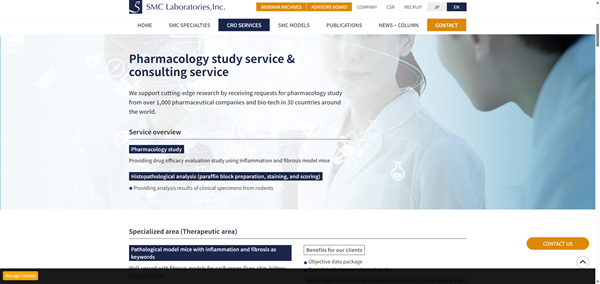
Reference: SMC Laboratories, Inc. official website (https://www.smccro-lab.com/)
SMC Laboratories, Inc.
SMC Laboratories is a specialized non-clinical CRO focused on in vivo pharmacology and efficacy studies using disease-relevant animal models, particularly in fibrosis, inflammation, metabolic diseases, and oncology.
Areas of Expertise
Disease-Relevant Model Portfolio
SMC Laboratories offers models covering the liver, lung, kidney, intestine, and oncology. Its portfolio includes the proprietary STAM™ model for MASH, fibrosis, and hepatocellular carcinoma.
Study Design Based on Target Biology
Study plans are developed around the target biology, mechanism of action, disease stage, and development objective. Pharmacological endpoints can be combined with histopathology, biomarkers, and disease-specific readouts.
Support from Target Validation to Proof of Concept
With experience from more than 1,000 studies for clients in 30 countries, SMC Laboratories supports programs from target validation and candidate selection through in vivo proof-of-concept studies.
Safety StudiesComprehensive Safety Assessment for Preclinical Development
Reference: Charles River Laboratories official website (https://www.criver.com/)
Charles River Laboratories
Charles River provides non-clinical toxicology and safety assessment services for programs ranging from exploratory safety studies to IND-enabling development.
Areas of Expertise
General Toxicology Across Study Designs
Services include single- and repeat-dose toxicology, dose-range finding, and general toxicology studies across multiple species and administration routes.
Non-GLP and GLP Study Support
Charles River supports both non-GLP and GLP studies, allowing sponsors to progress from early safety characterization to studies intended for regulatory submissions.
Integrated IND-Enabling Safety Assessment
Toxicology studies can be integrated with toxicokinetics, clinical pathology, histopathology, and safety pharmacology to support interpretation and IND-enabling safety packages.
Pharmacokinetic (PK/PD) StudiesConnecting Drug Exposure with Pharmacological Response
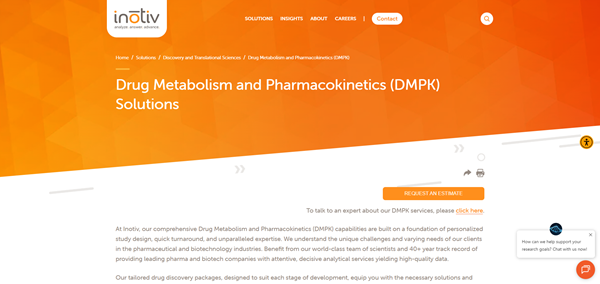
Reference: Inotiv official website (https://www.inotiv.com/)
Inotiv
Inotiv provides integrated PK/PD, DMPK, and bioanalytical services to characterize drug exposure and its relationship with pharmacological response.
Areas of Expertise
Pharmacokinetic Characterization
PK studies characterize exposure, half-life, clearance, and other pharmacokinetic parameters needed to understand how a candidate behaves in the selected model.
Exposure–Response Evaluation
Pharmacokinetic data can be combined with pharmacodynamic endpoints and bioanalysis to evaluate the relationship between drug exposure and pharmacological response.
Integrated DMPK and Development Support
Integrated DMPK, pharmacology, and safety information supports candidate comparison, dose selection, dosing-frequency optimization, and decisions about subsequent preclinical development.

 Japanese