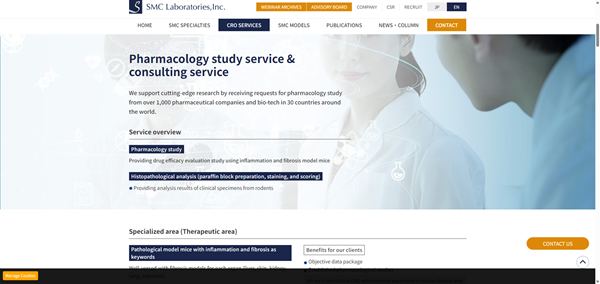
SMC Laboratories, Inc.
SMC Laboratories is a provider of drug evaluation testing & consulting services.High level of patented technologyThis section details examples of pathological models and case studies held by SMC Laboratories, which has Please use this as a reference when choosing a contracting company.
Features of SMC’s Contract Non-Clinical Study Services
Support for Diseases Lacking Established Disease Models
In the process of new drug development, models that accurately recapitulate the pathology of the target disease are required. At SMC Laboratories (SMC), even for diseases for which no model currently exists that can represent human pathology, the company can undertake the development of proprietary disease models. As a result, new drug development for untreated diseases can be enabled.
STAM™ Mouse: A Proprietary Disease Model
The STAM™ mouse—developed by SMC—mimics the progression from non-alcoholic steatohepatitis (NASH) to hepatocellular carcinoma (HCC). The disease progresses rapidly and shows a 100% incidence of hepatocarcinoma, making the model suitable for evaluating immunotherapies and molecularly targeted drugs. The tumor microenvironment can also be analyzed, and the model plays an important role in new drug development.
Extensive Experience in Liver Disease and Fibrosis
Over the past 10 years, SMC has provided services to more than 1,000 research institutions across 30+ countries, and studies using the patented STAM™ mouse have been published in numerous papers and presented at international conferences.
Examples of Disease Models Developed by SMC Laboratories, Inc.
It is essential to go through the testing of candidate compounds in animal models that reproduce the target disease before advancing to clinical trials.
However, clinically relevant disease models may not always exist, thus there are demands for animal models with strong clinical correlation.
Below are some examples of disease models offered at Ina Research.
STAM™ Model
This model shows pathological progression similar to human MASH/NASH–liver cancer. Mimicking late-stage type 2 diabetes , the disease progresses from fatty liver to NASH, fibrosis, and liver cancer. The disease progresses over a short period, with 100% liver cancer at 20 weeks of age;, as a result of these characteristics, research using this model has been published in more than 70 papers to date.
Unilateral Ureteral Obstruction (UUO) Model
UUO model is widely used as a renal fibrosis model. It exhibits interstitial fibrosis, tubular atrophy, and infiltration of inflammatory cells, which are characteristic pathological features of chronic kidney disease.
With a study duration of only two weeks, this model is well suited for in vivo screening studies of antifibrotic drug candidates for kidney fibrosis.
SMC Laboratories’ Nonclinical Case Studies
Phase 2 study in NASH-related liver cirrhosis
Galectin Therapeutics Inc. (NASDAQ: GALT) conducted a drug evaluation study targeting fibrosis in STAM™ mice, supporting a Phase 2 study in NASH-related liver cirrhosis.
*Reference: https://www.smccro-lab.com/jp/quality/
Ongoing Phase 2 study in NASH at the hepatic fibrosis stage
Can-Fite BioPharma Ltd. (NYSE American: CANF, TASE: CFBI) conducted a drug evaluation study targeting NASH using the STAM™ model. A Phase 2 study targeting NASH at the hepatic fibrosis stage is currently ongoing.
*Reference: https://www.smccro-lab.com/jp/quality/
SMC Laboratories, Inc. (SMC) Information
SMC supports more than 1,000 pharmaceutical companies and bio ventures in 30 countries around the world, including Japan and North America*.
SMC Group International, Inc., our U.S.-based group company, serves as the primary point of contact for clients in the United States.
| Address |
Technoport Kamata Center Bldg.
2-16-1 Minami-Kamata Ota-City Tokyo 144-0035, Japan |
| Tel |
+1-949-756-8500 |
| Website |
https://www.smccro-lab.com/ |

 Japanese