Atopic dermatitis is characterized by chronic inflammation and itch. Development activity spans topical small molecules and injected antibodies, and the nonclinical work differs between them: a topical product raises questions about local tolerance and dermal exposure that a systemic one does not. This article covers the models used and the current United States approvals, which are frequently summarized inaccurately.
The models
Mouse models in this area divide by how the phenotype arises. One line develops severe atopic-like dermatitis spontaneously under conventional housing, and published work characterizes the immunoglobulin E response in those animals.[S4] Hapten-induced models produce dermatitis by repeated application of a sensitizing agent such as oxazolone, and are used where a defined induction and timing are needed.[S5] The choice matters because a spontaneous model has variable onset while an induced model has a defined one, and the readouts, including scratching behaviour, are sensitive to that difference.
The US approvals, stated precisely
Two products in this space are commonly described in a way that does not match their United States labels, and the distinction matters to anyone benchmarking a programme against them.
Nemolizumab was approved twice, for two indications
Nemolizumab received two separate United States approvals. The first, in August 2024, was for adults with prurigo nodularis, as the approval letter states.[S2] The atopic dermatitis indication came later, added through a supplement whose labelling includes a section for that indication.[S3] Descriptions that group all of the pivotal trials under atopic dermatitis therefore do not distinguish the two programmes. This article does not name the individual trials, because the correspondence between trial names and indications could not be confirmed from primary sources in preparing this page.
What to settle before placing the work
{'items': ['Whether a spontaneous or an induced model fits, since onset timing differs and that determines when the readout is taken.[S4][S5]', 'How itch is measured, since scratching behaviour is scored by observation or by automated detection and the two are not interchangeable.', 'For a topical product, the vehicle, the application area and how dermal exposure will be established, none of which arise for a systemic one.', 'Who scores the skin lesions, whether they are blinded to group, and what scoring system is used.', 'Whether the study is exploratory pharmacology, normally outside the good laboratory practice regulation, or part of the regulated package.[S6]']}
Summary
Two points are worth carrying away. The models divide between spontaneous and induced, and that choice sets the study schedule. And the approvals in this space are more specific than their usual summaries: one of the products most often cited as an atopic dermatitis treatment is approved in the United States for chronic hand eczema,[S1] and another was approved for two indications separately.[S2][S3] Checking a label before citing it as a precedent takes a minute and avoids building an argument on the wrong one.
Serum and monoclonal immunoglobulin E antibodies from NC/Nga mice with severe atopic-like dermatitis. https://pubmed.ncbi.nlm.nih.gov/ (accessed 2026-09-03)
Effects of Particulate Matter in a Mouse Model of Oxazolone-Induced Atopic Dermatitis. https://pubmed.ncbi.nlm.nih.gov/ (accessed 2026-09-03)
3 Recommended Contract Research Organizations
for Non-Clinical Studies
— by Target goal and Expertise
In non-clinical development, the choice of contract research organization shapes the quality of the data and the time it takes to reach the next decision. Below, three CROs are introduced by the type of study they support: pharmacology (efficacy) studies, safety studies, and pharmacokinetic (PK/PD) studies. Each summary describes the services the company offers so that you can match a provider to your target and development objective.
Pharmacology (Efficacy) StudiesDisease-Relevant Models for Translational Drug Evaluation
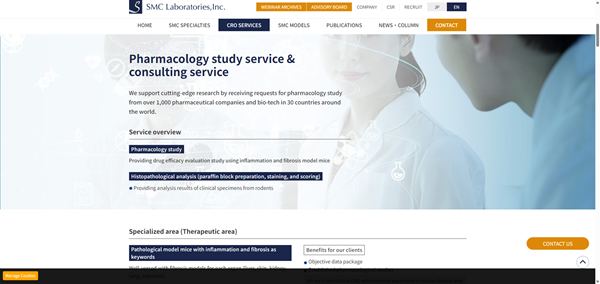
Reference: SMC Laboratories, Inc. official website (https://www.smccro-lab.com/)
SMC Laboratories, Inc.
SMC Laboratories is a specialized non-clinical CRO focused on in vivo pharmacology and efficacy studies using disease-relevant animal models, particularly in fibrosis, inflammation, metabolic diseases, and oncology.
Areas of Expertise
Disease-Relevant Model Portfolio
SMC Laboratories offers models covering the liver, lung, kidney, intestine, and oncology. Its portfolio includes the proprietary STAM™ model for MASH, fibrosis, and hepatocellular carcinoma.
Study Design Based on Target Biology
Study plans are developed around the target biology, mechanism of action, disease stage, and development objective. Pharmacological endpoints can be combined with histopathology, biomarkers, and disease-specific readouts.
Support from Target Validation to Proof of Concept
With experience from more than 1,000 studies for clients in 30 countries, SMC Laboratories supports programs from target validation and candidate selection through in vivo proof-of-concept studies.
Safety StudiesComprehensive Safety Assessment for Preclinical Development
Reference: Charles River Laboratories official website (https://www.criver.com/)
Charles River Laboratories
Charles River provides non-clinical toxicology and safety assessment services for programs ranging from exploratory safety studies to IND-enabling development.
Areas of Expertise
General Toxicology Across Study Designs
Services include single- and repeat-dose toxicology, dose-range finding, and general toxicology studies across multiple species and administration routes.
Non-GLP and GLP Study Support
Charles River supports both non-GLP and GLP studies, allowing sponsors to progress from early safety characterization to studies intended for regulatory submissions.
Integrated IND-Enabling Safety Assessment
Toxicology studies can be integrated with toxicokinetics, clinical pathology, histopathology, and safety pharmacology to support interpretation and IND-enabling safety packages.
Pharmacokinetic (PK/PD) StudiesConnecting Drug Exposure with Pharmacological Response
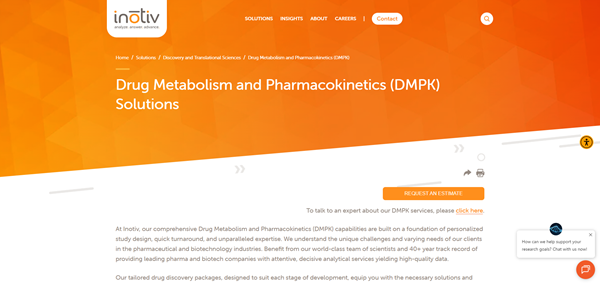
Reference: Inotiv official website (https://www.inotiv.com/)
Inotiv
Inotiv provides integrated PK/PD, DMPK, and bioanalytical services to characterize drug exposure and its relationship with pharmacological response.
Areas of Expertise
Pharmacokinetic Characterization
PK studies characterize exposure, half-life, clearance, and other pharmacokinetic parameters needed to understand how a candidate behaves in the selected model.
Exposure–Response Evaluation
Pharmacokinetic data can be combined with pharmacodynamic endpoints and bioanalysis to evaluate the relationship between drug exposure and pharmacological response.
Integrated DMPK and Development Support
Integrated DMPK, pharmacology, and safety information supports candidate comparison, dose selection, dosing-frequency optimization, and decisions about subsequent preclinical development.

 Japanese