A site where you can find recommended contractors for non-clinical testing|effical " List of Drug Discovery Modalities

List of Drug Discovery Modalities

Drug discovery modalities are classifications of therapeutic methods based on drug mechanisms of action, structure, and manufacturing technology. In recent years, modalities have diversified due to technological innovation, and the necessary testing and evaluation items to assess the efficacy and safety of each differ. This article provides a list of representative drug discovery modalities.

Modality

What are drug discovery modalities?Treatment/attack methods that indicate how to act against the cause of a diseaseThis refers to the following. For example, even when targeting HER2, which is involved in cell proliferation, in cancer treatment, the means of attack vary. Trastuzumab binds to HER2 and inhibits proliferation signals, while pertuzumab suppresses proliferation by preventing HER2 from binding to other receptors. In this way,Even if they target the same molecule (HER2), different drug modalities are used if their mechanisms of action and treatment methods differ.is classified as.

Why are modalities increasing?

Drug discovery modalities areEvolving and diversifying to solve new drug discovery challengesInitially, there were proteins that could not be targeted by low-molecular-weight drugs, so antibody drugs that could recognize specific targets with high precision emerged. However, antibodies are not effective against intracellular targets, so PROTACs that degrade target proteins were developed. Furthermore, nucleic acid drugs have been commercialized in response to the need to target RNA itself rather than proteins. New modalities are born to overcome challenges that cannot be addressed by existing technologies.

List of Modality Types

Modality feature Main non-clinical evaluation
Small molecule drug Easily acts on intracellular targets and is easy to administer orally. Pharmacokinetics, Pharmacodynamics, and Safety
Antibody drug Acts on extracellular targets with high specificity ADA・Pharmacology and Pharmacokinetics
Nucleic acid medicine Control of RNA expression Organizational distribution, pharmacokinetics, and safety
Peptide and mid-molecule drugs Having intermediate characteristics between small molecules and antibodies Stability, Pharmacokinetics, Efficacy, and Pharmacology
Cell and gene therapy To use cells and genes themselves for treatment Pharmacological effects, immunological evaluation, and safety
Regenerative medicine To regenerate cells and tissues Pathological model, drug efficacy and pharmacology, safety

Small molecule drug

Small molecule drugs are,Low molecular weight and easily acts on intracellular targetsis a characteristic modality. Many formulations are available for oral administration, and manufacturing costs can be kept relatively low, allowing them to be used for a wide range of diseases. On the other hand, they can easily act on targets other than the intended ones, and side effects and drug resistance can become issues.

Required non-clinical evaluation
For small molecule drugs, we evaluate whether the drug sufficiently reaches the target tissue (pharmacokinetics), binds to the target protein and exhibits the expected pharmacological effect (target engagement), and whether there are any safety issues. Typical studies include pharmacokinetic studies, intratumoral distribution analysis, target engagement evaluation, and safety pharmacology studies.

EGFR inhibitor

BCR-ABL inhibitor

BTK inhibitor

Antibody drug

Antibody drugs areIt has high specificity for the target molecule, allowing it to act while suppressing its effects on normal cells.is a modality with this characteristic. It primarily acts on extracellular target molecules and is expected to have high therapeutic efficacy. On the other hand, challenges include the fact that it is mainly administered by injection, high manufacturing costs, and the need to consider immunogenicity.

Required non-clinical evaluation
In antibody therapeutics, we evaluate whether the drug reliably binds to the target molecule and exerts its pharmacological effect (Target Engagement), whether it is properly distributed and maintained in the body (pharmacokinetics), and whether there are any issues with immune responses or safety. Typical evaluations include Target Engagement assessment, ADA (anti-drug antibody) assessment, tissue distribution analysis, and safety studies.

Anti-PD-1 antibody

Anti-HER2 antibody

anti-VEGF antibody

Nucleic acid medicine

Nucleic acid drugs areIt can regulate gene expression by targeting DNA and RNAThis modality is characterized by [...]. Because it can act on molecules that were difficult to target with conventional small-molecule drugs or antibody-based therapeutics, it is viewed as a promising new treatment option. On the other hand, since it is easily degraded in the body, the development of technologies for efficient delivery to target tissues (DDS) is a critical challenge.

Required non-clinical evaluation
In nucleic acid drug development, evaluation focuses on whether the drug can be sufficiently delivered to target tissues or

siRNA

Antisense oligonucleotide

mRNA

Peptide and mid-molecule drugs

Peptides and medium-molecular-weight drugs are,Possessing intermediate characteristics between small molecule drugs and antibody drugs, it can achieve both high target selectivity and excellent efficacy.This is about modality. It is easily effective on molecules that are difficult to target with small molecule drugs, and is attracting attention as a new drug discovery method. On the other hand, because they can be easily degraded in the body and sometimes oral administration is difficult, formulation design and delivery technology are required.

Required non-clinical evaluation
For peptides and medium-molecular-weight drugs, we evaluate whether they can maintain sufficient stability in the body (stability evaluation), whether they reach their target and exert their therapeutic effect (pharmacokinetics and pharmacodynamics), and whether there are any safety concerns.Typical evaluations include plasma stability studies, pharmacokinetic studies, pharmacodynamic studies, and safety studies.

GLP-1 receptor agonists

Cyclic Peptide

Macrocycle Pharmaceuticals

Cell and gene therapy

Cell and gene therapy isAiming for a fundamental cure using the patient's own body, provided cells, or genes.It is a modality. It is expected to be applied to diseases that were difficult to treat with conventional drugs, and its practical application is progressing, especially in the fields of cancer and genetic diseases. On the other hand, the manufacturing process is complex, and quality control and long-term safety evaluation are important.

Required non-clinical evaluation
In cell and gene therapy, we evaluate whether therapeutic cells appropriately reach their targets and exert sufficient effects (pharmacodynamics), function safely in the body for extended periods, and whether there are no issues with safety or immune responses. Typical evaluations include pharmacodynamic studies, biodistribution analysis, immunological evaluations, and safety studies.

CAR T-cell

CAR-NK

TCR-T

Regenerative medicine

再生医療は、細胞や組織を利用して損傷した臓器や組織の機能回復を目指すモダリティです。従来の薬物療法では治療が難しかった疾患への新たな選択肢として期待されており、眼科や整形外科、循環器など幅広い分野で研究・実用化が進んでいます。一方で、細胞品質の管理や長期的な有効性・安全性の評価が重要です。

Required non-clinical evaluation
再生医療では、移植した細胞や組織が目的部位で生着・機能するか(薬効薬理)、適切に分化・増殖するか、安全性に問題がないかを評価します。代表的な評価には、病態モデルを用いた薬効薬理試験、生着・分化評価、腫瘍形成性評価、安全性試験などがあります。

iPS細胞

ES細胞

間葉系幹細胞(MSC)

モダリティによってCRO選びは変わる

創薬モダリティとは、病気に対する治療アプローチを分類したものであり、近年は低分子医薬だけでなく、抗体医薬や核酸医薬、細胞・遺伝子治療、再生医療など多様なモダリティが実用化されています。それぞれで作用機序や体内での挙動が異なるため、必要となる非臨床評価や試験項目も異なります。適切な評価を行うには、各モダリティの特性を理解し、専門的な知見や評価技術を備えたCROを選定することが、医薬品開発を円滑に進める重要なポイントとなります。

3 Recommended Contract Research Organizations for Non-Clinical Studies
— by Target goal and Expertise

In drug discovery, the quality and efficiency of non-clinical studies have a direct impact on clinical success rates, development costs, and overall length of time required in R&D. In recent years, there has been more demand for clinically relevant data, globally accepted reliability, and accurate early-stage screening. Thus, it is more important than ever to select the right CRO (Contract Research Organization) for strategic approach.
In this article, we highlight three CROs with proven technical capabilities, expertise, and long standing track records. These are our TOP 3 choices based on their capabilities and the specific target goals of the researchers for their non-clinical studies.

Pharmacology (Efficacy) Studies
Replicate unknown pathological models and
Discovery to clinically oriented drug evaluation
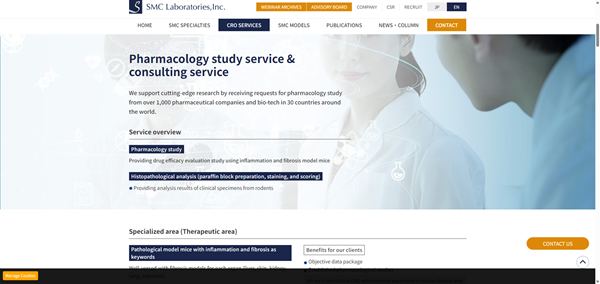
SMC Laboratories, Inc.
Reference: SMC Laboratories, Inc. official website (https://www.smccro-lab.com/jp/)
  • SMC Laboratories, Inc. has established a disease models using patented mouse technologies. The company has established proprietary pathological models—particularly in liver disease and fibrosis—and continues to expand their approach across a wide range of models in cancer, inflammation, and metabolic diseases.
  • From exploratory research to clinically oriented efficacy evaluation, SMC offers customized study designs, dosing strategies, and evaluation analysis tailored to each project. Their collaborative approachallows researchers to discuss and refine study plans together with SMC’s expert scientists.

  • With flexible small-scale study options and strong technical support, SMC Laboratories, Inc. is an ideal partner for start-ups, biotech ventures, and academic institutions alike.
Safety Studies
Comprehensive Safety Evaluation for FIH Applications
Labcorp Holdings Inc.
(Labcorp Drug Development)
Labcorp Holdings Inc.
Reference: Labcorp Holdings Inc. official website (https://jp.labcorp.com/)
  • Labcorp Holdings Inc. provides a fully integrated GLP testing system aligned with international regulatory standards, including FDA, EMA, and PMDA requirements. All studies are conducted under ICH-compliant quality assurance, making it ready for data submission.
  • The company has extensive expertise in long-term toxicity studies such as Segment I–III reproductive and carcinogenicity studies, as well as 2-year chronic toxicity assessments.
  • Labcorp Holdings Inc.’s comprehensive approach enables sponsors to efficiently outsource the entire preclinical package from toxicology, toxicokinetic (TK), and safety pharmacology study design to execution. This accelerates a path to First-in-Human (FIH) trials. For most of the global drug developers, this all-in-one service structure minimizes cost, risk, and expedite the time before advancing to clinical phase.
Pharmacokinetic (PK/PD) Studies
High-Precision Bioanalysis for Clinically Predictive PK/PD Evaluation
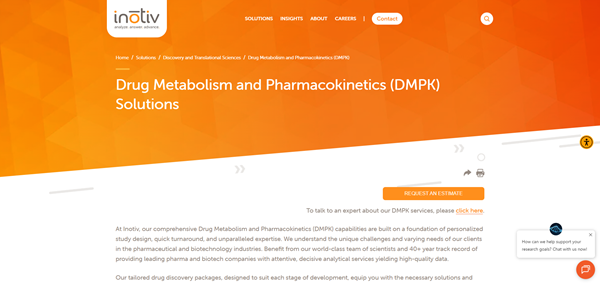
PhoenixBio Co., Ltd.
Source: PhoenixBio Co., Ltd. Official Website (https://phoenixbio.co.jp/)
  • PhoenixBio Co., Ltd.offers pharmacokinetic and hepatic metabolism studies using their proprietary PXB-mouse®, a humanized-liver chimeric mouse model. This platform enables the acquisition of data with high clinical correlation in ADME, drug–to-drug interaction studies, bridging the gap between preclinical and clinical stages.
  • With advanced LC-MS/MS-based bioanalysis, PhoenixBio Co., Ltd. provides aseamless workflow from plasma concentration measurement and metabolite identification to quantitative validation.

  • The company offersan integrated evaluation analysiscovering pharmacokinetics, hepatotoxicity, and safety with flexibility to accommodate complex modalities such as oligonucleotide and middle-molecule therapeutics. For compounds where hepatic metabolism is a development bottleneck—or where quantitative, reproducible exposure data are critical—PhoenixBio Co., Ltd. delivers unmatched analytical precision and consistency.