Liver-humanized mice engraft human hepatocytes into a mouse host whose liver and immune backgrounds permit repopulation.[S1][S3] The resulting system can measure specified human-hepatocyte endpoints in vivo. It does not eliminate species differences, establish human toxicity or safety, or predict development success. This article focuses on the platform records that were verified for US commissioning.
What the human hepatocyte compartment establishes
Published platform records describe human hepatocyte expansion in Fah-/-Rag2-/-Il2rg-/- mice and human-type metabolic responses in a uPA/SCID-based system.[S1][S3] Those findings support measuring metabolism or another prespecified hepatocyte endpoint under the reported conditions. They do not make the remainder of the animal human, and they do not establish human pharmacokinetics, drug-induced liver injury, efficacy, or safety. “Gold standard” is therefore not used.
Verified foundational papers
Both citations in the Japanese original contained bibliographic discrepancies.[S2][S3] The blocks below replace them with the closest verified papers by the named authors. Read the full papers before using a specific method or performance claim in a protocol.
{'items': ['Verified paper: “Near completely humanized liver in mice shows human-type metabolic responses to drugs.”[S3]', 'Tateno C, et al.; American Journal of Pathology, 2004;164(4):1301-1313.[S3]']}
The verified Tateno paper reports a uPA/SCID-based liver-humanization system and human-type metabolic responses to drugs.[S3] Cite the paper for its reported model and findings, not for the stronger original claims that it established a universal replacement-rate metric or a standard framework for pharmacokinetic studies.
{'items': ['Verified paper: “Chimeric mice with humanized liver.”[S2]', 'Katoh M, Tateno C, Yoshizato K, and Yokoi T; Toxicology, 2008;246(1):9-17.[S2]']}
The verified record establishes a 2008 Toxicology review titled “Chimeric mice with humanized liver.”[S2] It does not substantiate the different title in the Japanese original or, by bibliographic record alone, the claims of high predictive performance for human clearance, toxicity, or safety. Any such performance claim requires a directly supporting validation study.
Verified platform records
The verified records cover three platform families: published uPA/SCID work, published FRG work with a US commercial record, and the PXB-mouse company record.[S1][S3][S4][S5] They are listed without ranking. A sponsor still has to match host genotype, donor, replacement or engraftment criterion, test article, endpoint, and study duration to the question.
Platform record
Verified identity or source
Commissioning check
uPA/SCID
Tateno et al., American Journal of Pathology, 2004.[S3]
Confirm the exact host allele, donor, replacement criterion, and assay supporting the proposed endpoint.
FRG
Fah-/-Rag2-/-Il2rg-/- mice in the 2007 Azuma paper; Yecuris lists an FRG commercial platform in Oregon.[S1][S4]
Confirm current genotype, material or service format, donor options, availability, and deliverables.
PXB-mouse
PhoenixBio’s English-language company page describes the PXB-mouse product (company website archive, accessed September 3, 2026).[S5]
Confirm current US ordering route, host line, donor, engraftment specification, and study scope directly with the company.
Protocol decisions that govern interpretation
Put the variables that could change interpretation into the protocol: host genotype, human-hepatocyte donor and lot, qualification data, engraftment or replacement criterion, allocation across groups, test-article exposure, sampling schedule, primary endpoint, exclusions, and analysis plan. If an immune-humanized component is proposed, require separate evidence and acceptance criteria for it. Adding a human cell compartment does not establish a human safety response.
Commissioning checklist
The verified literature identifies uPA/SCID and FRG approaches, and the verified company records identify US-accessible FRG and PXB offerings.[S1][S3][S4][S5] Compare them on the exact host, donor, engraftment criterion, endpoint, schedule, and current supply terms. Results establish what occurred in that chimeric mouse system. They do not show that a candidate will have human pharmacokinetics, avoid liver injury, or succeed clinically.
References
Robust expansion of human hepatocytes in Fah-/-/Rag2-/-/Il2rg-/- mice. https://doi.org/10.1038/nbt1326 (accessed 2026-09-03)
3 Recommended Contract Research Organizations
for Non-Clinical Studies
— by Target goal and Expertise
In non-clinical development, the choice of contract research organization shapes the quality of the data and the time it takes to reach the next decision. Below, three CROs are introduced by the type of study they support: pharmacology (efficacy) studies, safety studies, and pharmacokinetic (PK/PD) studies. Each summary describes the services the company offers so that you can match a provider to your target and development objective.
Pharmacology (Efficacy) StudiesDisease-Relevant Models for Translational Drug Evaluation
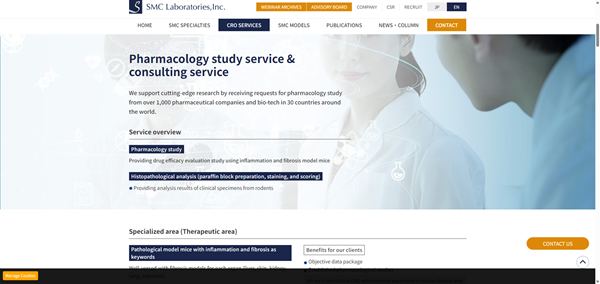
Reference: SMC Laboratories, Inc. official website (https://www.smccro-lab.com/)
SMC Laboratories, Inc.
SMC Laboratories is a specialized non-clinical CRO focused on in vivo pharmacology and efficacy studies using disease-relevant animal models, particularly in fibrosis, inflammation, metabolic diseases, and oncology.
Areas of Expertise
Disease-Relevant Model Portfolio
SMC Laboratories offers models covering the liver, lung, kidney, intestine, and oncology. Its portfolio includes the proprietary STAM™ model for MASH, fibrosis, and hepatocellular carcinoma.
Study Design Based on Target Biology
Study plans are developed around the target biology, mechanism of action, disease stage, and development objective. Pharmacological endpoints can be combined with histopathology, biomarkers, and disease-specific readouts.
Support from Target Validation to Proof of Concept
With experience from more than 1,000 studies for clients in 30 countries, SMC Laboratories supports programs from target validation and candidate selection through in vivo proof-of-concept studies.
Safety StudiesComprehensive Safety Assessment for Preclinical Development
Reference: Charles River Laboratories official website (https://www.criver.com/)
Charles River Laboratories
Charles River provides non-clinical toxicology and safety assessment services for programs ranging from exploratory safety studies to IND-enabling development.
Areas of Expertise
General Toxicology Across Study Designs
Services include single- and repeat-dose toxicology, dose-range finding, and general toxicology studies across multiple species and administration routes.
Non-GLP and GLP Study Support
Charles River supports both non-GLP and GLP studies, allowing sponsors to progress from early safety characterization to studies intended for regulatory submissions.
Integrated IND-Enabling Safety Assessment
Toxicology studies can be integrated with toxicokinetics, clinical pathology, histopathology, and safety pharmacology to support interpretation and IND-enabling safety packages.
Pharmacokinetic (PK/PD) StudiesConnecting Drug Exposure with Pharmacological Response
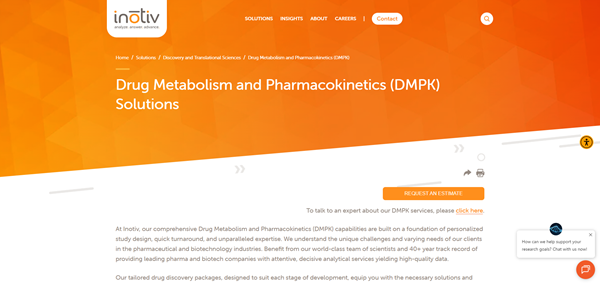
Reference: Inotiv official website (https://www.inotiv.com/)
Inotiv
Inotiv provides integrated PK/PD, DMPK, and bioanalytical services to characterize drug exposure and its relationship with pharmacological response.
Areas of Expertise
Pharmacokinetic Characterization
PK studies characterize exposure, half-life, clearance, and other pharmacokinetic parameters needed to understand how a candidate behaves in the selected model.
Exposure–Response Evaluation
Pharmacokinetic data can be combined with pharmacodynamic endpoints and bioanalysis to evaluate the relationship between drug exposure and pharmacological response.
Integrated DMPK and Development Support
Integrated DMPK, pharmacology, and safety information supports candidate comparison, dose selection, dosing-frequency optimization, and decisions about subsequent preclinical development.

 Japanese