Routine pharmacokinetic studies are run repeatedly across a programme, and most of them do not need a bespoke design. Where a laboratory has an established package, using it rather than writing a protocol from scratch removes the setup work and the negotiation. This article covers what those studies produce, when the standard package is the right choice, and the two places where accepting a default causes trouble later.
What these studies are for
Exposure is the output
The purpose is to quantify exposure. The concentration time course and the parameters derived from it set the doses and intervals for the efficacy studies, and they establish what exposure a given dose produces in the species that will be used for toxicology. The general guidance is explicit that systemic exposure data in the species used for repeated-dose toxicity studies should generally be evaluated before human trials begin.[S3] A comprehensive knowledge of absorption, distribution, metabolism and elimination is described as important for interpreting the pharmacology and toxicology studies themselves.[S2]
A typical design
The usual design is a rodent study with two routes: intravenous administration, which gives the reference for complete availability, and the intended clinical route, most often oral. Running both is what makes bioavailability calculable, and a study with only the oral arm cannot produce that figure. Blood is sampled across a series of timepoints from shortly after dosing until the concentration has declined substantially, and plasma is analysed by chromatography with mass spectrometry. Group sizes and the number of sampling points are set in the protocol according to what the study has to detect; no standard figures are given here, because the ones in circulation are laboratory conventions rather than requirements.
The parameters
These parameters are defined in the toxicokinetics guidance, so the definitions below are the regulatory ones rather than a laboratory convention.[S1]
Parameter
Symbol
What it measures
Maximum concentration
Cmax
The highest concentration reached after a given dose[S1]
Total exposure over the sampling period. This is the figure toxicology findings are related to
Elimination half-life
t1/2
The time for concentration to halve during the elimination phase
Bioavailability
F
The fraction reaching systemic circulation, calculated from the ratio of oral to intravenous exposure
Where the standard package helps, and where it does not
Three factors decide whether a standard package is the right choice for a given study.
Using the laboratory template
Accepting the laboratory established design removes the protocol negotiation and the setup that a bespoke study requires, and it means the study runs on procedures the staff perform routinely. The trade-off is that the template answers the question it was built for. Where the compound has a property the template does not accommodate, such as a formulation requiring a different vehicle or a half-life longer than the sampling window, the standard design will produce data that look complete and are not. No percentage figure for cost saving is given here, because none could be substantiated for this market.
How much assay validation the study needs
The bioanalytical guidance states directly that exploratory methods which would not be used to support regulatory decision making, giving candidate selection as its example, may not require the same stringent validation.[S4] The term the guidance uses is fit for purpose, not qualification. Establishing which studies fall on each side of that line before assay development begins is where the time is saved, because a fully validated method developed for a screening study is effort spent on a decision that did not need it. Studies supporting a submission are a different matter and are normally conducted under the good laboratory practice regulation.[S6]
Historical control data
A laboratory that runs the same design frequently accumulates data on what normal looks like for it. That is what allows an unexpected value to be recognized as unusual rather than investigated from scratch, and it is worth asking to see: whether historical data exist for this design in this species and strain, and whether they can be provided. This is the kind of thing that distinguishes laboratories running the same nominal study.
Operational factors
Three operational points affect the schedule more than the study duration does. Whether the laboratory holds the animals or orders them in, since supply lead time can exceed the study itself for some species. Whether a summary of results can be issued before the final report is signed, which lets the next decision be made without waiting for report finalization. And where work is placed across time zones, who the point of contact is during the sponsor working day, since a question that waits a day for an answer costs a day.
Summary
Routine pharmacokinetic work is standardized enough to be placed as a defined piece of work rather than designed each time, and using a laboratory established package is usually the sensible choice. Two decisions still belong to the sponsor. Whether the template accommodates this compound, since it will produce a report either way. And which studies need a validated method and which do not,[S4] since that is set before assay development rather than after.
3 Recommended Contract Research Organizations
for Non-Clinical Studies
— by Target goal and Expertise
In non-clinical development, the choice of contract research organization shapes the quality of the data and the time it takes to reach the next decision. Below, three CROs are introduced by the type of study they support: pharmacology (efficacy) studies, safety studies, and pharmacokinetic (PK/PD) studies. Each summary describes the services the company offers so that you can match a provider to your target and development objective.
Pharmacology (Efficacy) StudiesDisease-Relevant Models for Translational Drug Evaluation
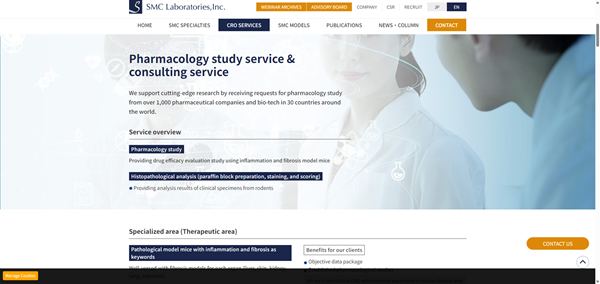
Reference: SMC Laboratories, Inc. official website (https://www.smccro-lab.com/)
SMC Laboratories, Inc.
SMC Laboratories is a specialized non-clinical CRO focused on in vivo pharmacology and efficacy studies using disease-relevant animal models, particularly in fibrosis, inflammation, metabolic diseases, and oncology.
Areas of Expertise
Disease-Relevant Model Portfolio
SMC Laboratories offers models covering the liver, lung, kidney, intestine, and oncology. Its portfolio includes the proprietary STAM™ model for MASH, fibrosis, and hepatocellular carcinoma.
Study Design Based on Target Biology
Study plans are developed around the target biology, mechanism of action, disease stage, and development objective. Pharmacological endpoints can be combined with histopathology, biomarkers, and disease-specific readouts.
Support from Target Validation to Proof of Concept
With experience from more than 1,000 studies for clients in 30 countries, SMC Laboratories supports programs from target validation and candidate selection through in vivo proof-of-concept studies.
Safety StudiesComprehensive Safety Assessment for Preclinical Development
Reference: Charles River Laboratories official website (https://www.criver.com/)
Charles River Laboratories
Charles River provides non-clinical toxicology and safety assessment services for programs ranging from exploratory safety studies to IND-enabling development.
Areas of Expertise
General Toxicology Across Study Designs
Services include single- and repeat-dose toxicology, dose-range finding, and general toxicology studies across multiple species and administration routes.
Non-GLP and GLP Study Support
Charles River supports both non-GLP and GLP studies, allowing sponsors to progress from early safety characterization to studies intended for regulatory submissions.
Integrated IND-Enabling Safety Assessment
Toxicology studies can be integrated with toxicokinetics, clinical pathology, histopathology, and safety pharmacology to support interpretation and IND-enabling safety packages.
Pharmacokinetic (PK/PD) StudiesConnecting Drug Exposure with Pharmacological Response
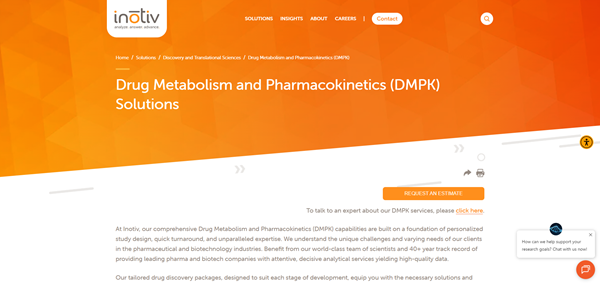
Reference: Inotiv official website (https://www.inotiv.com/)
Inotiv
Inotiv provides integrated PK/PD, DMPK, and bioanalytical services to characterize drug exposure and its relationship with pharmacological response.
Areas of Expertise
Pharmacokinetic Characterization
PK studies characterize exposure, half-life, clearance, and other pharmacokinetic parameters needed to understand how a candidate behaves in the selected model.
Exposure–Response Evaluation
Pharmacokinetic data can be combined with pharmacodynamic endpoints and bioanalysis to evaluate the relationship between drug exposure and pharmacological response.
Integrated DMPK and Development Support
Integrated DMPK, pharmacology, and safety information supports candidate comparison, dose selection, dosing-frequency optimization, and decisions about subsequent preclinical development.

 Japanese