Metabolite identification in pharmacokinetic studies
Why metabolites are characterized separately
A compound that is metabolized is not the only substance circulating after a dose. Some metabolites are inactive, some carry pharmacological activity of their own, and some are the reason a toxicity appears. Identifying them matters for a specific regulatory reason as well as a scientific one: if a metabolite is present in humans at a substantially higher level than in the animals used for the safety studies, those studies did not test what patients are exposed to.
Both the agency guidance on this subject and the general nonclinical safety guideline set the same threshold. Human metabolites that can raise a safety concern are those present at greater than 10 percent of total drug-related exposure at steady state,[S1] and nonclinical characterization of a human metabolite is warranted only when it is observed above that level.[S4] That figure is the decision point this whole area turns on.
How the work is done
In vitro comparison across species
The guidance names the systems used: liver microsomes, liver slices or hepatocytes, from animals and from humans, and states that these studies should generally be conducted before clinical trials begin.[S3] Running the human system alongside the species used for toxicology is what reveals a metabolite that humans form and the test species does not, which is the situation the threshold above is written for.
In vivo and mass balance work
In vivo work profiles what is actually formed, from plasma, urine and faeces after dosing. A mass balance study, in which a radiolabelled dose is followed until it is accounted for, is what establishes the proportions each metabolite represents; the guidance uses such a study as the starting point in its worked example.[S5] Proportions are the point, because the threshold is expressed as a share of total drug-related exposure rather than an absolute concentration.
Structural work
High resolution mass spectrometry measures mass accurately enough to propose an elemental composition for an unknown metabolite. Fragmentation then narrows the possible structures. Confirming a structure definitively usually requires comparison against a synthesized reference standard, which is a separate piece of work with its own lead time.
Labelled compounds
Radiolabelled compound allows every drug-related species to be detected regardless of its structure, which is what makes a complete mass balance possible. Stable isotope labelling assists structure determination and helps distinguish genuine metabolites from background signals. Both require the labelled material to be synthesized, and the position of the label has to be chosen so that it is retained in the metabolites of interest rather than lost in an early cleavage.
When each study is run
Discovery
At the lead optimization stage the work is fast and exploratory: incubations in human microsomes indicate how quickly a compound is metabolized and which part of the molecule is attacked, which directs the chemistry. This is screening rather than characterization, and the studies are normally conducted outside the good laboratory practice regulation.[S7]
Before clinical work begins
The comparison between human and animal in vitro systems belongs here, and the guidance says these studies should generally be conducted before clinical trials begin.[S3] Doing them at this point is what allows a species mismatch to be found while the toxicology programme can still be adjusted, rather than after the studies have run.
After human exposure data exist
Once human data exist, the proportions can be compared directly. If a metabolite is present only in humans, or at higher plasma concentration in humans than in the animals used for the nonclinical studies,[S2] and it exceeds 10 percent of total drug-related exposure at steady state,[S1] nonclinical characterization of that metabolite is warranted.[S4] In practice that means additional animal work on the metabolite itself, which is why finding this late is expensive: the studies are the same studies, run again, on a different substance.
What to establish with the laboratory
Scope of the work
Establish where the work stops. Proposing a structure from mass spectrometry, confirming it against a synthesized standard, and synthesizing that standard are three different activities, and a quotation may cover only the first. Ask which of them are included, and if reference standard synthesis is not, who will do it and on what timeline.
Instrumentation
High resolution mass spectrometry is required for identifying unknowns, and a laboratory doing this work will have it. The more useful question is whether it is licensed and equipped to handle radiolabelled material, since mass balance work requires that and not every laboratory can take it on.
Which regulation the study follows
Ask which good laboratory practice regulation a given study will follow, since compliance is determined study by study under a specific regulation rather than held by a facility.[S7] Ask also which guidance the metabolite work is designed against, because the exposure comparison it produces has to be in the form the threshold is expressed in.[S1][S4]
What happens when something unexpected appears
Metabolite work produces surprises more often than most study types, because the question is open-ended. The useful thing to establish is not responsiveness in general but what happens specifically when an unexpected peak appears: whether investigating it is inside the quoted scope, how the decision to pursue it is made, and who is authorized to make it. Agreeing that before the study starts avoids a delay at the point where the answer matters most.
3 Recommended Contract Research Organizations
for Non-Clinical Studies
— by Target goal and Expertise
In non-clinical development, the choice of contract research organization shapes the quality of the data and the time it takes to reach the next decision. Below, three CROs are introduced by the type of study they support: pharmacology (efficacy) studies, safety studies, and pharmacokinetic (PK/PD) studies. Each summary describes the services the company offers so that you can match a provider to your target and development objective.
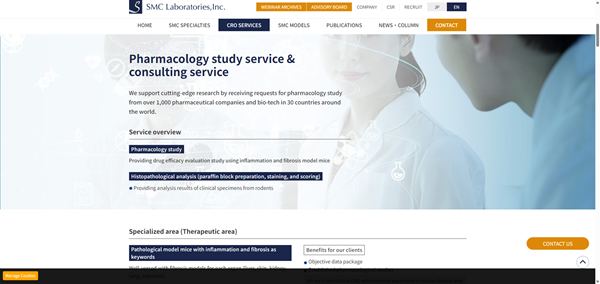
Pharmacology (Efficacy) StudiesDisease-Relevant Models for Translational Drug Evaluation
Reference: SMC Laboratories, Inc. official website (https://www.smccro-lab.com/)
SMC Laboratories, Inc.
SMC Laboratories is a specialized non-clinical CRO focused on in vivo pharmacology and efficacy studies using disease-relevant animal models, particularly in fibrosis, inflammation, metabolic diseases, and oncology.
Areas of Expertise
Disease-Relevant Model Portfolio
SMC Laboratories offers models covering the liver, lung, kidney, intestine, and oncology. Its portfolio includes the proprietary STAM™ model for MASH, fibrosis, and hepatocellular carcinoma.
Study Design Based on Target Biology
Study plans are developed around the target biology, mechanism of action, disease stage, and development objective. Pharmacological endpoints can be combined with histopathology, biomarkers, and disease-specific readouts.
Support from Target Validation to Proof of Concept
With experience from more than 1,000 studies for clients in 30 countries, SMC Laboratories supports programs from target validation and candidate selection through in vivo proof-of-concept studies.
Safety StudiesComprehensive Safety Assessment for Preclinical Development
Reference: Charles River Laboratories official website (https://www.criver.com/)
Charles River Laboratories
Charles River provides non-clinical toxicology and safety assessment services for programs ranging from exploratory safety studies to IND-enabling development.
Areas of Expertise
General Toxicology Across Study Designs
Services include single- and repeat-dose toxicology, dose-range finding, and general toxicology studies across multiple species and administration routes.
Non-GLP and GLP Study Support
Charles River supports both non-GLP and GLP studies, allowing sponsors to progress from early safety characterization to studies intended for regulatory submissions.
Integrated IND-Enabling Safety Assessment
Toxicology studies can be integrated with toxicokinetics, clinical pathology, histopathology, and safety pharmacology to support interpretation and IND-enabling safety packages.
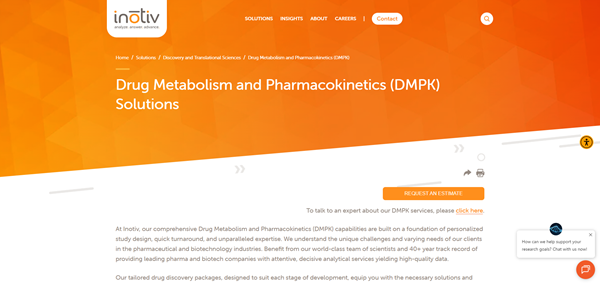
Pharmacokinetic (PK/PD) StudiesConnecting Drug Exposure with Pharmacological Response
Reference: Inotiv official website (https://www.inotiv.com/)
Inotiv
Inotiv provides integrated PK/PD, DMPK, and bioanalytical services to characterize drug exposure and its relationship with pharmacological response.
Areas of Expertise
Pharmacokinetic Characterization
PK studies characterize exposure, half-life, clearance, and other pharmacokinetic parameters needed to understand how a candidate behaves in the selected model.
Exposure–Response Evaluation
Pharmacokinetic data can be combined with pharmacodynamic endpoints and bioanalysis to evaluate the relationship between drug exposure and pharmacological response.
Integrated DMPK and Development Support
Integrated DMPK, pharmacology, and safety information supports candidate comparison, dose selection, dosing-frequency optimization, and decisions about subsequent preclinical development.

 Japanese