QPS Holdings, LLC is a contract research organization headquartered in the Delaware Technology Park in Newark, Delaware.[S3] The company states that "Dr. Benjamin Chien founded QPS in 1995 to provide high quality bioanalytical LC-MS/MS contract services" and that it is "still privately held and led by Dr. Benjamin Chien."[S1] Its Newark site page describes the entity there as "a GLP/GCP-compliant CRO, specializing in discovery, preclinical, and clinical drug development research."[S3] This profile summarizes the services, sites, stated compliance information, and company facts most relevant to US sponsors.
Nonclinical services relevant to US drug developers
Bioanalysis
Bioanalysis is the company's original service line. QPS states that it "complies with Good Laboratory Practice (GLP) regulations and guidance documents of the U.S. Food and Drug Administration (US FDA), the Organization for Economic Co-operation and Development (OECD)," and of the Chinese and Japanese regulators.[S4] Platforms listed are UPLC MS/MS for small molecules and metabolites, ligand binding assays, hybrid UPLC MS/MS for peptides and proteins, RT-qPCR and qPCR, immunogenicity assays, biomarker analysis, and pharmacogenomics testing.[S4]
DMPK and ADME
The company states that "DMPK projects cover a drug development program from the discovery, candidate selection, Investigational New Drug (IND) enabling, through New Drug Application (NDA) stages."[S5] Listed work includes in vitro metabolic stability and metabolites in safety testing, protein binding by ultrafiltration, equilibrium dialysis and ultracentrifugation, reaction phenotyping and CYP450 inhibition and induction, radiolabeled ADME including mass balance and tissue distribution, transporter and permeability assays, and toxicokinetic analysis.[S5] An IND is not "approved" by FDA: under 21 CFR 312.40 it goes into effect 30 days after FDA receives it unless FDA imposes a clinical hold.[R1] A CRO may conduct and report nonclinical studies that a sponsor includes in an IND, but it cannot guarantee that FDA will allow the clinical investigation to proceed.
Toxicology
The toxicology page states that the company's scientists "offer a wide range of toxicity studies, as well as other preclinical safety tests, that are essential for preclinical drug development programs."[S6] Named study types are single-dose toxicity, repeated-dose toxicity covering subacute, subchronic and chronic designs, gene mutation assays including the Ames test and the mouse lymphoma assay, the in vivo mammalian erythrocyte micronucleus assay under OECD Test Guideline 474, reproductive toxicology, and biocompatibility testing to ISO 10993.[S6] The company states that it has completed more than 2,200 GLP studies.[S6] A separately named safety pharmacology or pathology service was not found on the pages reviewed.
Preclinical pharmacology and disease models
The pharmacology page describes preclinical pharmacology as work "that occurs before a potential drug candidate is tested in humans (clinical trials)"[S7] and names models in metabolic dysfunction-associated steatohepatitis (MASH), acute and chronic ulcerative colitis, psoriasis, and Alzheimer's disease.[S7] Therapeutic areas listed elsewhere on the site include dermatology, endocrinology, inflammatory bowel disease, neuropsychiatry, obesity, oncology, and rheumatology.[S9] Because QPS also runs clinical trials, sponsors should be clear in the contract which parts of a program are nonclinical and which quality system applies to each.
Quality, compliance, and animal welfare (as stated by the company)
GLP. The Newark site is described as "a GLP/GCP-compliant CRO,"[S3] and the bioanalysis page names the FDA, OECD, and the Chinese and Japanese regulators as the authorities whose GLP regulations and guidance the company follows.[S4] The company names FDA, OECD in its GLP statement.[S4] GLP compliance is determined study by study under the applicable regulation, so sponsors should confirm in the protocol which regulation their study will follow and that the final report will carry the study director's compliance statement and the quality assurance unit's statement.[R2] Note also that GLP and Good Clinical Practice (GCP) are separate frameworks that apply to nonclinical studies and clinical trials respectively.
Accreditation and registration numbers. the Newark site page publishes identifiers: AAALAC International accreditation number 001067, with a "Full Accreditation continued" certification recorded in June 2021; an Animal Welfare Assurance from NIH OLAW with assurance number A4360-01; and a CLIA certificate with identification number 08D0995854.[S3] The page also lists a Minority Business Enterprise certification.[S3] No USDA registration statement was found on the pages reviewed. AAALAC International accreditation is a voluntary evaluation of an institution's animal care and use program, re-evaluated every three years,[R3] and USDA registration and an OLAW Animal Welfare Assurance relate to the Animal Welfare Act and the PHS Policy respectively;[R4][R5] none of these establishes GLP compliance, which applies to individual studies.[R2] FDA does not approve or certify laboratories; registration with FDA does not denote approval.[R6]
Inspection history as published by the company. The Newark site page states "11 US FDA inspections completed with 36% free from citations," and says that no agency escalation, warning letter, or employee debarment has occurred.[S3] These figures are the company's own summary and are not published with dates or inspection classifications. An inspection history is not an endorsement: FDA inspects nonclinical laboratories under its Bioresearch Monitoring program but does not approve or certify laboratories.[R6] Sponsors who need to assess inspection outcomes should request the underlying documentation from the company.
Animal welfare. The toxicology page states that "all studies reviewed by IACUC per animal welfare requirements."[S6] No statement using the 3Rs terminology was found on the pages reviewed. This profile does not evaluate the company's animal care program; the statements above are the company's own.
Company facts
Legal name
QPS Holdings, LLC; the Newark, Delaware entity is referred to on the site as QPS, LLC[S2][S3]
Headquarters
Delaware Technology Park, 3 Innovation Way, Newark, DE 19711, United States[S3]
Privately held and founder-led; no parent company or stock listing is shown[S1]
Employees
More than 1,250 globally; more than 250 at the Newark site[S1][S3]
Sites
Stated as eight locations across the United States, Europe, Asia and India. Named sites are Newark DE, South Miami FL, Springfield MO, Groningen (Netherlands), Graz (Austria), Hyderabad (India) and three Taiwan facilities; the Delaware page also refers to a facility in Fargo, ND[S1][S8][S3]
Newark laboratory space
70,500 sq ft (54,000 sq ft bioanalytical and 16,500 sq ft DMPK)[S3]
US nonclinical services
Bioanalysis; DMPK and radiolabeled ADME; toxicology and genetic toxicology; preclinical pharmacology[S4][S5][S6][S7]
GLP statement
Newark site described as GLP/GCP-compliant; FDA and OECD named among the authorities whose GLP regulations and guidance are followed; more than 2,200 GLP studies completed[S3][S4][S6]
Accreditation and certification numbers
AAALAC International 001067 (Full Accreditation continued, June 2021); OLAW Animal Welfare Assurance A4360-01; CLIA 08D0995854[S3]
FDA — "Is It Really FDA Approved?" (FDA does not approve health care providers, including laboratories; registration does not denote approval); FDA Compliance Program 7348.808 (GLP inspections of nonclinical laboratories). https://www.fda.gov/consumers/consumer-updates/it-really-fda-approved (accessed 2026-09-03)
3 Recommended Contract Research Organizations
for Non-Clinical Studies
— by Target goal and Expertise
In non-clinical development, the choice of contract research organization shapes the quality of the data and the time it takes to reach the next decision. Below, three CROs are introduced by the type of study they support: pharmacology (efficacy) studies, safety studies, and pharmacokinetic (PK/PD) studies. Each summary describes the services the company offers so that you can match a provider to your target and development objective.
Pharmacology (Efficacy) StudiesDisease-Relevant Models for Translational Drug Evaluation
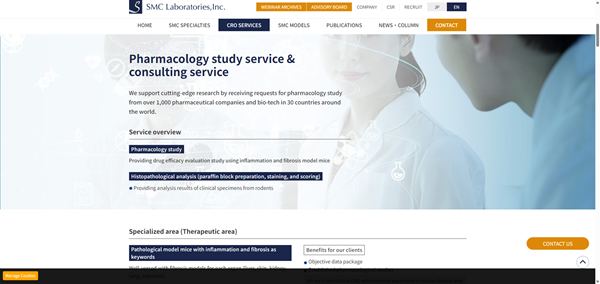
Reference: SMC Laboratories, Inc. official website (https://www.smccro-lab.com/)
SMC Laboratories, Inc.
SMC Laboratories is a specialized non-clinical CRO focused on in vivo pharmacology and efficacy studies using disease-relevant animal models, particularly in fibrosis, inflammation, metabolic diseases, and oncology.
Areas of Expertise
Disease-Relevant Model Portfolio
SMC Laboratories offers models covering the liver, lung, kidney, intestine, and oncology. Its portfolio includes the proprietary STAM™ model for MASH, fibrosis, and hepatocellular carcinoma.
Study Design Based on Target Biology
Study plans are developed around the target biology, mechanism of action, disease stage, and development objective. Pharmacological endpoints can be combined with histopathology, biomarkers, and disease-specific readouts.
Support from Target Validation to Proof of Concept
With experience from more than 1,000 studies for clients in 30 countries, SMC Laboratories supports programs from target validation and candidate selection through in vivo proof-of-concept studies.
Safety StudiesComprehensive Safety Assessment for Preclinical Development
Reference: Charles River Laboratories official website (https://www.criver.com/)
Charles River Laboratories
Charles River provides non-clinical toxicology and safety assessment services for programs ranging from exploratory safety studies to IND-enabling development.
Areas of Expertise
General Toxicology Across Study Designs
Services include single- and repeat-dose toxicology, dose-range finding, and general toxicology studies across multiple species and administration routes.
Non-GLP and GLP Study Support
Charles River supports both non-GLP and GLP studies, allowing sponsors to progress from early safety characterization to studies intended for regulatory submissions.
Integrated IND-Enabling Safety Assessment
Toxicology studies can be integrated with toxicokinetics, clinical pathology, histopathology, and safety pharmacology to support interpretation and IND-enabling safety packages.
Pharmacokinetic (PK/PD) StudiesConnecting Drug Exposure with Pharmacological Response
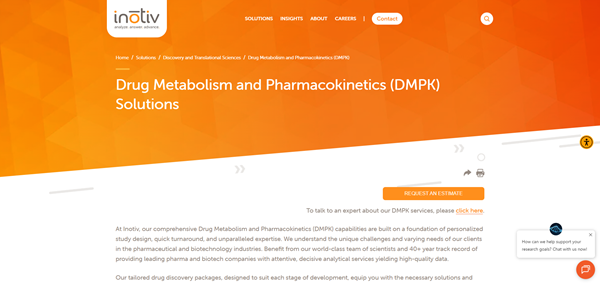
Reference: Inotiv official website (https://www.inotiv.com/)
Inotiv
Inotiv provides integrated PK/PD, DMPK, and bioanalytical services to characterize drug exposure and its relationship with pharmacological response.
Areas of Expertise
Pharmacokinetic Characterization
PK studies characterize exposure, half-life, clearance, and other pharmacokinetic parameters needed to understand how a candidate behaves in the selected model.
Exposure–Response Evaluation
Pharmacokinetic data can be combined with pharmacodynamic endpoints and bioanalysis to evaluate the relationship between drug exposure and pharmacological response.
Integrated DMPK and Development Support
Integrated DMPK, pharmacology, and safety information supports candidate comparison, dose selection, dosing-frequency optimization, and decisions about subsequent preclinical development.

 Japanese