Nonclinical Efficacy Testing » Non-Clinical CROs and Agencies » Reprocell (Biopta)

Reprocell (Biopta)

Reprocell (Biopta) isA global CRO with strengths in non-clinical evaluation using fresh human tissuesIt is. In addition to contract testing for efficacy, safety, ADME, etc., we also support ex vivo evaluation using patient-derived tissues.

Features of Reprocell's (Biopta) non-clinical contract testing services

Evaluate candidate compounds using fresh human tissue

The major feature of Reprocell (Biopta) isTest systems utilizing fresh human tissues, including those of patient originIt enables ex vivo evaluation of drug efficacy and safety across a wide range of tissues, including IBD, skin diseases, respiratory, and cardiovascular systems. Because human responses, which are difficult to capture with animal models alone, can be confirmed from the early stages of drug discovery, it can be utilized for Go/No-Go decisions on candidate compounds and decisions on transitioning to clinical trials. We also have a track record of being involved in the evaluation of over 1,000 new drug candidates since 2002.

Human tissue testing compliant with GLP

The company offersCRO GLP-certified for testing using fresh human tissueIt also supports evaluations based on ICH S7A in safety pharmacology, which can be conducted as GLP studies when necessary. In addition, comparative studies across animal species are available, making it possible to examine to what extent data obtained in animals can be replicated in humans. Because human tissue is handled, an organizational framework for tissue procurement is in place, including ethical review and informed consent.

Efficacy and ADME evaluation utilizing human tissue

In ADME/DMPK,Evaluation of permeability and metabolism in human gastrointestinal tissue using the Ussing chamberIt supports applications such as these. A key feature is the ability to evaluate while maintaining the enzymes and transporters inherent to human tissue, which are difficult to reproduce in conventional cell lines or animal tissues. Furthermore, it supports drug efficacy evaluation using patient-derived tissues, iPSC-derived models, and 3D tissue models. It also accommodates GLP studies intended for submission to regulatory authorities.

Source: Reprocell official website
https://www.reprocell.com

An example of a disease model owned by Reprocell (Biopta)

At Reprocell (Biopta),inflammatory bowel diseases (IBD) such as ulcerative colitis and Crohn's diseaseWe offer human tissue models targeting . Using patient-derived intestinal tissue, we can evaluate the effects of candidate compounds on inflammatory responses and intestinal permeability. We also offer human tissue assays targeting diseases such as psoriasis, atopic dermatitis, COPD, and asthma.

Source: Reprocell official website
https://www.reprocell.com

Non-clinical study cases of Reprocell (Biopta)

Evaluate the safety of nNOS inhibitors in human resistance vessels

At Reprocell (Biopta),Vascular safety of selective nNOS inhibitorsThis has been investigated using fresh human subcutaneous resistance vessels. The presence or absence of human-specific vasoconstrictive risks and side effects, which are difficult to predict in animal models, is directly verified using human tissue. It is utilized as a method to reduce cardiovascular safety risks during the preclinical stage before proceeding to clinical trials.

Source: Reprocell official website Demonstrating Functional Vascular Safety of a Selective nNOS Inhibitor in Human Resistance Arteries
https://www.reprocell.com/demonstrating-functional-vascular-safety-of-a-selective-nnos-inhibitor-in-human-resistance-arteries

Corporate Information of Reprocell (Biopta)

Source: Reprocell official website
https://www.reprocell.com
Address9F MetLife Shin-Yokohama Building, 3-8-11 Shin-Yokohama, Kohoku-ku, Yokohama-shi, Kanagawa-ken
Tel+81 (45)-475-3887
Websitehttps://www.reprocell.com/

3 Recommended Contract Research Organizations
for Non-Clinical Studies
— by Target goal and Expertise

In non-clinical development, the choice of contract research organization shapes the quality of the data and the time it takes to reach the next decision. Below, three CROs are introduced by the type of study they support: pharmacology (efficacy) studies, safety studies, and pharmacokinetic (PK/PD) studies. Each summary describes the services the company offers so that you can match a provider to your target and development objective.

Pharmacology (Efficacy) StudiesDisease-Relevant Models for
Translational Drug Evaluation
SMC Laboratories, Inc.
Reference: SMC Laboratories, Inc. official website (https://www.smccro-lab.com/)

SMC Laboratories, Inc.

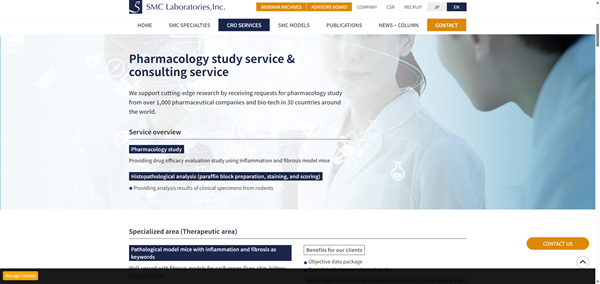
SMC Laboratories is a specialized non-clinical CRO focused on in vivo pharmacology and efficacy studies using disease-relevant animal models, particularly in fibrosis, inflammation, metabolic diseases, and oncology.

Areas of Expertise
Disease-Relevant Model Portfolio

SMC Laboratories offers models covering the liver, lung, kidney, intestine, and oncology. Its portfolio includes the proprietary STAM™ model for MASH, fibrosis, and hepatocellular carcinoma.

Study Design Based on Target Biology

Study plans are developed around the target biology, mechanism of action, disease stage, and development objective. Pharmacological endpoints can be combined with histopathology, biomarkers, and disease-specific readouts.

Support from Target Validation to Proof of Concept

With experience from more than 1,000 studies for clients in 30 countries, SMC Laboratories supports programs from target validation and candidate selection through in vivo proof-of-concept studies.

Safety StudiesComprehensive Safety Assessment for
Preclinical Development
Charles River Laboratories
Reference: Charles River Laboratories official website (https://www.criver.com/)

Charles River Laboratories

Charles River provides non-clinical toxicology and safety assessment services for programs ranging from exploratory safety studies to IND-enabling development.

Areas of Expertise
General Toxicology Across Study Designs

Services include single- and repeat-dose toxicology, dose-range finding, and general toxicology studies across multiple species and administration routes.

Non-GLP and GLP Study Support

Charles River supports both non-GLP and GLP studies, allowing sponsors to progress from early safety characterization to studies intended for regulatory submissions.

Integrated IND-Enabling Safety Assessment

Toxicology studies can be integrated with toxicokinetics, clinical pathology, histopathology, and safety pharmacology to support interpretation and IND-enabling safety packages.

Pharmacokinetic (PK/PD) StudiesConnecting Drug Exposure with
Pharmacological Response
Inotiv
Reference: Inotiv official website (https://www.inotiv.com/)

Inotiv

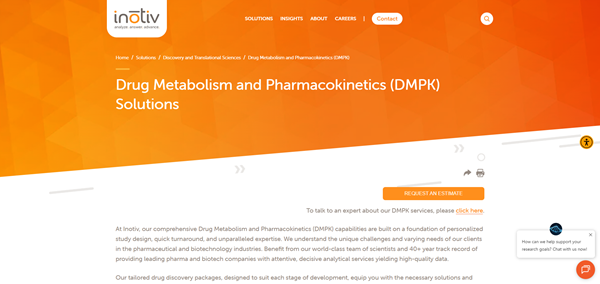
Inotiv provides integrated PK/PD, DMPK, and bioanalytical services to characterize drug exposure and its relationship with pharmacological response.

Areas of Expertise
Pharmacokinetic Characterization

PK studies characterize exposure, half-life, clearance, and other pharmacokinetic parameters needed to understand how a candidate behaves in the selected model.

Exposure–Response Evaluation

Pharmacokinetic data can be combined with pharmacodynamic endpoints and bioanalysis to evaluate the relationship between drug exposure and pharmacological response.

Integrated DMPK and Development Support

Integrated DMPK, pharmacology, and safety information supports candidate comparison, dose selection, dosing-frequency optimization, and decisions about subsequent preclinical development.

By Therapeutic Area
Disease Animal Models
and Reviews
Proven Capability, Expertise and Track Record
Top 3 Non-Clinical CRO Services