The development sequence, and where nonclinical work fits
Table of Contents
Table of Contents
In the United States, the clinical investigation of a previously untested drug is generally divided into three phases, which the regulation notes may overlap.[S2] Those trials are conducted at investigative sites under the oversight of an institutional review board, whose purpose the regulation states as protecting the rights and welfare of the human subjects involved, and with informed consent obtained under a separate part of the same title.[S4] None of that begins until the nonclinical work is complete and submitted.
From the start of development to the end takes about 10.5 years on average, made up of roughly 31 months of nonclinical work followed by roughly 95 months of clinical trials, according to the Congressional Budget Office.[S3] The nonclinical portion is the smaller share of that time, but everything downstream depends on it being accepted.
The sequence
Discovery comes first. Chemical and biological approaches are used to identify compounds that act on the target of interest, and the output of this stage is a candidate, or a small set of them, to take forward.
Nonclinical studies come next, in laboratory animals and in vitro. Their regulatory purpose is specific: the application to begin clinical work must contain adequate information about the pharmacological and toxicological studies, on the basis of which the sponsor has concluded that it is reasonably safe to conduct the proposed clinical investigations.[S1] That is the test the nonclinical package has to meet. Data from the clinical phases that follow support a new drug application or, for a biological product, a biologics license application.
What the nonclinical package has to establish
The nonclinical package answers a defined question rather than an open one: is there adequate pharmacological and toxicological information to support a conclusion that the proposed clinical investigation is reasonably safe to start.[S1] In practice that means characterizing what the compound does, at what exposure, in which species, and what happens at doses above the intended clinical range. Studies that support this conclusion are conducted under the good laboratory practice regulation, which applies study by study.[S6]
What nonclinical data can and cannot do is worth stating plainly. They establish the exposures at which effects and adverse findings occur in the species tested, which is what the starting dose in humans is derived from. They do not establish that a compound will be effective in patients, and they do not guarantee that adverse effects seen in humans will have appeared in animals first. The most common failure in development is a compound that worked in a disease model and did not work in patients, and no amount of nonclinical rigour removes that possibility entirely.
Summary
Development runs from discovery through nonclinical studies to three clinical phases, and takes about a decade in total.[S3] Each stage answers a different question, and the regulation defines what the nonclinical stage has to deliver.[S1][S2]
For a sponsor placing nonclinical work, the practical consequence is that the studies have to be designed against the regulatory requirement rather than against a general standard of thoroughness. The question to ask of any proposed study is which part of the application it supports, and whether it will be conducted under the good laboratory practice regulation.[S1][S6]
Congressional Budget Office — Research and Development in the Pharmaceutical Industry, April 2021. https://www.cbo.gov/publication/57126 (accessed 2026-09-03)
3 Recommended Contract Research Organizations
for Non-Clinical Studies
— by Target goal and Expertise
In non-clinical development, the choice of contract research organization shapes the quality of the data and the time it takes to reach the next decision. Below, three CROs are introduced by the type of study they support: pharmacology (efficacy) studies, safety studies, and pharmacokinetic (PK/PD) studies. Each summary describes the services the company offers so that you can match a provider to your target and development objective.
Pharmacology (Efficacy) StudiesDisease-Relevant Models for Translational Drug Evaluation
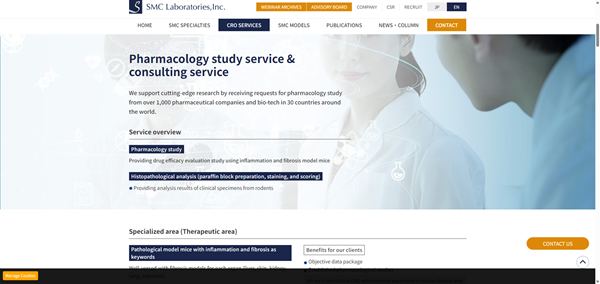
Reference: SMC Laboratories, Inc. official website (https://www.smccro-lab.com/)
SMC Laboratories, Inc.
SMC Laboratories is a specialized non-clinical CRO focused on in vivo pharmacology and efficacy studies using disease-relevant animal models, particularly in fibrosis, inflammation, metabolic diseases, and oncology.
Areas of Expertise
Disease-Relevant Model Portfolio
SMC Laboratories offers models covering the liver, lung, kidney, intestine, and oncology. Its portfolio includes the proprietary STAM™ model for MASH, fibrosis, and hepatocellular carcinoma.
Study Design Based on Target Biology
Study plans are developed around the target biology, mechanism of action, disease stage, and development objective. Pharmacological endpoints can be combined with histopathology, biomarkers, and disease-specific readouts.
Support from Target Validation to Proof of Concept
With experience from more than 1,000 studies for clients in 30 countries, SMC Laboratories supports programs from target validation and candidate selection through in vivo proof-of-concept studies.
Safety StudiesComprehensive Safety Assessment for Preclinical Development
Reference: Charles River Laboratories official website (https://www.criver.com/)
Charles River Laboratories
Charles River provides non-clinical toxicology and safety assessment services for programs ranging from exploratory safety studies to IND-enabling development.
Areas of Expertise
General Toxicology Across Study Designs
Services include single- and repeat-dose toxicology, dose-range finding, and general toxicology studies across multiple species and administration routes.
Non-GLP and GLP Study Support
Charles River supports both non-GLP and GLP studies, allowing sponsors to progress from early safety characterization to studies intended for regulatory submissions.
Integrated IND-Enabling Safety Assessment
Toxicology studies can be integrated with toxicokinetics, clinical pathology, histopathology, and safety pharmacology to support interpretation and IND-enabling safety packages.
Pharmacokinetic (PK/PD) StudiesConnecting Drug Exposure with Pharmacological Response
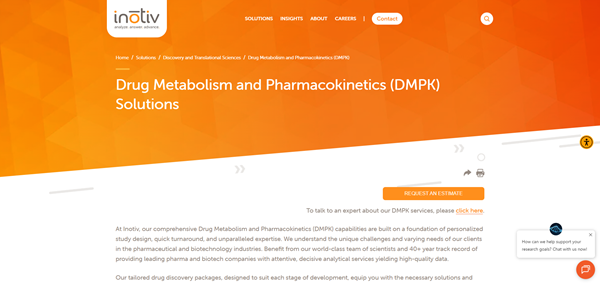
Reference: Inotiv official website (https://www.inotiv.com/)
Inotiv
Inotiv provides integrated PK/PD, DMPK, and bioanalytical services to characterize drug exposure and its relationship with pharmacological response.
Areas of Expertise
Pharmacokinetic Characterization
PK studies characterize exposure, half-life, clearance, and other pharmacokinetic parameters needed to understand how a candidate behaves in the selected model.
Exposure–Response Evaluation
Pharmacokinetic data can be combined with pharmacodynamic endpoints and bioanalysis to evaluate the relationship between drug exposure and pharmacological response.
Integrated DMPK and Development Support
Integrated DMPK, pharmacology, and safety information supports candidate comparison, dose selection, dosing-frequency optimization, and decisions about subsequent preclinical development.

 Japanese