A site where you can find recommended contractors for non-clinical testing|effical " Essential Information Before Requesting a Nonclinical Study " Types of Non-clinical Studies

Types of Non-clinical Studies

Table of Contents
Table of Contents

Nonclinical studies play a critical role in new drug development. These studies are conducted to assess a drug’s efficacy, safety, and behavior in the body, and to evaluate its potential before advancing to clinical trials. Below are typical types of nonclinical studies.

Pharmacology (Efficacy) Studies

Pharmacology (efficacy) studies evaluate how a drug acts against a specific disease. In particular, they examine the extent to which the intended therapeutic effect is achieved and, where applicable, the mechanism of action. Animal and cell-based models are used to determine whether the expected effect is observed. The results provide essential evidence of efficacy and form the foundational data to proceed to clinical studies.

Toxicology Studies

Safety (toxicology) studies evaluate the degree to which a drug is safe for human use. These studies identify potential adverse effects and toxicities and generate data to inform appropriate dosing. Using animal studies and other models, both short-term and long-term effects are examined. This work helps minimize risk in humans and helps ensure that clinical trials can proceed on a sound safety basis.

Pharmacokinetic Studies(PK)

Pharmacokinetic studies assess how a drug is absorbed, distributed, metabolized, and excreted (ADME) in the body. The objective is to clarify how the drug moves through the body and what changes occur along the way. PK results are important for dose selection and dosing regimen decisions and provide core data that can help predict a drug’s safety and efficacy.

References:Pharmaceuticals and Medical Devices Agency (PMDA).https://www.pmda.go.jp/

Other Studies: Toxicity and Carcinogenicity

In addition to pharmacodynamic, safety, and pharmacokinetic studies, various other tests are essential to assure the safety of new drugs and chemicals before they are used in humans. Below you will find information on toxicity and carcinogenicity testing.

Toxicity Studies

Toxicity studies evaluate the degree of toxicity a drug may exert. They determine whether the drug has harmful effects on specific organs or tissues. Typical designs include acute, subacute, and chronic toxicity studies, which assess effects after single or repeated/long-term dosing. Results establish the drug’s safety profile and support clinical trial design.

Reference:Japan Food Research Laboratories (JFRL). https://www.jfrl.or.jp/service/safetytrial (accessed Nov. 11, 2025).

Carcinogenicity Studies

Carcinogenicity studies evaluate whether long-term use of a drug could increase the risk of cancer. These studies are typically conducted in animal models to determine whether prolonged exposure promotes tumor development in specific organs or tissues. The results provide important data for risk assessment and risk management in defined patient populations.

References:Pharmaceuticals and Medical Devices Agency (PMDA).https://www.pmda.go.jp/
References:Japan Association for Pharmaceutical Legislation (JAPAL). https://www.japal.org/dom/notice/2023033115.html

Summary

Nonclinical studies are an essential stage in new drug development, used to evaluate efficacy, safety, pharmacokinetics, toxicity, and carcinogenicity. Their results support benefit–risk assessment before clinical entry and provide foundational data to establish appropriate dosing and therapeutic approaches. Accurate and rigorous execution of these studies is critical to development success.


3 Recommended Contract Research Organizations for Non-Clinical Studies
— by Target goal and Expertise

In drug discovery, the quality and efficiency of non-clinical studies have a direct impact on clinical success rates, development costs, and overall length of time required in R&D. In recent years, there has been more demand for clinically relevant data, globally accepted reliability, and accurate early-stage screening. Thus, it is more important than ever to select the right CRO (Contract Research Organization) for strategic approach.
In this article, we highlight three CROs with proven technical capabilities, expertise, and long standing track records. These are our TOP 3 choices based on their capabilities and the specific target goals of the researchers for their non-clinical studies.

Pharmacology (Efficacy) Studies
Replicate unknown pathological models and
Discovery to clinically oriented drug evaluation
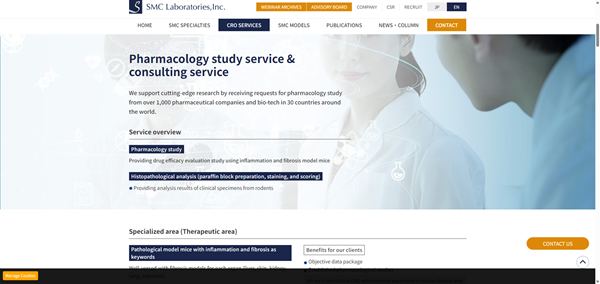
SMC Laboratories, Inc.
Reference: SMC Laboratories, Inc. official website (https://www.smccro-lab.com/jp/)
  • SMC Laboratories, Inc. has established a disease models using patented mouse technologies. The company has established proprietary pathological models—particularly in liver disease and fibrosis—and continues to expand their approach across a wide range of models in cancer, inflammation, and metabolic diseases.
  • From exploratory research to clinically oriented efficacy evaluation, SMC offers customized study designs, dosing strategies, and evaluation analysis tailored to each project. Their collaborative approachallows researchers to discuss and refine study plans together with SMC’s expert scientists.

  • With flexible small-scale study options and strong technical support, SMC Laboratories, Inc. is an ideal partner for start-ups, biotech ventures, and academic institutions alike.
Safety Studies
Comprehensive Safety Evaluation for FIH Applications
Labcorp Holdings Inc.
(Labcorp Drug Development)
Labcorp Holdings Inc.
Reference: Labcorp Holdings Inc. official website (https://jp.labcorp.com/)
  • Labcorp Holdings Inc. provides a fully integrated GLP testing system aligned with international regulatory standards, including FDA, EMA, and PMDA requirements. All studies are conducted under ICH-compliant quality assurance, making it ready for data submission.
  • The company has extensive expertise in long-term toxicity studies such as Segment I–III reproductive and carcinogenicity studies, as well as 2-year chronic toxicity assessments.
  • Labcorp Holdings Inc.’s comprehensive approach enables sponsors to efficiently outsource the entire preclinical package from toxicology, toxicokinetic (TK), and safety pharmacology study design to execution. This accelerates a path to First-in-Human (FIH) trials. For most of the global drug developers, this all-in-one service structure minimizes cost, risk, and expedite the time before advancing to clinical phase.
Pharmacokinetic (PK/PD) Studies
High-Precision Bioanalysis for Clinically Predictive PK/PD Evaluation
PhoenixBio Co., Ltd.
Source: PhoenixBio Co., Ltd. Official Website (https://phoenixbio.co.jp/)
  • PhoenixBio Co., Ltd.offers pharmacokinetic and hepatic metabolism studies using their proprietary PXB-mouse®, a humanized-liver chimeric mouse model. This platform enables the acquisition of data with high clinical correlation in ADME, drug–to-drug interaction studies, bridging the gap between preclinical and clinical stages.
  • With advanced LC-MS/MS-based bioanalysis, PhoenixBio Co., Ltd. provides aseamless workflow from plasma concentration measurement and metabolite identification to quantitative validation.

  • The company offersan integrated evaluation analysiscovering pharmacokinetics, hepatotoxicity, and safety with flexibility to accommodate complex modalities such as oligonucleotide and middle-molecule therapeutics. For compounds where hepatic metabolism is a development bottleneck—or where quantitative, reproducible exposure data are critical—PhoenixBio Co., Ltd. delivers unmatched analytical precision and consistency.

By region
list of animal models
Expertise & Track Record
3 Recommended Contract Non-Clinical Testing Services