A compound that binds its target but is not absorbed, does not reach the tissue where the target sits, or is cleared before it can act will not become a drug. Nonclinical work on absorption, distribution, metabolism and excretion characterizes those properties. In the United States a specific part of it is expected rather than optional: the drug interaction guidance names the enzymes and transporters a sponsor should routinely evaluate, and this article covers those alongside the general framework.[S1]
The four processes
Absorption, distribution, metabolism and excretion are conventionally grouped under the abbreviation ADME. Each is described below, with the regulatory expectations that attach to it.
Absorption
Absorption is movement from the site of administration into the systemic circulation. What is measured is how much reaches the circulation and how quickly. In vitro, permeability across a cell monolayer is used as an early indicator, and the drug interaction guidance names Caco-2 cells among the systems used for transporter and permeability work.[S1] In vivo, the plasma concentration time course after dosing gives the same answer directly. For an orally administered compound this is usually the first place a programme fails, which is why it is characterized before more expensive work begins.
Distribution
Distribution is movement from the circulation into tissues. Two questions are asked of it: whether enough compound reaches the tissue containing the target, and whether it accumulates anywhere it should not. Plasma protein binding is measured alongside, because only the unbound fraction is available to distribute and to act. Tissue distribution studies, often using a radiolabelled compound, answer the second question across the whole body rather than in selected organs.
Metabolism
Metabolism converts the compound into other substances, mostly through enzymes in the liver, generally into forms more readily excreted. Two separate questions arise. Which enzymes metabolize this compound, which determines what happens when a patient takes something that inhibits or induces those enzymes. And does this compound inhibit or induce enzymes itself, which determines its effect on other drugs the patient takes. The guidance treats both, and what it asks for is set out in the next section.[S1]
What the guidance says to evaluate
The in vitro drug interaction guidance is specific about which enzymes to look at. It states that the sponsor should routinely evaluate CYP1A2, CYP2B6, CYP2C8, CYP2C9, CYP2C19, CYP2D6 and CYP3A using in vitro phenotyping experiments.[S1] It also addresses transporters, noting that several of them interact with drugs in clinical use.[S1] The systems it names for this work are subcellular liver fractions including reconstituted microsomes and the supernatant after centrifugation of liver homogenate, human liver tissue including freshly prepared and cryopreserved hepatocytes that preserve enzyme architecture, and for transporter and permeability work, Caco-2 cells, membrane vesicles, knock-out or knock-down cells and transfected cell lines.[S1] A companion guidance covers the clinical studies that follow from these results and what reaches the label.[S2] An internationally harmonized guideline on the same subject was finalized in August 2024, and a programme starting now should check which of the two the laboratory is designing against.[S3]
Excretion
Excretion removes the compound and its metabolites from the body, principally through the kidney into urine and the liver into bile. What is established is the route and the rate. The route matters for the patient population: a compound cleared mainly renally behaves differently in a patient with impaired kidney function, and that determines what the label has to say. The rate contributes to the dosing interval.
The parameters these studies produce
Four parameters carry most of the interpretation. They describe the compound behaviour in the species tested; the human values are estimated from them and confirmed in the clinical work, not established by it.
Bioavailability
The fraction of the administered dose reaching systemic circulation unchanged. For an oral compound this is the headline measure of absorption.
Volume of distribution
The ratio of total drug in the body to plasma concentration. A large value indicates the compound leaves the circulation and distributes into tissue.
Clearance
The volume of blood cleared of drug per unit time. It combines metabolic and excretory elimination into one figure.
Half-life
The time for plasma concentration to halve. It is the main input to the dosing interval, though not the only one.
What to establish with the laboratory
This work is normally placed outside, because it needs instrumentation and assay development that are not worth building for one programme. Three things are worth settling before award.
Which validation level the assay will meet
The question that matters is not whether the laboratory has the instrument but what validation level the assay will meet, because that is what determines whether the data can be used later. Bioanalytical method validation requirements differ according to the purpose the data will serve, and a method adequate for a discovery screen is not necessarily adequate for a study supporting a submission.[S5] Establish which studies need a fully validated method and which do not, before the assay is developed rather than after. No claim is made here about time or cost savings from outsourcing; that depends on the programme.
Which guidance the design follows
For work intended to support a United States submission, ask which guidance each study is designed against: the in vitro drug interaction guidance for the enzyme and transporter panel,[S1] the clinical companion for what follows from it,[S2] and the harmonized guideline finalized in 2024 where that is the chosen basis.[S3] Ask separately which studies will be conducted under the good laboratory practice regulation, since much exploratory ADME work is not and does not need to be.[S4] Advisory input on design and species selection is worth having, and is worth distinguishing in the contract from the analytical work itself.
Summary
Nonclinical ADME work establishes how a compound behaves in the species tested and produces the parameters that later exposure calculations rest on. The part that is specified rather than discretionary is the enzyme and transporter evaluation, where the guidance names what to look at.[S1] That specificity is useful when reviewing a proposal: the panel either covers the listed enzymes or it does not, and that is checkable before the work begins.
References
FDA — In Vitro Drug Interaction Studies: Cytochrome P450 Enzyme- and Transporter-Mediated Drug Interactions, Guidance for Industry, January 2020 (Final). https://www.fda.gov/media/134582/download (accessed 2026-09-03)
FDA — Clinical Drug Interaction Studies: Cytochrome P450 Enzyme- and Transporter-Mediated Drug Interactions, Guidance for Industry, January 2020 (Final). https://www.fda.gov/media/134581/download (accessed 2026-09-03)
3 Recommended Contract Research Organizations
for Non-Clinical Studies
— by Target goal and Expertise
In non-clinical development, the choice of contract research organization shapes the quality of the data and the time it takes to reach the next decision. Below, three CROs are introduced by the type of study they support: pharmacology (efficacy) studies, safety studies, and pharmacokinetic (PK/PD) studies. Each summary describes the services the company offers so that you can match a provider to your target and development objective.
Pharmacology (Efficacy) StudiesDisease-Relevant Models for Translational Drug Evaluation
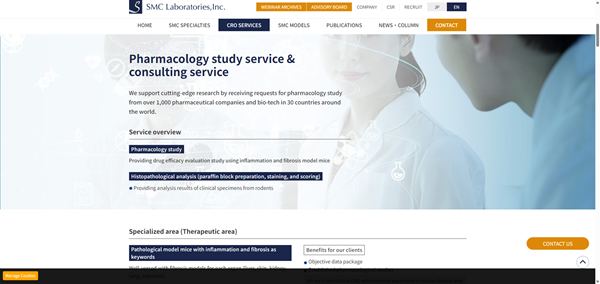
Reference: SMC Laboratories, Inc. official website (https://www.smccro-lab.com/)
SMC Laboratories, Inc.
SMC Laboratories is a specialized non-clinical CRO focused on in vivo pharmacology and efficacy studies using disease-relevant animal models, particularly in fibrosis, inflammation, metabolic diseases, and oncology.
Areas of Expertise
Disease-Relevant Model Portfolio
SMC Laboratories offers models covering the liver, lung, kidney, intestine, and oncology. Its portfolio includes the proprietary STAM™ model for MASH, fibrosis, and hepatocellular carcinoma.
Study Design Based on Target Biology
Study plans are developed around the target biology, mechanism of action, disease stage, and development objective. Pharmacological endpoints can be combined with histopathology, biomarkers, and disease-specific readouts.
Support from Target Validation to Proof of Concept
With experience from more than 1,000 studies for clients in 30 countries, SMC Laboratories supports programs from target validation and candidate selection through in vivo proof-of-concept studies.
Safety StudiesComprehensive Safety Assessment for Preclinical Development
Reference: Charles River Laboratories official website (https://www.criver.com/)
Charles River Laboratories
Charles River provides non-clinical toxicology and safety assessment services for programs ranging from exploratory safety studies to IND-enabling development.
Areas of Expertise
General Toxicology Across Study Designs
Services include single- and repeat-dose toxicology, dose-range finding, and general toxicology studies across multiple species and administration routes.
Non-GLP and GLP Study Support
Charles River supports both non-GLP and GLP studies, allowing sponsors to progress from early safety characterization to studies intended for regulatory submissions.
Integrated IND-Enabling Safety Assessment
Toxicology studies can be integrated with toxicokinetics, clinical pathology, histopathology, and safety pharmacology to support interpretation and IND-enabling safety packages.
Pharmacokinetic (PK/PD) StudiesConnecting Drug Exposure with Pharmacological Response
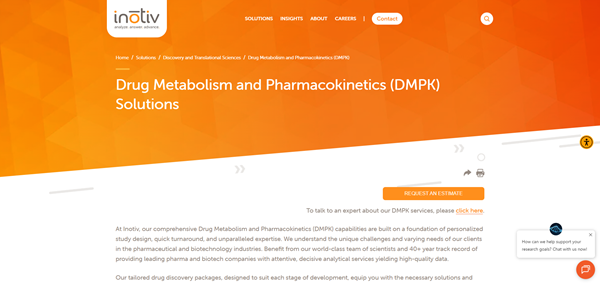
Reference: Inotiv official website (https://www.inotiv.com/)
Inotiv
Inotiv provides integrated PK/PD, DMPK, and bioanalytical services to characterize drug exposure and its relationship with pharmacological response.
Areas of Expertise
Pharmacokinetic Characterization
PK studies characterize exposure, half-life, clearance, and other pharmacokinetic parameters needed to understand how a candidate behaves in the selected model.
Exposure–Response Evaluation
Pharmacokinetic data can be combined with pharmacodynamic endpoints and bioanalysis to evaluate the relationship between drug exposure and pharmacological response.
Integrated DMPK and Development Support
Integrated DMPK, pharmacology, and safety information supports candidate comparison, dose selection, dosing-frequency optimization, and decisions about subsequent preclinical development.

 Japanese