This article covers macrocycles built from amino-acid units. Many occupy chemical space beyond the Rule of Five, where permeability and oral exposure cannot be inferred reliably from the screens used for conventional small molecules.[S4][S5][S6] The nonclinical package should connect conformation, permeability, peptidase stability, renal handling, tissue exposure, target engagement, and anti-drug antibody (ADA) assessment. The companion macrocyclic-drug article covers non-peptide and small-molecule-like macrocycles, with greater emphasis on CYP enzymes, transporters, and drug-drug interactions.
US regulatory examples
Cyclosporine
DailyMed identifies Sandimmune (cyclosporine), NDA 050573, with a US marketing start date of November 14, 1983, and includes oral capsule and liquid dosage forms.[S1] It is useful here as a regulatory example showing that an orally administered cyclic peptide exists, not as evidence that a new cyclic peptide will be orally absorbed. Each candidate still needs its own permeability, stability, and exposure data.
Pasireotide
Pasireotide (Signifor) received initial US approval in 2012.[S2] The supplied research did not verify the receptor-affinity profile or comparative duration statements in the Japanese source, so they are not repeated. For study design, the relevant lesson is to measure the candidate's receptor panel and functional activity directly under the conditions proposed for the program.
Pegcetacoplan
FDA approved Empaveli (pegcetacoplan) on May 14, 2021, for paroxysmal nocturnal hemoglobinuria.[S3] The supplied approval source does not support comparative claims about potency, renal clearance, or duration, so this article records only the approval fact. A conjugated candidate should be tested as the actual conjugate, with assays able to distinguish intact drug, released components where relevant, and target-tissue exposure.
Peptide-specific development questions
Permeability, peptide stability, and clearance
Oral peptide development has pharmacokinetic boundaries that make route selection an early decision, not an assumption to postpone until toxicology.[S5] For a cyclic candidate, test solubility and permeability alongside stability in the proposed biological matrices, then identify whether loss of parent reflects ring opening, peptide-bond cleavage, another metabolic route, or clearance of intact material. The requested bioanalytical method should quantify intact drug separately from relevant products. Unsupported molecular-weight cutoffs and fixed clearance rules are not used here.
Conformation can separate affinity from cellular activity
Permeability prediction for macrocycles has to account for conformational behavior; a strong result in a cell-free binding assay does not show that enough compound reaches an intracellular target.[S6] Commission a sequence of assays that separates target affinity, permeability, nonspecific binding, live-cell target engagement, and downstream function. Where related proteins are plausible off-targets, define a counter-screen panel before candidate selection. Each assay answers one part of the mechanism and should not substitute for the others.
Immunogenicity and organ findings need separate plans
If a candidate contains non-natural amino acids, D-amino acids, or a non-peptide linker, the sponsor should not assume that improved stability makes the construct immunologically or toxicologically routine. Define an ADA strategy that addresses screening, confirmation, titer, and the effect of ADA on exposure and pharmacology. Evaluate liver and kidney findings with measured tissue exposure and compound-specific follow-up. ADA, organ accumulation, and transporter effects are distinct hypotheses and should not be collapsed into one safety endpoint.
A peptide-focused nonclinical package
1. Connect conformation, permeability, and stability
Do not rank compounds from one permeability assay alone. Macrocycle permeability models increasingly combine structural descriptors and conformational information because translation from a single in vitro result to in vivo PK is difficult.[S6] Use orthogonal permeability measurements, characterize conformation in relevant environments, and pair those results with solubility and matrix-specific stability. Use mass spectrometry to identify intact parent and major cleavage products. The goal is an explainable compound-ranking dataset, not a claim that one assay predicts absorption.
2. Demonstrate intracellular engagement separately from affinity
Choose a live-cell target-engagement method appropriate to the target and pair it with a functional pathway readout. Measure extracellular and intracellular concentration at the same timepoints so that failure of engagement can be separated from failure of downstream biology. A PK/PD model may integrate those nonclinical measurements, but it does not establish a clinically effective dose.
3. Resolve intact drug, metabolites, and tissue localization
Start with a quantitative tissue-distribution question: which tissue, which analyte, which timepoint, and what lower limit of quantification is needed for the decision. Add imaging only when cellular or regional localization matters and the method can distinguish parent from relevant products. Align distribution with target engagement and pathology. A tissue signal without chemical identity or spatial resolution may not show that active compound reached the intended cell.
4. Stage immunogenicity and organ-safety work
Write an immunogenicity assessment plan before repeat-dose studies so that samples, timing, and interference controls are adequate for screening, confirmation, titer, and neutralizing follow-up where relevant. Use in vitro assays only for the question they have been qualified to answer. Investigate liver or kidney findings with exposure, clinical pathology, histopathology, and recovery data. Early assays identify hazards and mechanisms in their test systems; they do not ensure clinical safety.
What to confirm with a contract laboratory
Confirm that the laboratory can measure intact cyclic peptide and relevant products in the proposed matrices, connect conformation with orthogonal permeability data, distinguish peptidase loss from clearance, measure live-cell target engagement, and operate an ADA assay with documented drug tolerance. Ask how samples and results will move between DMPK, bioanalysis, pharmacology, and toxicology teams. Select against the candidate's defined questions; breadth of services alone does not establish fitness or guarantee success.
Oral delivery of peptides and proteins: pharmacokinetic boundaries, negative selection, and route triage. https://europepmc.org/article/MED/41939723 (accessed 2026-09-03)
Predictive machine learning models for rational permeability design in de novo macrocycle engineering: a review. https://europepmc.org/article/MED/42015308 (accessed 2026-09-03)
3 Recommended Contract Research Organizations
for Non-Clinical Studies
— by Target goal and Expertise
In non-clinical development, the choice of contract research organization shapes the quality of the data and the time it takes to reach the next decision. Below, three CROs are introduced by the type of study they support: pharmacology (efficacy) studies, safety studies, and pharmacokinetic (PK/PD) studies. Each summary describes the services the company offers so that you can match a provider to your target and development objective.
Pharmacology (Efficacy) StudiesDisease-Relevant Models for Translational Drug Evaluation
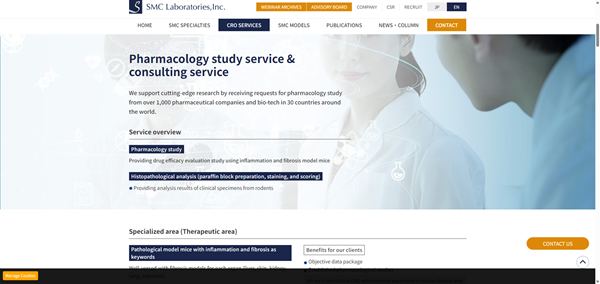
Reference: SMC Laboratories, Inc. official website (https://www.smccro-lab.com/)
SMC Laboratories, Inc.
SMC Laboratories is a specialized non-clinical CRO focused on in vivo pharmacology and efficacy studies using disease-relevant animal models, particularly in fibrosis, inflammation, metabolic diseases, and oncology.
Areas of Expertise
Disease-Relevant Model Portfolio
SMC Laboratories offers models covering the liver, lung, kidney, intestine, and oncology. Its portfolio includes the proprietary STAM™ model for MASH, fibrosis, and hepatocellular carcinoma.
Study Design Based on Target Biology
Study plans are developed around the target biology, mechanism of action, disease stage, and development objective. Pharmacological endpoints can be combined with histopathology, biomarkers, and disease-specific readouts.
Support from Target Validation to Proof of Concept
With experience from more than 1,000 studies for clients in 30 countries, SMC Laboratories supports programs from target validation and candidate selection through in vivo proof-of-concept studies.
Safety StudiesComprehensive Safety Assessment for Preclinical Development
Reference: Charles River Laboratories official website (https://www.criver.com/)
Charles River Laboratories
Charles River provides non-clinical toxicology and safety assessment services for programs ranging from exploratory safety studies to IND-enabling development.
Areas of Expertise
General Toxicology Across Study Designs
Services include single- and repeat-dose toxicology, dose-range finding, and general toxicology studies across multiple species and administration routes.
Non-GLP and GLP Study Support
Charles River supports both non-GLP and GLP studies, allowing sponsors to progress from early safety characterization to studies intended for regulatory submissions.
Integrated IND-Enabling Safety Assessment
Toxicology studies can be integrated with toxicokinetics, clinical pathology, histopathology, and safety pharmacology to support interpretation and IND-enabling safety packages.
Pharmacokinetic (PK/PD) StudiesConnecting Drug Exposure with Pharmacological Response
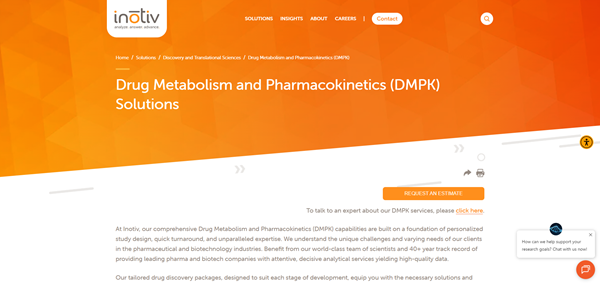
Reference: Inotiv official website (https://www.inotiv.com/)
Inotiv
Inotiv provides integrated PK/PD, DMPK, and bioanalytical services to characterize drug exposure and its relationship with pharmacological response.
Areas of Expertise
Pharmacokinetic Characterization
PK studies characterize exposure, half-life, clearance, and other pharmacokinetic parameters needed to understand how a candidate behaves in the selected model.
Exposure–Response Evaluation
Pharmacokinetic data can be combined with pharmacodynamic endpoints and bioanalysis to evaluate the relationship between drug exposure and pharmacological response.
Integrated DMPK and Development Support
Integrated DMPK, pharmacology, and safety information supports candidate comparison, dose selection, dosing-frequency optimization, and decisions about subsequent preclinical development.

 Japanese