Certis Oncology Solutions, Inc. is an oncology company in the Sorrento Valley district of San Diego, California, founded in 2016.[S1][S2] Its work is built on one model type: orthotopic patient-derived xenografts, in which a piece of a patient tumor is surgically placed at the anatomically correct site in an immunocompromised mouse rather than under the skin.[S3] The company pairs that with humanized versions for immunotherapy work, a searchable database of its own models, and a laboratory that holds both animal-welfare accreditation and a clinical laboratory certificate.[S4][S5][S7][S8] This profile summarizes what could be confirmed from the company published material, and is explicit about what could not.
Services relevant to US drug developers
Orthotopic patient-derived xenograft studies
The company describes efficacy testing in orthotopic patient-derived xenograft models, abbreviated O-PDX, which the company abbreviates as O-PDX. A small tissue specimen from a patient tumor is engrafted surgically into the anatomically correct place in immunocompromised mice, producing what the company calls avatars of that patient cancer.[S3] The orthotopic placement is the point of difference from a subcutaneous xenograft: the tumor grows in the tissue environment it came from, which is the argument for using it when the site of growth is expected to matter. Whether that difference changes the answer for a given compound is a question for the study design, and this profile does not evaluate the claim.
Humanized models for immuno-oncology
For immunotherapy programs, the company describes humanized orthotopic patient-derived xenograft models, abbreviated huO-PDX, as relevant to solid tumor immunotherapies and to mechanisms directed at the tumor microenvironment.[S4] Support for evaluating cell therapies directed at solid tumors is described alongside this work.[S4] Sponsors should confirm which human immune components are reconstituted in a given model and how they are sourced, since that determines what an immunotherapy readout in such a model can and cannot show.
Model library and database
Certis maintains a bank of patient-derived xenograft models and cancer cell lines with molecular characterization data, published through an online database it launched in October 2022 under the name BarneyOI.[S5] The size of the collection is stated differently at different dates. An announcement in November 2023 cites a library of more than 450 characterized tumor models,[S4] while the database announcement a year earlier describes hundreds of models and cell lines.[S5] Both figures are given here with their dates; no current authoritative count was found in the sources reviewed. Sponsors selecting a model should ask for the passage number, the consent status and the molecular annotation of the specific model rather than relying on a library total.
Predictive analytics
The company markets a machine learning platform, CertisAI, which it describes as generating drug response predictions from gene expression signatures for model selection and as informing both preclinical model selection and clinical trial enrollment criteria.[S4][S9] In February 2025 it announced that the United States Patent and Trademark Office had allowed a patent application covering the platform, with protection stated to run to March 2043.[S9] This profile did not verify the current status of the application in the patent register, and the grant status was not checked against patent office records for this profile, so the platform is described here as the subject of an allowed application rather than as patented. The company own announcements also give different launch dates for the platform, so no launch date is stated here.
Quality, compliance, and animal welfare (as stated by the company)
Certis states that it was awarded AAALAC International accreditation in June 2022 and that it obtained an Animal Welfare Assurance with the Office of Laboratory Animal Welfare in February 2022, giving the assurance number D22-01133.[S7][S8] The page carrying that number labels it an insurance identifier, which appears to be a typographical error, and it is reproduced here as written.[S8] AAALAC International accreditation is a voluntary evaluation of an institution's animal care and use program, re-evaluated every three years,[R3] and USDA registration and an OLAW Animal Welfare Assurance relate to the Animal Welfare Act and the PHS Policy respectively;[R4][R5] none of these establishes GLP compliance, which applies to individual studies.[R2] FDA does not approve or certify laboratories; registration with FDA does not denote approval.[R6] No GLP statement, USDA registration statement, or reference to an Institutional Animal Care and Use Committee was found in the sources reviewed for this profile.[S1][S2] Given that the main service pages could not be read, sponsors requiring a GLP study should ask the company directly rather than treating the absence as an answer.[R2]
Separately from animal work, the laboratory holds a certificate under the Clinical Laboratory Improvement Amendments, which the company states it has held since 2018 and recertified in November 2024 following an inspection with no deficiencies.[S2][S7] That certificate governs testing of human specimens for clinical purposes and applies to laboratory testing of human specimens for health assessment or diagnosis. It is a different regime from the Good Laboratory Practice regulations that apply to nonclinical safety studies,[R2] and one does not substitute for the other. For a sponsor, the practical relevance of the clinical certificate is that human specimens can be handled in the same laboratory as the animal models.
FDA — "Is It Really FDA Approved?" (FDA does not approve health care providers, including laboratories; registration does not denote approval); FDA Compliance Program 7348.808 (GLP inspections of nonclinical laboratories). https://www.fda.gov/consumers/consumer-updates/it-really-fda-approved (accessed 2026-09-03)
3 Recommended Contract Research Organizations
for Non-Clinical Studies
— by Target goal and Expertise
In non-clinical development, the choice of contract research organization shapes the quality of the data and the time it takes to reach the next decision. Below, three CROs are introduced by the type of study they support: pharmacology (efficacy) studies, safety studies, and pharmacokinetic (PK/PD) studies. Each summary describes the services the company offers so that you can match a provider to your target and development objective.
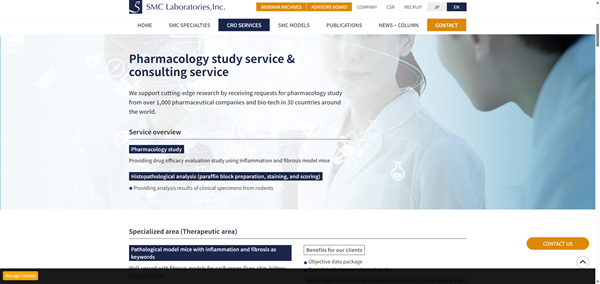
Pharmacology (Efficacy) StudiesDisease-Relevant Models for Translational Drug Evaluation
Reference: SMC Laboratories, Inc. official website (https://www.smccro-lab.com/)
SMC Laboratories, Inc.
SMC Laboratories is a specialized non-clinical CRO focused on in vivo pharmacology and efficacy studies using disease-relevant animal models, particularly in fibrosis, inflammation, metabolic diseases, and oncology.
Areas of Expertise
Disease-Relevant Model Portfolio
SMC Laboratories offers models covering the liver, lung, kidney, intestine, and oncology. Its portfolio includes the proprietary STAM™ model for MASH, fibrosis, and hepatocellular carcinoma.
Study Design Based on Target Biology
Study plans are developed around the target biology, mechanism of action, disease stage, and development objective. Pharmacological endpoints can be combined with histopathology, biomarkers, and disease-specific readouts.
Support from Target Validation to Proof of Concept
With experience from more than 1,000 studies for clients in 30 countries, SMC Laboratories supports programs from target validation and candidate selection through in vivo proof-of-concept studies.
Safety StudiesComprehensive Safety Assessment for Preclinical Development
Reference: Charles River Laboratories official website (https://www.criver.com/)
Charles River Laboratories
Charles River provides non-clinical toxicology and safety assessment services for programs ranging from exploratory safety studies to IND-enabling development.
Areas of Expertise
General Toxicology Across Study Designs
Services include single- and repeat-dose toxicology, dose-range finding, and general toxicology studies across multiple species and administration routes.
Non-GLP and GLP Study Support
Charles River supports both non-GLP and GLP studies, allowing sponsors to progress from early safety characterization to studies intended for regulatory submissions.
Integrated IND-Enabling Safety Assessment
Toxicology studies can be integrated with toxicokinetics, clinical pathology, histopathology, and safety pharmacology to support interpretation and IND-enabling safety packages.
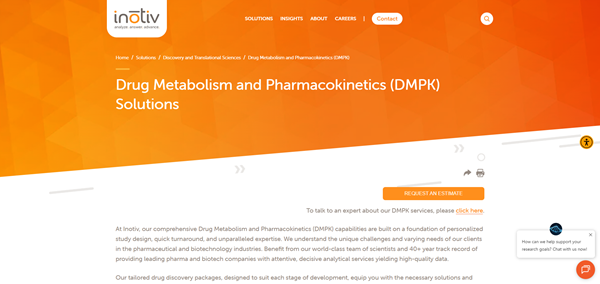
Pharmacokinetic (PK/PD) StudiesConnecting Drug Exposure with Pharmacological Response
Reference: Inotiv official website (https://www.inotiv.com/)
Inotiv
Inotiv provides integrated PK/PD, DMPK, and bioanalytical services to characterize drug exposure and its relationship with pharmacological response.
Areas of Expertise
Pharmacokinetic Characterization
PK studies characterize exposure, half-life, clearance, and other pharmacokinetic parameters needed to understand how a candidate behaves in the selected model.
Exposure–Response Evaluation
Pharmacokinetic data can be combined with pharmacodynamic endpoints and bioanalysis to evaluate the relationship between drug exposure and pharmacological response.
Integrated DMPK and Development Support
Integrated DMPK, pharmacology, and safety information supports candidate comparison, dose selection, dosing-frequency optimization, and decisions about subsequent preclinical development.

 Japanese