Lovelace Biomedical is a not-for-profit nonclinical contract research organization (CRO) in Albuquerque, New Mexico. The company describes itself as "a not-for-profit preclinical contract research organization"[S1] and states its mission as advancing "Biomedical Science through Nonclinical and Clinical Research Focused on Toxicology, Drug Development, and Characterization of Disease."[S1] Its history page traces the organization to a clinic and nonprofit medical foundation established in Albuquerque in 1947 by Dr. William Randolph "Randy" Lovelace II, originally known as the Lovelace Foundation for Medical Education and Research; the same page lists "Lovelace Respiratory Research Institute 2000-2015" as a past name.[S2]
This profile summarizes the services, facilities, stated compliance information, and company facts that are most relevant to US sponsors evaluating Lovelace Biomedical as a nonclinical partner.
Nonclinical services relevant to US drug developers
Service lines and specialty areas
The company lists seven specialty areas: respiratory, infectious disease, gene therapy, neuroscience, alternative tobacco and cannabis products, medical countermeasures, and animal health.[S14] Its service lines include toxicology, described as "performing large- and small-animal toxicology studies ranging from non-GLP investigational toxicology to GLP regulatory toxicology";[S5] pharmacology, where the company states that its "scientists are experts in more than 100 animal models of disease";[S6] pharmacokinetics and toxicokinetics covering "the absorption, distribution, metabolism, and excretion of drug entities delivered by all exposure routes";[S7] bioanalytical and analytical chemistry with in-house method development;[S8] formulation for "parenteral, oral, dermal and inhaled dosing";[S9] and colony maintenance for short- or long-term housing of small and large animals.[S10]
On GLP, the facilities page states that the company is "fully compliant with the FDA's Good Laboratory Practice regulations (21 CFR Part 58)."[S3] The company names FDA 21 CFR Part 58 in its GLP statement.[S3] GLP compliance is determined study by study under the applicable regulation, so sponsors should confirm in the protocol which regulation their study will follow and that the final report will carry the study director's compliance statement and the quality assurance unit's statement.[R2] The company also offers non-GLP investigational toxicology and dose-range-finding work alongside GLP regulatory toxicology,[S5] so sponsors should establish at the protocol stage which studies in a program are intended to be GLP.
IND-enabling programs
The company describes IND-enabling safety programs and, for gene therapy, states that it "consults on experimental design and content of pivotal, pre-IND packages and provides final reports for submission."[S13] An IND is not "approved" by FDA: under 21 CFR 312.40 it goes into effect 30 days after FDA receives it unless FDA imposes a clinical hold.[R1] A CRO may conduct and report nonclinical studies that a sponsor includes in an IND, but it cannot guarantee that FDA will allow the clinical investigation to proceed.
The Albuquerque campus
Operations are centralized on a company-owned site within a US Air Force base in Albuquerque.[S3] The website states more than 100 acres of land, 300,000 square feet of laboratory space, more than 90 animal rooms, and more than 10,000 square feet of ABSL-3 enhanced laboratory space with six multi-species animal rooms;[S1] a separate services page describes a "250,000-square-foot vivarium" for short- or long-term housing.[S10] The two square-footage figures are quoted as published and may cover different areas. On-site laboratories are listed for histopathology, clinical pathology, analytical chemistry, microbiology, virology, and molecular biology.[S3] Species listed for toxicology work are canine, non-human primate, rat, mouse, ferret, swine, hamster, guinea pig, and rabbit.[S5]
Disease models and specialty programs
Infectious disease
The company lists ABSL-1, 2, 3, and 3+ facilities and states that "the high-containment laboratories are described as "fully GLP compliant", without the applicable regulation being named on that page with remote telemetry capabilities."[S12] It describes six multi-species animal rooms "capable of housing rodents, rabbits, ferrets and non-human primates"[S12] and lists viral and bacterial neutralization and clearance assays among its assays.[S12] Pathogens named on the page include SARS-CoV-1 and SARS-CoV-2, Zika, anthrax, and Cryptococcus and other fungal models.[S12] The species combinations and physiological measurements used in any specific program should be confirmed with the company, because the website does not describe them study by study.
Respiratory and inhalation
The respiratory page lists "research expertise and pharmacology models in asthma, COPD, cancer, fibrosis, infectious disease and inflammation"[S11] and a "inhalation bioassays in GLP and non-GLP formats, without the applicable GLP regulation being named on that page."[S11] Stated capabilities include nose-only, whole-body, and head-only exposures; inhalation formulation for dry powder, nebulizer, and metered dose inhalers; and exposure systems for rodent, swine, canine, and non-human primate species.[S11] Acute respiratory distress syndrome (ARDS) is not named on the page reviewed; sponsors needing that model should confirm availability with the company.
Gene therapy
The company states that "in 2007 our Gene Therapy pharmacology/toxicology Center was established by the NIH along with pioneers at the University of Pennsylvania"[S13] and that "gene therapy studies are described as run under "GLP standards", without the applicable regulation or the study types being identified on that page in species ranging from rodents to nonhuman primates."[S13] Listed endpoints are efficacy, general toxicity, vector biodistribution by qPCR, gene expression, and immunogenicity, and listed species are non-human primate, canine, swine, rabbit, ferret, guinea pig, rat, and mouse.[S13] The page does not state that rare disease models are generated in-house; model development and propagation are listed as separate services.[S13]
Quality, compliance, and animal welfare (as stated by the company)
Accreditation and registration. The company states that it "has been accredited with the Association for Assessment and Accreditation of Laboratory Animal Care (AAALAC) since 1970,"[S4] that it "is registered with the United States Department of Agriculture as a Class R research facility, upholding compliance to the Animal Welfare Act,"[S4] and that the NIH Office of Laboratory Animal Welfare "issued the renewal of our Animal Welfare Assurance, demonstrating our continued compliance with Public Health Service Policy."[S4] AAALAC International accreditation is a voluntary evaluation of an institution's animal care and use program, re-evaluated every three years,[R3] and USDA registration and an OLAW Animal Welfare Assurance relate to the Animal Welfare Act and the PHS Policy respectively;[R4][R5] none of these establishes GLP compliance, which applies to individual studies.[R2] FDA does not approve or certify laboratories; registration with FDA does not denote approval.[R6]
Animal welfare program. The company describes "dedicated behavioral management staff" that "works with subject matter experts in the field to share best practices in enrichment."[S4] No statement naming an Institutional Animal Care and Use Committee (IACUC) or using the 3Rs terminology was found on the pages reviewed; an Institutional Biosafety Committee is named separately.[S4] This profile does not evaluate the company's animal care program; the statements above are the company's own.
Company facts
Organization
Lovelace Biomedical; originally the Lovelace Foundation for Medical Education and Research, and Lovelace Respiratory Research Institute from 2000 to 2015[S2]
Headquarters
2425 Ridgecrest Dr. SE, Albuquerque, NM 87108-5127, United States[S15]
Founded
1947, by Dr. William Randolph "Randy" Lovelace II[S2]
Ownership
Not-for-profit research institute (company statement)[S1]
Campus
Company-owned site within a US Air Force base in Albuquerque; more than 100 acres, 300,000 sq ft of laboratory space, more than 90 animal rooms[S1][S3]
High containment
ABSL-1, 2, 3, and 3+ facilities; more than 10,000 sq ft of ABSL-3 enhanced laboratory space with six multi-species animal rooms[S1][S12]
FDA — "Is It Really FDA Approved?" (FDA does not approve health care providers, including laboratories; registration does not denote approval); FDA Compliance Program 7348.808 (GLP inspections of nonclinical laboratories). https://www.fda.gov/consumers/consumer-updates/it-really-fda-approved (accessed 2026-09-03)
3 Recommended Contract Research Organizations
for Non-Clinical Studies
— by Target goal and Expertise
In non-clinical development, the choice of contract research organization shapes the quality of the data and the time it takes to reach the next decision. Below, three CROs are introduced by the type of study they support: pharmacology (efficacy) studies, safety studies, and pharmacokinetic (PK/PD) studies. Each summary describes the services the company offers so that you can match a provider to your target and development objective.
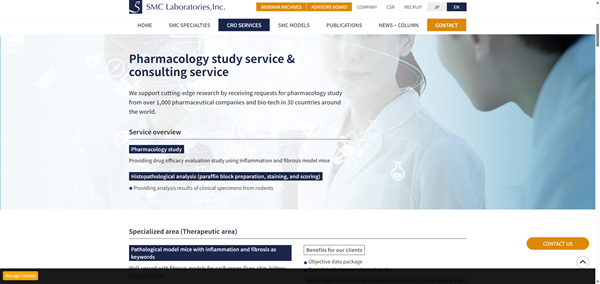
Pharmacology (Efficacy) StudiesDisease-Relevant Models for Translational Drug Evaluation
Reference: SMC Laboratories, Inc. official website (https://www.smccro-lab.com/)
SMC Laboratories, Inc.
SMC Laboratories is a specialized non-clinical CRO focused on in vivo pharmacology and efficacy studies using disease-relevant animal models, particularly in fibrosis, inflammation, metabolic diseases, and oncology.
Areas of Expertise
Disease-Relevant Model Portfolio
SMC Laboratories offers models covering the liver, lung, kidney, intestine, and oncology. Its portfolio includes the proprietary STAM™ model for MASH, fibrosis, and hepatocellular carcinoma.
Study Design Based on Target Biology
Study plans are developed around the target biology, mechanism of action, disease stage, and development objective. Pharmacological endpoints can be combined with histopathology, biomarkers, and disease-specific readouts.
Support from Target Validation to Proof of Concept
With experience from more than 1,000 studies for clients in 30 countries, SMC Laboratories supports programs from target validation and candidate selection through in vivo proof-of-concept studies.
Safety StudiesComprehensive Safety Assessment for Preclinical Development
Reference: Charles River Laboratories official website (https://www.criver.com/)
Charles River Laboratories
Charles River provides non-clinical toxicology and safety assessment services for programs ranging from exploratory safety studies to IND-enabling development.
Areas of Expertise
General Toxicology Across Study Designs
Services include single- and repeat-dose toxicology, dose-range finding, and general toxicology studies across multiple species and administration routes.
Non-GLP and GLP Study Support
Charles River supports both non-GLP and GLP studies, allowing sponsors to progress from early safety characterization to studies intended for regulatory submissions.
Integrated IND-Enabling Safety Assessment
Toxicology studies can be integrated with toxicokinetics, clinical pathology, histopathology, and safety pharmacology to support interpretation and IND-enabling safety packages.
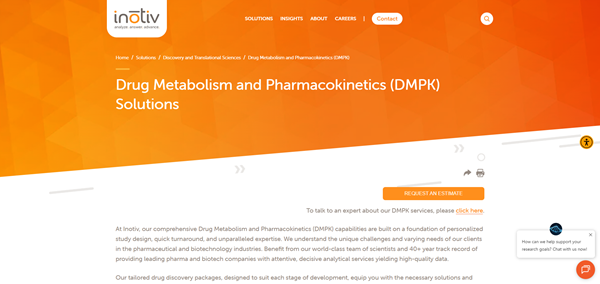
Pharmacokinetic (PK/PD) StudiesConnecting Drug Exposure with Pharmacological Response
Reference: Inotiv official website (https://www.inotiv.com/)
Inotiv
Inotiv provides integrated PK/PD, DMPK, and bioanalytical services to characterize drug exposure and its relationship with pharmacological response.
Areas of Expertise
Pharmacokinetic Characterization
PK studies characterize exposure, half-life, clearance, and other pharmacokinetic parameters needed to understand how a candidate behaves in the selected model.
Exposure–Response Evaluation
Pharmacokinetic data can be combined with pharmacodynamic endpoints and bioanalysis to evaluate the relationship between drug exposure and pharmacological response.
Integrated DMPK and Development Support
Integrated DMPK, pharmacology, and safety information supports candidate comparison, dose selection, dosing-frequency optimization, and decisions about subsequent preclinical development.

 Japanese