Melior Discovery, Inc. is an in vivo pharmacology contract research organization in Exton, Pennsylvania.[S2] The company offers multiplexed phenotypic screening in which one compound is evaluated across an array of animal models: running one compound through a large array of disease models at once to look for activity that was not predicted. This profile summarizes the platforms, models, stated compliance information, and company facts most relevant to US sponsors.
Nonclinical services relevant to US drug developers
Phenotypic screening platforms
The company's platform theraTRACE, which it describes as its proprietary phenotypic screening platform, is, described as "Melior's proprietary phenotypic screening platform" for identifying "new therapeutic applications for your candidate with our customizable multiplexed array of animal models."[S3] It states that "by evaluating compounds through approximately 40 different animal models representing 14 broad therapeutic areas, Melior is able to uncover efficacy that is otherwise unpredicted and expected by other means."[S3] Two derivative platforms are offered. OpioidTRACE is described as "our in vivo pharmacology platform specifically tailored for the field of analgesic therapy research aimed at finding analgesic alternatives to opioid or opioids with reduced liability," covering acute and chronic analgesia, pain pathways, respiratory depression, gastric motility and abuse liability.[S4] Immuno-theraTRACE is an oncology platform that "enables you to screen your immune-modulating agents for their therapeutic potential across a range of tumor types," in a high-throughput mode for several compounds in smaller groups or a lead candidate mode for multiple doses of one compound.[S4] Activity found in a rodent model is a starting point for further work, not evidence of efficacy in patients.
Model catalog
Model counts differ across the company's pages and appear to describe different subsets. The homepage cites "more than 150 validated animal models (rat and mouse)" across 14 therapeutic areas;[S1] the model catalog says "these include more than eighty validated animal models (both rat in vivo models and mouse in vivo models) across fourteen therapeutic areas";[S5] and the theraTRACE page refers to the roughly 40 models in the default screening panel.[S3] The FAQ reconciles these in part, stating that "in addition to the 80 models featured on this website, Melior has validated dozens of additional models."[S6] Named models on the catalog page include db/db and ob/ob mouse models of type II diabetes and a streptozotocin-induced type I model; 6-OHDA lesion in rat, haloperidol-induced catalepsy, L-DOPA-induced dyskinesia and MPTP-induced mouse models for Parkinson's disease; cuprizone and EAE models of multiple sclerosis; collagen-induced arthritis, acute nephritis, acute pancreatitis and LPS-induced systemic and pulmonary inflammation; the 6-Hz psychomotor seizure, maximal electroshock, pentylenetetrazole and lithium-pilocarpine status epilepticus seizure models; and pain models including Hargreaves hyperalgesia, hot plate, tail flick, chemotherapy-induced neuropathy, chronic constriction injury and spinal nerve ligation.[S5] Oncology models are grouped as syngeneic, xenograft and orthotopic.[S5]
Supporting services
Alongside the models the catalog lists pharmacokinetics and pharmacodynamics, bioanalysis, receptor occupancy and histology under a general and safety pharmacology grouping.[S5] The company also offers development of customized models, stating that sponsors should contact it "if you want to work with Melior to develop a customized in vivo disease model or replicate something from the literature that is not generally available,"[S5] and offers full-time-equivalent arrangements as an alternative to per-project pricing.[S5]
Quality, compliance, and animal welfare (as stated by the company)
The site makes one explicit regulatory statement: "Melior Discovery is DEA-licensed for Schedule I-V,"[S1] which appears site-wide. On the other topics a sponsor would ask about, the pages reviewed contain no statement. No GLP, USDA registration or OLAW Animal Welfare Assurance statement was found on the pages reviewed and no mention of an Institutional Animal Care and Use Committee or the 3Rs. AAALAC appears only as an unlabelled badge image in the site footer linking to aaalac.org; the dedicated page generated for that image contains no accreditation text,[S10] and no accreditation statement was found on those pages; that is an absence in those pages, not a finding about the status of the company, by what accreditation type, for which site, or as of when. Sponsors who require documented AAALAC accreditation or GLP capability should ask the company directly and, for AAALAC, check the accrediting body's own directory. AAALAC International accreditation is a voluntary evaluation of an institution's animal care and use program, re-evaluated every three years,[R3] and USDA registration and an OLAW Animal Welfare Assurance relate to the Animal Welfare Act and the PHS Policy respectively;[R4][R5] none of these establishes GLP compliance, which applies to individual studies.[R2] FDA does not approve or certify laboratories; registration with FDA does not denote approval.[R6]
One point of care when reading the company's news. The press release page mixes announcements about Melior Discovery, the contract research business, with announcements about Melior Pharmaceuticals, an affiliated drug development company, and Melior Pharmaceuticals II, LLC, which the company announced as a spinout in May 2016.[S9] Regulatory milestones such as IND clearances reported there belong to the affiliate's own pipeline and are not results of the contract research service.
FDA — "Is It Really FDA Approved?" (FDA does not approve health care providers, including laboratories; registration does not denote approval); FDA Compliance Program 7348.808 (GLP inspections of nonclinical laboratories). https://www.fda.gov/consumers/consumer-updates/it-really-fda-approved (accessed 2026-09-03)
3 Recommended Contract Research Organizations
for Non-Clinical Studies
— by Target goal and Expertise
In non-clinical development, the choice of contract research organization shapes the quality of the data and the time it takes to reach the next decision. Below, three CROs are introduced by the type of study they support: pharmacology (efficacy) studies, safety studies, and pharmacokinetic (PK/PD) studies. Each summary describes the services the company offers so that you can match a provider to your target and development objective.
Pharmacology (Efficacy) StudiesDisease-Relevant Models for Translational Drug Evaluation
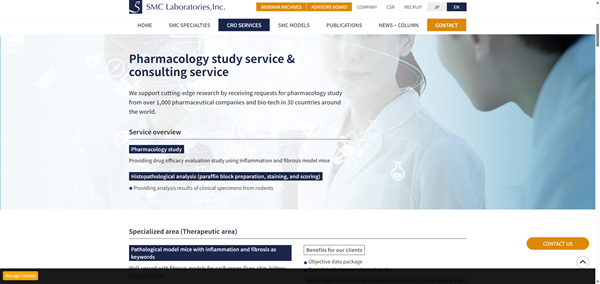
Reference: SMC Laboratories, Inc. official website (https://www.smccro-lab.com/)
SMC Laboratories, Inc.
SMC Laboratories is a specialized non-clinical CRO focused on in vivo pharmacology and efficacy studies using disease-relevant animal models, particularly in fibrosis, inflammation, metabolic diseases, and oncology.
Areas of Expertise
Disease-Relevant Model Portfolio
SMC Laboratories offers models covering the liver, lung, kidney, intestine, and oncology. Its portfolio includes the proprietary STAM™ model for MASH, fibrosis, and hepatocellular carcinoma.
Study Design Based on Target Biology
Study plans are developed around the target biology, mechanism of action, disease stage, and development objective. Pharmacological endpoints can be combined with histopathology, biomarkers, and disease-specific readouts.
Support from Target Validation to Proof of Concept
With experience from more than 1,000 studies for clients in 30 countries, SMC Laboratories supports programs from target validation and candidate selection through in vivo proof-of-concept studies.
Safety StudiesComprehensive Safety Assessment for Preclinical Development
Reference: Charles River Laboratories official website (https://www.criver.com/)
Charles River Laboratories
Charles River provides non-clinical toxicology and safety assessment services for programs ranging from exploratory safety studies to IND-enabling development.
Areas of Expertise
General Toxicology Across Study Designs
Services include single- and repeat-dose toxicology, dose-range finding, and general toxicology studies across multiple species and administration routes.
Non-GLP and GLP Study Support
Charles River supports both non-GLP and GLP studies, allowing sponsors to progress from early safety characterization to studies intended for regulatory submissions.
Integrated IND-Enabling Safety Assessment
Toxicology studies can be integrated with toxicokinetics, clinical pathology, histopathology, and safety pharmacology to support interpretation and IND-enabling safety packages.
Pharmacokinetic (PK/PD) StudiesConnecting Drug Exposure with Pharmacological Response
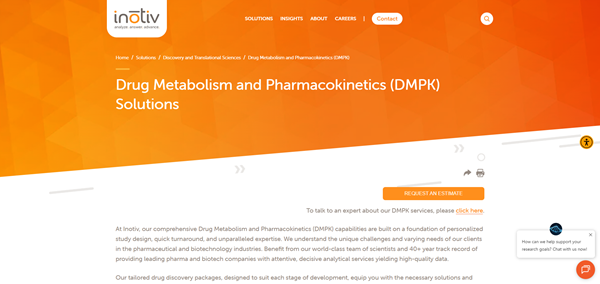
Reference: Inotiv official website (https://www.inotiv.com/)
Inotiv
Inotiv provides integrated PK/PD, DMPK, and bioanalytical services to characterize drug exposure and its relationship with pharmacological response.
Areas of Expertise
Pharmacokinetic Characterization
PK studies characterize exposure, half-life, clearance, and other pharmacokinetic parameters needed to understand how a candidate behaves in the selected model.
Exposure–Response Evaluation
Pharmacokinetic data can be combined with pharmacodynamic endpoints and bioanalysis to evaluate the relationship between drug exposure and pharmacological response.
Integrated DMPK and Development Support
Integrated DMPK, pharmacology, and safety information supports candidate comparison, dose selection, dosing-frequency optimization, and decisions about subsequent preclinical development.

 Japanese