Biomere is a preclinical contract research organization in Worcester, Massachusetts that presents itself as "A JOINN Company."[S1] It was spun out of the University of Massachusetts Medical School in 1996 and acquired in 2019 by JOINN Laboratories, a contract research organization based in China.[S2] One structural point should be settled before anything else: the company states on its own toxicology page that "the following toxicology services are offered by our parent company JOINN Laboratories,"[S3] whose facilities are in China. A US sponsor engaging Biomere for GLP toxicology should therefore establish where the study will actually be run. This profile summarizes the services, sites, stated compliance information, and company facts most relevant to US sponsors.
What runs in the United States
The Worcester site is described as focused on non-GLP work: pharmacology, pharmacokinetic and pharmacodynamic studies and early toxicology.[S4] Sponsors should determine which exploratory studies may be conducted outside the good laboratory practice regulation and which safety studies must fall within it. The second US site is in Richmond, California, operating as JOINN Laboratories CA Inc.[S5] Sponsors should confirm which of the two would run their work, because the compliance statements differ between them.
Where the GLP toxicology runs
The toxicology page states plainly that "the following toxicology services are offered by our parent company JOINN Laboratories,"[S3] listing the parent's facilities in Suzhou, Beijing, Wuzhou, Chongqing and Guangzhou.[S3] The parent states GLP status in several regimes, describing itself as inspected under US FDA GLP and certified or inspected under Chinese, OECD, Japanese and Korean regimes.[S6] The company's website does not name a specific GLP regulation (FDA 21 CFR Part 58, EPA 40 CFR Part 160/792, or OECD GLP) for its facilities.[S6] GLP compliance is determined study by study under the applicable regulation, so sponsors should confirm in the protocol which regulation their study will follow and that the final report will carry the study director's compliance statement and the quality assurance unit's statement.[R2] For a US sponsor there are practical consequences beyond the regulation itself: before contracting, sponsors should document the test facility, the monitoring plan, the sample and data transfer process, the timeline, the applicable GLP regime and inspection responsibilities. None of that makes the arrangement unsuitable; it does mean the arrangement should be understood before contracting rather than discovered later.
Quality, compliance, and animal welfare (as stated by the company)
Compliance statements differ by site. The Worcester, Massachusetts facility is listed with AAALAC accreditation, an OLAW Animal Welfare Assurance, USDA registration and a DEA registration.[S5] The Richmond, California facility is listed with AAALAC, USDA and DEA but without an OLAW statement.[S5] Whether that reflects a real difference or an omission on the page is not explained, and a sponsor whose work is funded by the Public Health Service would need to resolve it. AAALAC International accreditation is a voluntary evaluation of an institution's animal care and use program, re-evaluated every three years,[R3] and USDA registration and an OLAW Animal Welfare Assurance relate to the Animal Welfare Act and the PHS Policy respectively;[R4][R5] none of these establishes GLP compliance, which applies to individual studies.[R2] FDA does not approve or certify laboratories; registration with FDA does not denote approval.[R6] This profile does not evaluate the company's animal care program; the statements above are the company's own.
FDA ? "Is It Really FDA Approved?" (FDA does not approve health care providers, including laboratories; registration does not denote approval); FDA Compliance Program 7348.808 (GLP inspections of nonclinical laboratories). https://www.fda.gov/consumers/consumer-updates/it-really-fda-approved (accessed 2026-09-03)
3 Recommended Contract Research Organizations
for Non-Clinical Studies
— by Target goal and Expertise
In non-clinical development, the choice of contract research organization shapes the quality of the data and the time it takes to reach the next decision. Below, three CROs are introduced by the type of study they support: pharmacology (efficacy) studies, safety studies, and pharmacokinetic (PK/PD) studies. Each summary describes the services the company offers so that you can match a provider to your target and development objective.
Pharmacology (Efficacy) StudiesDisease-Relevant Models for Translational Drug Evaluation
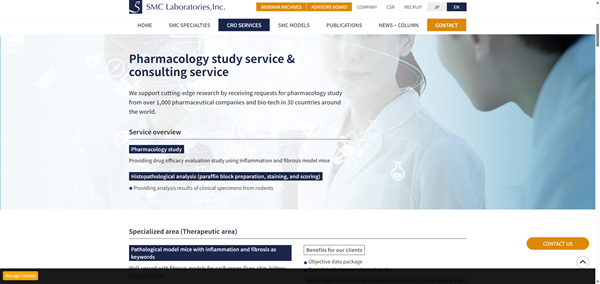
Reference: SMC Laboratories, Inc. official website (https://www.smccro-lab.com/)
SMC Laboratories, Inc.
SMC Laboratories is a specialized non-clinical CRO focused on in vivo pharmacology and efficacy studies using disease-relevant animal models, particularly in fibrosis, inflammation, metabolic diseases, and oncology.
Areas of Expertise
Disease-Relevant Model Portfolio
SMC Laboratories offers models covering the liver, lung, kidney, intestine, and oncology. Its portfolio includes the proprietary STAM™ model for MASH, fibrosis, and hepatocellular carcinoma.
Study Design Based on Target Biology
Study plans are developed around the target biology, mechanism of action, disease stage, and development objective. Pharmacological endpoints can be combined with histopathology, biomarkers, and disease-specific readouts.
Support from Target Validation to Proof of Concept
With experience from more than 1,000 studies for clients in 30 countries, SMC Laboratories supports programs from target validation and candidate selection through in vivo proof-of-concept studies.
Safety StudiesComprehensive Safety Assessment for Preclinical Development
Reference: Charles River Laboratories official website (https://www.criver.com/)
Charles River Laboratories
Charles River provides non-clinical toxicology and safety assessment services for programs ranging from exploratory safety studies to IND-enabling development.
Areas of Expertise
General Toxicology Across Study Designs
Services include single- and repeat-dose toxicology, dose-range finding, and general toxicology studies across multiple species and administration routes.
Non-GLP and GLP Study Support
Charles River supports both non-GLP and GLP studies, allowing sponsors to progress from early safety characterization to studies intended for regulatory submissions.
Integrated IND-Enabling Safety Assessment
Toxicology studies can be integrated with toxicokinetics, clinical pathology, histopathology, and safety pharmacology to support interpretation and IND-enabling safety packages.
Pharmacokinetic (PK/PD) StudiesConnecting Drug Exposure with Pharmacological Response
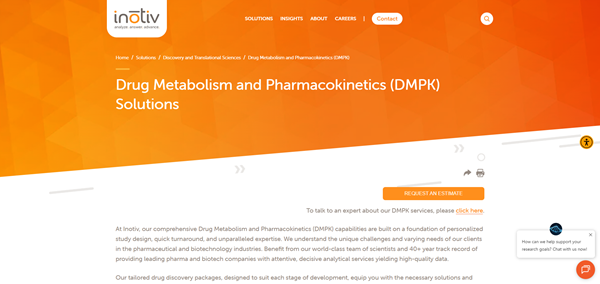
Reference: Inotiv official website (https://www.inotiv.com/)
Inotiv
Inotiv provides integrated PK/PD, DMPK, and bioanalytical services to characterize drug exposure and its relationship with pharmacological response.
Areas of Expertise
Pharmacokinetic Characterization
PK studies characterize exposure, half-life, clearance, and other pharmacokinetic parameters needed to understand how a candidate behaves in the selected model.
Exposure–Response Evaluation
Pharmacokinetic data can be combined with pharmacodynamic endpoints and bioanalysis to evaluate the relationship between drug exposure and pharmacological response.
Integrated DMPK and Development Support
Integrated DMPK, pharmacology, and safety information supports candidate comparison, dose selection, dosing-frequency optimization, and decisions about subsequent preclinical development.

 Japanese