The intracerebroventricular streptozotocin (ICV-STZ) rat model is used to study cognitive and metabolic changes produced after STZ is delivered directly into the cerebral ventricles. This article explains what the model establishes, which endpoints can be commissioned, how reported dosing regimens differ, and where the model does not fit a program.[S1][S3]
What the model establishes
ICV-STZ is an induced model used to examine brain insulin signaling, energy metabolism, oxidative stress, neuroinflammation, cholinergic dysfunction, and cognitive performance without introducing a familial Alzheimer disease mutation.[S3][S4] A treatment effect in this model establishes an effect on those prespecified animal endpoints. It does not establish efficacy in people with sporadic Alzheimer's disease.
A recent review describes reproducible oxidative-stress, inflammatory, cholinergic, and cognitive changes after ICV-STZ, but also notes that the model does not fully reproduce amyloid-beta plaque formation. Its value is therefore mechanism-dependent, and its predictive value for amyloidogenesis-targeted treatments may be restricted.[S3]
Questions the model can address
Study question
What to measure
Central insulin signaling and energy metabolism
Brain insulin-pathway readouts and cerebral energy-metabolism measures after ICV-STZ[S4]
Learning and memory in the induced phenotype
A prespecified behavioral battery with matched motor and activity controls; long-term learning and memory reductions were reported in adult rats[S1]
Neuroinflammation and neuronal injury
Biochemical and histologic markers linked to the behavioral time point[S3]
Amyloid-targeted pharmacology
Use only with an explicit rationale and complementary models because plaque formation is not fully represented[S3]
Choose endpoints from the mechanism being tested. Behavioral change is most interpretable when paired with tissue or biochemical evidence collected at a defined interval after dosing, and when locomotor or motor impairment cannot explain the result.
Endpoint group
Commissioning considerations
Behavior
Select a prespecified learning or memory test matched to the question. Published ICV-STZ work used hole-board and passive-avoidance measures and reported long-term deficits.[S1] Account for activity, vision, stress, and motor performance.
Histology and immunostaining
If GFAP, Iba1, NeuN, or Nissl staining is proposed, predefine regions, sampling, image-analysis rules, and whether scoring is blinded.[S3]
Biochemistry
Pair behavioral findings with measures tied to the proposed insulin-signaling, energy-metabolism, oxidative-stress, inflammatory, or cholinergic mechanism.[S3][S4]
Evidence behind the model
Long-term behavioral and metabolic effects
Lannert and Hoyer administered STZ intracerebroventricularly to adult rats and evaluated learning, memory, and cerebral energy metabolism. Their study links the intervention to long-term reductions in those animal measures.[S1] A later critical review places ICV-STZ findings in the broader hypothesis of disrupted brain insulin-receptor signaling, while treating that hypothesis as a subject for appraisal rather than a settled description of Alzheimer's disease.[S4]
The study reported long-term reductions in learning and memory performance and in cerebral energy metabolism after ICV-STZ.[S1] Those findings support use of the model to study the induced phenotype. They do not show that a compound reversing the phenotype will improve cognition in patients.
Commissioning checklist
Before commissioning the study, specify the administration regimen, behavioral primary endpoint, control for motor or activity effects, tissue collection time, brain regions, blinded analysis, and a mechanism-based justification for using ICV-STZ. Add another model when the program depends on biology that ICV-STZ does not reproduce, especially amyloid-beta plaque formation.[S3]
References
Intracerebroventricular administration of streptozotocin causes long-term diminutions in learning and memory abilities and in cerebral energy metabolism in adult rats. https://doi.org/10.1037//0735-7044.112.5.1199 (accessed 2026-09-03)
Approaching therapy of Alzheimer's disease via the antidiabetic drug liraglutide-a study with streptozotocin intracerebroventricularly treated Wistar rats. https://doi.org/10.1007/s00702-025-02979-z (accessed 2026-09-03)
Intracerebroventricular streptozotocin-induced animal model of Alzheimer's disease: revealing dose optimization, administration regimen, and molecular pathways. https://doi.org/10.1186/s42826-026-00278-6 (accessed 2026-09-03)
3 Recommended Contract Research Organizations
for Non-Clinical Studies
— by Target goal and Expertise
In non-clinical development, the choice of contract research organization shapes the quality of the data and the time it takes to reach the next decision. Below, three CROs are introduced by the type of study they support: pharmacology (efficacy) studies, safety studies, and pharmacokinetic (PK/PD) studies. Each summary describes the services the company offers so that you can match a provider to your target and development objective.
Pharmacology (Efficacy) StudiesDisease-Relevant Models for Translational Drug Evaluation
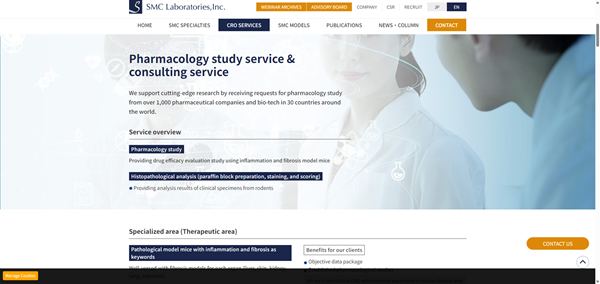
Reference: SMC Laboratories, Inc. official website (https://www.smccro-lab.com/)
SMC Laboratories, Inc.
SMC Laboratories is a specialized non-clinical CRO focused on in vivo pharmacology and efficacy studies using disease-relevant animal models, particularly in fibrosis, inflammation, metabolic diseases, and oncology.
Areas of Expertise
Disease-Relevant Model Portfolio
SMC Laboratories offers models covering the liver, lung, kidney, intestine, and oncology. Its portfolio includes the proprietary STAM™ model for MASH, fibrosis, and hepatocellular carcinoma.
Study Design Based on Target Biology
Study plans are developed around the target biology, mechanism of action, disease stage, and development objective. Pharmacological endpoints can be combined with histopathology, biomarkers, and disease-specific readouts.
Support from Target Validation to Proof of Concept
With experience from more than 1,000 studies for clients in 30 countries, SMC Laboratories supports programs from target validation and candidate selection through in vivo proof-of-concept studies.
Safety StudiesComprehensive Safety Assessment for Preclinical Development
Reference: Charles River Laboratories official website (https://www.criver.com/)
Charles River Laboratories
Charles River provides non-clinical toxicology and safety assessment services for programs ranging from exploratory safety studies to IND-enabling development.
Areas of Expertise
General Toxicology Across Study Designs
Services include single- and repeat-dose toxicology, dose-range finding, and general toxicology studies across multiple species and administration routes.
Non-GLP and GLP Study Support
Charles River supports both non-GLP and GLP studies, allowing sponsors to progress from early safety characterization to studies intended for regulatory submissions.
Integrated IND-Enabling Safety Assessment
Toxicology studies can be integrated with toxicokinetics, clinical pathology, histopathology, and safety pharmacology to support interpretation and IND-enabling safety packages.
Pharmacokinetic (PK/PD) StudiesConnecting Drug Exposure with Pharmacological Response
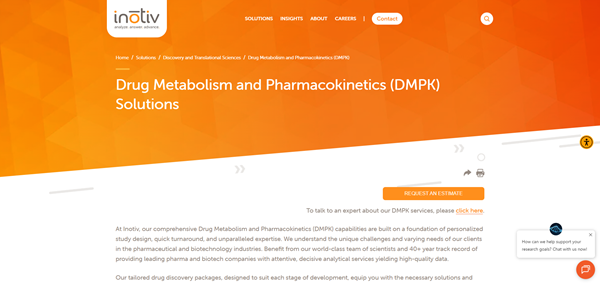
Reference: Inotiv official website (https://www.inotiv.com/)
Inotiv
Inotiv provides integrated PK/PD, DMPK, and bioanalytical services to characterize drug exposure and its relationship with pharmacological response.
Areas of Expertise
Pharmacokinetic Characterization
PK studies characterize exposure, half-life, clearance, and other pharmacokinetic parameters needed to understand how a candidate behaves in the selected model.
Exposure–Response Evaluation
Pharmacokinetic data can be combined with pharmacodynamic endpoints and bioanalysis to evaluate the relationship between drug exposure and pharmacological response.
Integrated DMPK and Development Support
Integrated DMPK, pharmacology, and safety information supports candidate comparison, dose selection, dosing-frequency optimization, and decisions about subsequent preclinical development.

 Japanese