What an ASO program changes in the nonclinical package
An antisense oligonucleotide (ASO) binds a complementary RNA sequence and can act through an RNase H-dependent mechanism or by changing RNA splicing.[S9] For a nonclinical program, the sequence and chemical architecture are part of the test article: they determine which species can provide pharmacology data, where exposure must be measured, and which safety signals need focused follow-up. The package therefore has to connect tissue exposure, RNA modulation, protein or functional change, and toxicity rather than treating an ASO like a conventional small molecule.
US regulatory examples
Spinraza (nusinersen)
FDA approved Spinraza (nusinersen) in 2016 as the first drug for spinal muscular atrophy. The application received fast track designation, priority review, and orphan drug designation. It was not an accelerated approval.[S1] Nusinersen is a splice-modulating ASO, so its pharmacology package must demonstrate the intended splice change before downstream protein or functional endpoints are interpreted.[S9]
Tegsedi (inotersen)
Tegsedi (inotersen), initially approved in the United States in 2018, is an RNase H-dependent ASO directed at TTR mRNA.[S2][S9] Its FDA-approved labeling carries a boxed warning for thrombocytopenia and glomerulonephritis.[S2] Those label facts do not establish a class effect for every ASO, but they identify platelet and renal endpoints that a sponsor should address when the chemistry and exposure pattern make them relevant.
Questions to resolve before definitive studies
Is the intended tissue exposed?
The study plan should define exposure at the site of action, not only in plasma. Measure intact ASO and relevant metabolites in the target tissue, then align those measurements with the sampling time for RNA modulation. If a conjugate or delivery system is used, qualify assays that distinguish total material from pharmacologically available ASO. These data establish whether a negative pharmacology result reflects inadequate exposure or lack of activity in the test system.
Does the assay chain match the mechanism?
Match the primary assay to the mechanism. For an RNase H-dependent ASO, quantify loss of the intended RNA and check sequence-related off-target transcripts. For a splice-modulating ASO, quantify the specified splice product. Protein, pathway biomarkers, and model endpoints come after that molecular measurement. This ordering separates failure to engage RNA from failure of the downstream biology and should be fixed in the protocol before dosing begins.[S9]
How chemistry and species shape the safety plan
Safety assessment should be tied to sequence, backbone, sugar modification, conjugate, dose, route, and tissue exposure. Nonhuman-primate studies have examined severe ASO-associated thrombocytopenia and complement deposition on platelets, while mouse and monkey studies have shown species-specific inflammatory contributions to glomerular lesions.[S10][S11][S12] LNA chemistry is also being investigated in relation to hepatotoxicity.[S13] These findings support compound-specific endpoint selection; they do not predict safety in people. FDA published draft guidance on this subject in 2024, and ICH S13 remained an initiative in development in the supplied research record.[S5][S6]
Building the nonclinical evidence chain
Distribution and toxicokinetics
Request a bioanalytical plan that covers plasma, target tissue, and organs expected to accumulate the ASO. Sampling should support both pharmacokinetics and toxicokinetics, and should be synchronized with RNA and protein measurements. When chemistry changes during lead optimization, distribution cannot simply be assumed to remain constant; the bridge should be demonstrated with comparable assays.
Target engagement and downstream pharmacology
Use a prespecified sequence of readouts: intact ASO in tissue, the intended RNA change, the resulting protein or pathway change, and a model endpoint only where that model answers a defined development question. A downstream change without evidence of the intended RNA event does not establish the proposed mechanism. Conversely, RNA modulation without a downstream change defines a biological gap that dose escalation alone may not solve.
Use complementary systems without treating them as clinical predictors
Choose each system for a specific question. Human-cell systems can test sequence activity against the human transcript; animal studies can connect systemic exposure with tissue distribution and organism-level findings; disease models can test a defined pharmacology hypothesis. Agreement across systems strengthens that hypothesis, but it does not establish efficacy or safety in patients.
The protocol should include endpoints justified by the candidate rather than a generic oligonucleotide checklist. For relevant chemistries, that may include liver and kidney pathology and biomarkers, platelet counts and kinetics, complement measures, cytokines, and sequence-dependent off-target analysis.[S10][S11][S12][S13] Repeat-dose duration and recovery periods should match the expected persistence of tissue exposure. The result is a characterized nonclinical hazard profile, not assurance of clinical safety.
What to confirm with a contract laboratory
Ask the laboratory to show how it will quantify intact ASO and metabolites in matrices from the proposed species, measure the exact RNA event, connect exposure to pharmacology, and investigate chemistry-relevant safety findings. Confirm assay validation status, sample-stability controls, tissue-processing methods, and how data will be integrated across bioanalysis, pathology, and toxicology. Selection should be based on the protocol and deliverables required for this candidate, not on a claim that one provider can ensure development success.
An Industry Perspective on Key Considerations for the ICH S13 Guidance: Nonclinical Safety Evaluations of Oligonucleotide-Based Therapeutics. https://europepmc.org/article/MED/41565351 (accessed 2026-09-03)
Cellular immune changes during severe antisense oligonucleotide-associated thrombocytopenia in a nonhuman primate model. https://europepmc.org/article/MED/40101742 (accessed 2026-09-03)
Complement C3d/C4d Deposition on Platelets Correlates with 2'-O-Methoxyethyl Antisense Oligonucleotide-Induced Thrombocytopenia in Monkeys. https://europepmc.org/article/MED/37093125 (accessed 2026-09-03)
Species-specific inflammatory responses as a primary component for the development of glomerular lesions in mice and monkeys following chronic administration of a second-generation antisense oligonucleotide. https://europepmc.org/article/MED/24292388 (accessed 2026-09-03)
Cycloalkane Incorporation Into the 2',4'-Bridge of Locked Nucleic Acid: Enhancing Nuclease Stability, Reducing Phosphorothioate Modifications, and Lowering Hepatotoxicity in Antisense Oligonucleotides. https://europepmc.org/article/MED/41169576 (accessed 2026-09-03)
3 Recommended Contract Research Organizations
for Non-Clinical Studies
— by Target goal and Expertise
In non-clinical development, the choice of contract research organization shapes the quality of the data and the time it takes to reach the next decision. Below, three CROs are introduced by the type of study they support: pharmacology (efficacy) studies, safety studies, and pharmacokinetic (PK/PD) studies. Each summary describes the services the company offers so that you can match a provider to your target and development objective.
Pharmacology (Efficacy) StudiesDisease-Relevant Models for Translational Drug Evaluation
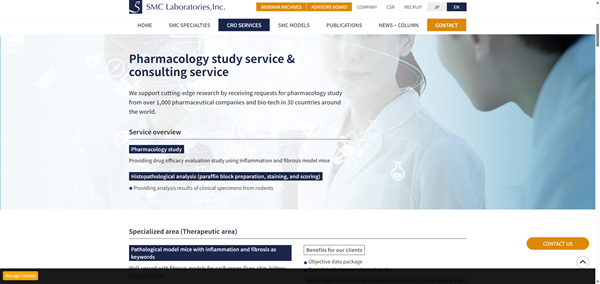
Reference: SMC Laboratories, Inc. official website (https://www.smccro-lab.com/)
SMC Laboratories, Inc.
SMC Laboratories is a specialized non-clinical CRO focused on in vivo pharmacology and efficacy studies using disease-relevant animal models, particularly in fibrosis, inflammation, metabolic diseases, and oncology.
Areas of Expertise
Disease-Relevant Model Portfolio
SMC Laboratories offers models covering the liver, lung, kidney, intestine, and oncology. Its portfolio includes the proprietary STAM™ model for MASH, fibrosis, and hepatocellular carcinoma.
Study Design Based on Target Biology
Study plans are developed around the target biology, mechanism of action, disease stage, and development objective. Pharmacological endpoints can be combined with histopathology, biomarkers, and disease-specific readouts.
Support from Target Validation to Proof of Concept
With experience from more than 1,000 studies for clients in 30 countries, SMC Laboratories supports programs from target validation and candidate selection through in vivo proof-of-concept studies.
Safety StudiesComprehensive Safety Assessment for Preclinical Development
Reference: Charles River Laboratories official website (https://www.criver.com/)
Charles River Laboratories
Charles River provides non-clinical toxicology and safety assessment services for programs ranging from exploratory safety studies to IND-enabling development.
Areas of Expertise
General Toxicology Across Study Designs
Services include single- and repeat-dose toxicology, dose-range finding, and general toxicology studies across multiple species and administration routes.
Non-GLP and GLP Study Support
Charles River supports both non-GLP and GLP studies, allowing sponsors to progress from early safety characterization to studies intended for regulatory submissions.
Integrated IND-Enabling Safety Assessment
Toxicology studies can be integrated with toxicokinetics, clinical pathology, histopathology, and safety pharmacology to support interpretation and IND-enabling safety packages.
Pharmacokinetic (PK/PD) StudiesConnecting Drug Exposure with Pharmacological Response
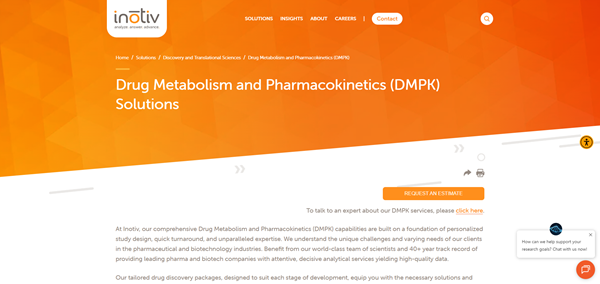
Reference: Inotiv official website (https://www.inotiv.com/)
Inotiv
Inotiv provides integrated PK/PD, DMPK, and bioanalytical services to characterize drug exposure and its relationship with pharmacological response.
Areas of Expertise
Pharmacokinetic Characterization
PK studies characterize exposure, half-life, clearance, and other pharmacokinetic parameters needed to understand how a candidate behaves in the selected model.
Exposure–Response Evaluation
Pharmacokinetic data can be combined with pharmacodynamic endpoints and bioanalysis to evaluate the relationship between drug exposure and pharmacological response.
Integrated DMPK and Development Support
Integrated DMPK, pharmacology, and safety information supports candidate comparison, dose selection, dosing-frequency optimization, and decisions about subsequent preclinical development.

 Japanese