Hooke Laboratories, LLC is a preclinical contract research organization (CRO) in Lawrence, Massachusetts, about 30 minutes north of Boston.[S3] The company describes itself as "a full-service preclinical CRO specializing in rodent models of inflammation and autoimmunity"[S1] and states that it was "founded in 2007 by immunologist Suzana Marusic, MD, PhD."[S2] Alongside contract studies it sells immunization reagents under the Hooke Kits name.[S7] This profile summarizes the models, services, stated compliance information, and company facts most relevant to US sponsors.
Nonclinical services relevant to US drug developers
A single-focus model menu
The company's service list is limited to inflammation and autoimmunity. Chronic disease models offered are experimental autoimmune encephalomyelitis (EAE), collagen-induced arthritis (CIA), inflammatory bowel disease (colitis and Crohn's models), systemic lupus erythematosus, psoriasis, atopic dermatitis, graft-versus-host disease, Sjögren's syndrome, and diabetes in NOD mice.[S3] Short-term assays offered alongside them are delayed-type hypersensitivity, ex vivo T cell function analysis, the T cell dependent antibody response (TDAR) assay, pharmacokinetics, maximum tolerated dose, passive cutaneous anaphylaxis, cytokine production by innate immune cells, and gut homing of cultured T cells.[S3] The company states that it "can usually start your project within two to four weeks of commitment."[S3]
The company states that its "scientists can help with model selection, study design, and interpretation of results, including investigating the mode of action of your compounds."[S3]
In-house reagents and stated scoring practices
The company manufactures the immunization reagents it uses, describing Hooke Kits as "high quality emulsions with consistent, pre-characterized potency" delivered in pre-filled syringes.[S7] It also sells these kits, control kits, antigens in solution, and tissues, cells, and serum from its disease models and immunized or control mice.[S7]
On study conduct, the company states: "We always score blind to treatment and previous scores,"[S2] and it says it repeats studies at no charge when pre-defined success criteria are not met.[S2] Sponsors should confirm in the study contract how success criteria are defined and what the repeat policy covers.
Selected models in detail
Experimental autoimmune encephalomyelitis (EAE)
Hooke describes EAE as an area in which its founder helped develop adoptive-transfer models in C57BL/6 mice. Hooke states that "our founder is Suzana Marusic, MD, PhD, a pioneer in development of adoptive transfer EAE models in C57BL/6 mice."[S4]
Species and strains listed for EAE are C57BL/6 mice, SJL mice, Lewis rats, and NOD mice.[S4] Readouts available with the model include clinical scoring together with the histology, immunohistochemistry, and flow cytometry services described below.[S3][S6] The company's claim about incidence and severity being stable was not verifiable from the pages reviewed and is not reproduced here.
Collagen-induced arthritis (CIA)
The company describes CIA as "one of the most commonly used animal models of human rheumatoid arthritis" and states that it has extensive experience with it.[S5]
Strains listed for CIA are DBA/1 mice, described as the usual choice, along with B10.R111 mice, B10.Q mice, and Lewis rats.[S5] Sponsors should confirm the scoring scheme, endpoints, and histology package for a specific study with the company at the protocol stage.
Ex vivo and histology services
Ex vivo T cell function analysis
Ex vivo T cell function analysis is offered as a stand-alone service,[S9] as is the T cell dependent antibody response (TDAR) assay,[S10] and the company describes mode-of-action investigation as part of what its scientists can help with.[S3] The specific readouts available for a given model should be confirmed with the company.
Histology, immunohistochemistry, and pathology
The histology page lists more than 25 validated stains and a defined panel of immunohistochemistry and immunofluorescence markers, with pathological scoring for spine, colon, kidney, and spleen across the company's disease models, and delivery of "high-resolution digital images of your slides (Hamamatsu NanoZoomer)."[S6] Whether a board-certified veterinary pathologist reads and scores the slides is not stated on the pages reviewed and should be confirmed with the company.
Quality, compliance, and animal welfare (as stated by the company)
The pages reviewed for this profile (home, about, frequently asked questions, the CRO services overview, the EAE and CIA model pages, the histology page, and the contact page; accessed September 3, 2026) do not state that Hooke Laboratories conducts studies under Good Laboratory Practice regulations, and they do not mention AAALAC International accreditation, USDA registration, an Animal Welfare Assurance with NIH OLAW, or an Institutional Animal Care and Use Committee. The services described are discovery and mechanism-of-action pharmacology rather than regulatory safety studies. Sponsors who need a GLP study or who require documented accreditation and registration should ask the company directly. AAALAC International accreditation is a voluntary evaluation of an institution's animal care and use program, re-evaluated every three years,[R3] and USDA registration and an OLAW Animal Welfare Assurance relate to the Animal Welfare Act and the PHS Policy respectively;[R4][R5] none of these establishes GLP compliance, which applies to individual studies.[R2] FDA does not approve or certify laboratories; registration with FDA does not denote approval.[R6]
The company describes itself as a woman-owned small business under US Small Business Administration definitions.[S2] No further ownership information was found on the pages reviewed
Leadership
Suzana Marusic, MD, PhD (President and CEO); Dave Lindbergh (Executive Vice President)[S2]
Sites
Lawrence, Massachusetts (the only site named on the website)[S3][S8]
Staff and facility size
Not stated on the website
Lines of business
Contract research; Hooke Kits reagents and biological products; histology, IHC, and pathology services[S2][S6][S7]
FDA — "Is It Really FDA Approved?" (FDA does not approve health care providers, including laboratories; registration does not denote approval); FDA Compliance Program 7348.808 (GLP inspections of nonclinical laboratories). https://www.fda.gov/consumers/consumer-updates/it-really-fda-approved (accessed 2026-09-03)
3 Recommended Contract Research Organizations
for Non-Clinical Studies
— by Target goal and Expertise
In non-clinical development, the choice of contract research organization shapes the quality of the data and the time it takes to reach the next decision. Below, three CROs are introduced by the type of study they support: pharmacology (efficacy) studies, safety studies, and pharmacokinetic (PK/PD) studies. Each summary describes the services the company offers so that you can match a provider to your target and development objective.
Pharmacology (Efficacy) StudiesDisease-Relevant Models for Translational Drug Evaluation
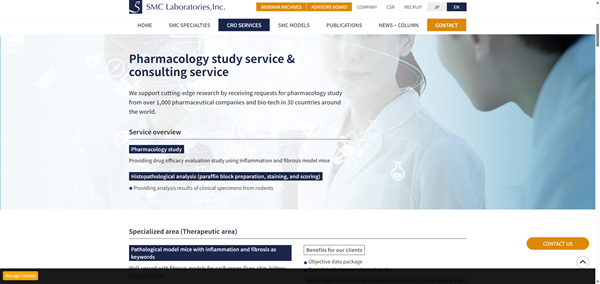
Reference: SMC Laboratories, Inc. official website (https://www.smccro-lab.com/)
SMC Laboratories, Inc.
SMC Laboratories is a specialized non-clinical CRO focused on in vivo pharmacology and efficacy studies using disease-relevant animal models, particularly in fibrosis, inflammation, metabolic diseases, and oncology.
Areas of Expertise
Disease-Relevant Model Portfolio
SMC Laboratories offers models covering the liver, lung, kidney, intestine, and oncology. Its portfolio includes the proprietary STAM™ model for MASH, fibrosis, and hepatocellular carcinoma.
Study Design Based on Target Biology
Study plans are developed around the target biology, mechanism of action, disease stage, and development objective. Pharmacological endpoints can be combined with histopathology, biomarkers, and disease-specific readouts.
Support from Target Validation to Proof of Concept
With experience from more than 1,000 studies for clients in 30 countries, SMC Laboratories supports programs from target validation and candidate selection through in vivo proof-of-concept studies.
Safety StudiesComprehensive Safety Assessment for Preclinical Development
Reference: Charles River Laboratories official website (https://www.criver.com/)
Charles River Laboratories
Charles River provides non-clinical toxicology and safety assessment services for programs ranging from exploratory safety studies to IND-enabling development.
Areas of Expertise
General Toxicology Across Study Designs
Services include single- and repeat-dose toxicology, dose-range finding, and general toxicology studies across multiple species and administration routes.
Non-GLP and GLP Study Support
Charles River supports both non-GLP and GLP studies, allowing sponsors to progress from early safety characterization to studies intended for regulatory submissions.
Integrated IND-Enabling Safety Assessment
Toxicology studies can be integrated with toxicokinetics, clinical pathology, histopathology, and safety pharmacology to support interpretation and IND-enabling safety packages.
Pharmacokinetic (PK/PD) StudiesConnecting Drug Exposure with Pharmacological Response
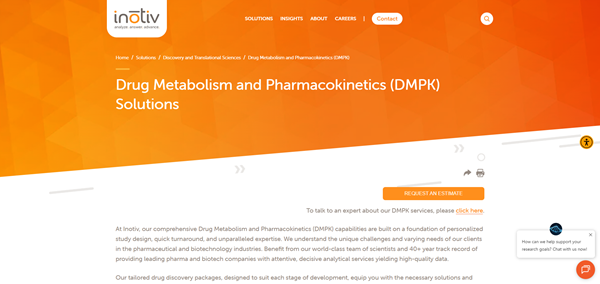
Reference: Inotiv official website (https://www.inotiv.com/)
Inotiv
Inotiv provides integrated PK/PD, DMPK, and bioanalytical services to characterize drug exposure and its relationship with pharmacological response.
Areas of Expertise
Pharmacokinetic Characterization
PK studies characterize exposure, half-life, clearance, and other pharmacokinetic parameters needed to understand how a candidate behaves in the selected model.
Exposure–Response Evaluation
Pharmacokinetic data can be combined with pharmacodynamic endpoints and bioanalysis to evaluate the relationship between drug exposure and pharmacological response.
Integrated DMPK and Development Support
Integrated DMPK, pharmacology, and safety information supports candidate comparison, dose selection, dosing-frequency optimization, and decisions about subsequent preclinical development.

 Japanese