WAKENYAKU CO.,LTD.
WAKENYAKU CO.,LTD. supports research and development across biotechnology and related disciplines. Here, we provide an overview of our nonclinical study capabilities, representative disease models, and case examples. Please use this information as a reference when selecting a CRO to conduct nonclinical studies.
Nonclinical studies undertaken by WAKENYAKU CO.,LTD.
WAKENYAKU CO.,LTD. conducts high-quality toxicology (safety), pharmacology/efficacy (PD), and pharmacokinetics (PK) studies in accordance with applicable guidelines. As a CRO, WAKENYAKU CO.,LTD. accepts contracts for pharmacology (PD), toxicology, and PK studies, performed in vitro and in vivo.
Contract Research Partners Available Through WAKENYAKU CO.,LTD.
FUJIFILM Wako Pure Chemical Corporation
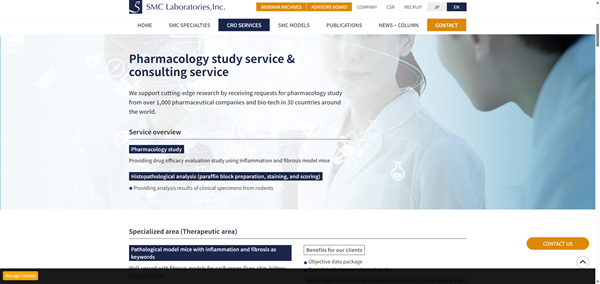
Provides contract efficacy studies using PDX/CDX mouse models. Services include dosing anticancer agents in PDX mice and conducting efficacy evaluations. With an inventory of 2,700 PDX models, appropriate models can be selected for the compound based on genetic and pathological data as well as efficacy data for existing agents.
Funakoshi
Provides contract study services using domestic swine. Offerings include collection of intestinal contents, DIAAS (Digestible Indispensable Amino Acid Score) evaluations, cartilage transplantation studies in the knee joint, and gastrointestinal tract adhesion testing.
TRANS GENIC INC.
Provides nonclinical studies under licenses for genetically engineered mouse lines established and characterized at universities and research institutes. Available models include APPosk-Tg mice for Alzheimer’s disease, ProBDNF KI mice for psychiatric and neurologic diseases, SJLB mice for dementia, and IL33 Tg mice for atopic dermatitis. Comprehensive support is available from study design aligned with each disease hypothesis through high-quality data acquisition.
SetsuroTech
Provides end-to-end support for CRISPR/Cas9 genome-edited mouse creation, breeding, and phenotyping. Available assessments include blood and urine testing, toxicity studies, and safety pharmacology studies. Planning is available from the mouse-creation stage, including required animal numbers for each study. Additional support includes in vitro fertilization (IVF), natural mating, and cryopreservation of embryos and sperm.
Examples of Nonclinical Studies by WAKENYAKU CO.,LTD.
Pharmacodynamic/Pharmacology Studies (non-GLP)
Studies are conducted in an SPF environment using isocage systems and support non-GLP pharmacodynamic/pharmacology studies in mice and rats. Endpoints span antitumor efficacy, obesity, diabetes, and hypertension. Projects can be commissioned starting from a single mouse, at low cost, with rapid turnaround.
Phenotypic Analysis of Genetically Engineered Animals
Phenotypic Analysis of Genetically Engineered Animals
Studies are conducted in an SPF environment using isocage systems and support non-GLP pharmacodynamic/pharmacology studies in mice and rats. Assessments include general clinical observations, behavioral analysis, hematology, clinical chemistry, and gross and histopathology. Projects can be commissioned starting from a single mouse, at low cost, with rapid turnaround.
WAKENYAKU CO.,LTD. Company Information
Founded in 1972, WAKENYAKU CO.,LTD. has developed its business through its dealing and manufacturing divisions. The company provides researching and developing support in a variety of fields.
| Address |
17 Nishimizubo-cho, Ichijyoji, Sakyo-ku, Kyoto-shi, Kyoto, Japan |
| Tel |
075-721-8111 |
| Website |
https://www.wakenyaku.co.jp/ |

 Japanese