Battelle Memorial Institute is an independent nonprofit applied science and technology organization in Columbus, Ohio,[S2] which states that it has served government and industry "since its founding in 1929."[S1] Its scope extends well beyond drug development: the locations page lists sites working on missile defense, aviation security, cyber capability, environmental testing and ecological observation.[S3] This profile covers only the part relevant to a drug developer, the biomedical work centered on the West Jefferson, Ohio facility, which the company describes as supporting "a variety of research work from pharmaceutical research to nonclinical research."[S3]
What is offered for nonclinical drug development
Biocontainment and medical countermeasures
One documented capability is high-containment infectious disease and countermeasure work. The company reports 22,000 square feet of biosafety level 3 laboratory and holding space.[S5] Named work in that area covers outbreak preparedness and response, and testing of therapeutics, prophylaxis and diagnostics.[S5] An Aerosol Research and Component Assessment chamber supports aerosol studies, and a Highly Toxic Materials Laboratory tests chemical warfare agents and other highly toxic materials in animal models.[S5] The cited page presents this capability for biodefense and medical countermeasure programs, which is a different kind of work from conventional small molecule or biologic development.
Toxicology, new approach methodologies, and medical devices
The life sciences research page refers to "toxicology, assay development and validation services, and toxicology and pharmacology for support for investigational new drug studies."[S4] An IND is not "approved" by FDA: under 21 CFR 312.40 it goes into effect 30 days after FDA receives it unless FDA imposes a clinical hold.[R1] A CRO may conduct and report nonclinical studies that a sponsor includes in an IND, but it cannot guarantee that FDA will allow the clinical investigation to proceed. The same page describes new approach methodologies, stating that they "apply advanced in vitro and microphysiological systems to generate earlier, more human-relevant evidence of safety, efficacy, and biological response."[S4] Separately, the medical device business states more than sixty-five years of developing regulated medical products,[S6] spanning human-centered design, drug delivery, device design and development and neurotechnology.[S6] No dedicated DMPK or ADME service page and no standalone pathology service page were found on the pages reviewed.
Quality, compliance, and animal welfare (as stated by the organization)
GLP. The life sciences page states: "We offer regulatory-compliant environments that adhere to strict GLP, GCP and GMP practices."[S4] The company's website does not name a specific GLP regulation (FDA 21 CFR Part 58, EPA 40 CFR Part 160/792, or OECD GLP) for its facilities.[S4] GLP compliance is determined study by study under the applicable regulation, so sponsors should confirm in the protocol which regulation their study will follow and that the final report will carry the study director's compliance statement and the quality assurance unit's statement.[R2] Note that GLP, GCP and GMP are three separate frameworks covering nonclinical studies, clinical trials and manufacturing respectively; a single sentence naming all three does not tell a sponsor which applies to a specific study.
No AAALAC accreditation, USDA registration, OLAW Animal Welfare Assurance, Institutional Animal Care and Use Committee or three Rs statement was found on any page reviewed for this profile, even though the organization describes animal holding space at biosafety level 3 and animal model testing of highly toxic materials.[S5] That is an absence in those pages, not a finding about the status of the organization. It is worth recording rather than glossing over: for an organization that plainly conducts animal work, a sponsor cannot verify oversight arrangements from the website and should request the current site-specific status directly. AAALAC International accreditation is a voluntary evaluation of an institution's animal care and use program, re-evaluated every three years,[R3] and USDA registration and an OLAW Animal Welfare Assurance relate to the Animal Welfare Act and the PHS Policy respectively;[R4][R5] none of these establishes GLP compliance, which applies to individual studies.[R2] FDA does not approve or certify laboratories; registration with FDA does not denote approval.[R6]
Organization facts
Legal name
Battelle Memorial Institute, operating publicly as Battelle[S2]
Headquarters
505 King Avenue, Columbus, Ohio 43201, United States[S3]
Total headcount not published; the homepage cites more than 1,200 scientists and engineers with advanced degrees, which is a subset rather than a total[S1]
Site relevant to drug development
West Jefferson, Ohio, described as supporting pharmaceutical and nonclinical research[S3]
Other sites
Columbus, OH; Norwell, MA; Ponce Inlet, FL; Boulder, CO; Charlottesville, VA; Egg Harbor Township, NJ; Huntsville, AL; Beavercreek, OH; Arlington, VA; Chantilly, VA; Washington, DC; and Chelmsford, United Kingdom[S3]
Biocontainment (company statement)
22,000 square feet of BSL-3 laboratory and holding space[S5]
Named biomedical capabilities
Outbreak preparedness and response; therapeutics, prophylaxis and diagnostics testing; aerosol research chamber; highly toxic materials laboratory; new approach methodologies; medical device development[S4][S5][S6]
Quality statement
Regulatory-compliant environments described as adhering to GLP, GCP and GMP practices; no regulation is named[S4]
FDA ? "Is It Really FDA Approved?" (FDA does not approve health care providers, including laboratories; registration does not denote approval); FDA Compliance Program 7348.808 (GLP inspections of nonclinical laboratories). https://www.fda.gov/consumers/consumer-updates/it-really-fda-approved (accessed 2026-09-03)
3 Recommended Contract Research Organizations
for Non-Clinical Studies
— by Target goal and Expertise
In non-clinical development, the choice of contract research organization shapes the quality of the data and the time it takes to reach the next decision. Below, three CROs are introduced by the type of study they support: pharmacology (efficacy) studies, safety studies, and pharmacokinetic (PK/PD) studies. Each summary describes the services the company offers so that you can match a provider to your target and development objective.
Pharmacology (Efficacy) StudiesDisease-Relevant Models for Translational Drug Evaluation
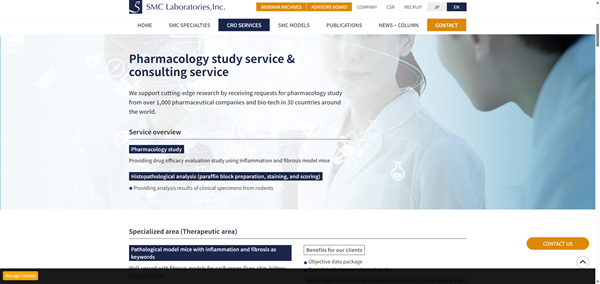
Reference: SMC Laboratories, Inc. official website (https://www.smccro-lab.com/)
SMC Laboratories, Inc.
SMC Laboratories is a specialized non-clinical CRO focused on in vivo pharmacology and efficacy studies using disease-relevant animal models, particularly in fibrosis, inflammation, metabolic diseases, and oncology.
Areas of Expertise
Disease-Relevant Model Portfolio
SMC Laboratories offers models covering the liver, lung, kidney, intestine, and oncology. Its portfolio includes the proprietary STAM™ model for MASH, fibrosis, and hepatocellular carcinoma.
Study Design Based on Target Biology
Study plans are developed around the target biology, mechanism of action, disease stage, and development objective. Pharmacological endpoints can be combined with histopathology, biomarkers, and disease-specific readouts.
Support from Target Validation to Proof of Concept
With experience from more than 1,000 studies for clients in 30 countries, SMC Laboratories supports programs from target validation and candidate selection through in vivo proof-of-concept studies.
Safety StudiesComprehensive Safety Assessment for Preclinical Development
Reference: Charles River Laboratories official website (https://www.criver.com/)
Charles River Laboratories
Charles River provides non-clinical toxicology and safety assessment services for programs ranging from exploratory safety studies to IND-enabling development.
Areas of Expertise
General Toxicology Across Study Designs
Services include single- and repeat-dose toxicology, dose-range finding, and general toxicology studies across multiple species and administration routes.
Non-GLP and GLP Study Support
Charles River supports both non-GLP and GLP studies, allowing sponsors to progress from early safety characterization to studies intended for regulatory submissions.
Integrated IND-Enabling Safety Assessment
Toxicology studies can be integrated with toxicokinetics, clinical pathology, histopathology, and safety pharmacology to support interpretation and IND-enabling safety packages.
Pharmacokinetic (PK/PD) StudiesConnecting Drug Exposure with Pharmacological Response
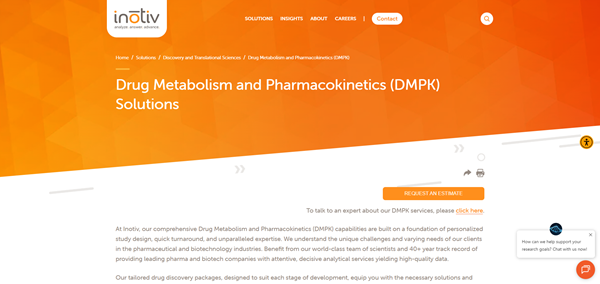
Reference: Inotiv official website (https://www.inotiv.com/)
Inotiv
Inotiv provides integrated PK/PD, DMPK, and bioanalytical services to characterize drug exposure and its relationship with pharmacological response.
Areas of Expertise
Pharmacokinetic Characterization
PK studies characterize exposure, half-life, clearance, and other pharmacokinetic parameters needed to understand how a candidate behaves in the selected model.
Exposure–Response Evaluation
Pharmacokinetic data can be combined with pharmacodynamic endpoints and bioanalysis to evaluate the relationship between drug exposure and pharmacological response.
Integrated DMPK and Development Support
Integrated DMPK, pharmacology, and safety information supports candidate comparison, dose selection, dosing-frequency optimization, and decisions about subsequent preclinical development.

 Japanese