TransPharm Preclinical Solutions, Inc. is a small infectious disease specialist in Jackson, Michigan. It was founded in 2008 by Daniel Ross and remains privately and family held.[S2] Its scope is narrow and clearly stated: rodent efficacy models of infection, supported by in vitro microbiology, run in its own vivarium.[S3][S4][S5] Two points shape how a sponsor should read it. The facility is biosafety level 2, not level 3, so agents requiring higher containment are out of scope.[S3] And the company publishes its animal welfare credentials in unusual detail, including accreditation and assurance numbers.[S7] This profile summarizes the services, facility, stated compliance information, and company facts most relevant to US sponsors.
Services relevant to US drug developers
In vivo infection models and in vitro microbiology
The company runs efficacy models of infection in mice and rats, with pharmacokinetic blood sampling available alongside the efficacy readouts.[S4] In vitro microbiology, including minimum inhibitory concentration determination, supports compound triage before animal work.[S5] Only mice and rats are used; no larger species are offered, which keeps the model set within what a BSL-2 facility can support.
Pathogen coverage
The homepage cites more than 50 pathogens,[S1] while the pathogen listing page names 34 individually.[S6] Both figures are reproduced here as published; the gap may reflect strains held but not listed, or a figure that has not been updated. Sponsors should confirm that the specific organism and strain for their program is available, and that it can be handled at biosafety level 2.
The facility
The vivarium is described as AAALAC accredited and operating at biosafety level 2, with nine bioBubble isolation cabins.[S3] Isolation cabins matter in infection work because they allow several studies with different organisms to run at once without cross-contamination, which is often the practical constraint on scheduling at a small site. Unlike consortium or brokerage models, TransPharm houses the animals itself, so the accreditation and assurance below apply to the facility that will actually run the study.
Quality, compliance, and animal welfare (as stated by the company)
Accreditation and assurance numbers are published. The company states AAALAC accreditation held since October 2009 under file number 001301, and a PHS Animal Welfare Assurance with the Office of Laboratory Animal Welfare held since June 2014 under assurance number A4707-01, together with the composition of its Institutional Animal Care and Use Committee.[S7] Publishing the file and assurance numbers lets a sponsor check the status against the issuing bodies' own records rather than taking the claim on trust, which is more than most sites in this list provide. AAALAC International accreditation is a voluntary evaluation of an institution's animal care and use program, re-evaluated every three years,[R3] and USDA registration and an OLAW Animal Welfare Assurance relate to the Animal Welfare Act and the PHS Policy respectively;[R4][R5] none of these establishes GLP compliance, which applies to individual studies.[R2] FDA does not approve or certify laboratories; registration with FDA does not denote approval.[R6] This profile does not evaluate the company's animal care program; the statements above are the company's own.
GLP is not claimed. No GLP statement was found on the pages reviewed, and no USDA registration statement appears for the facility itself; USDA is mentioned only in the founder's prior career description.[S2][S7] A facility working only with mice and rats may fall outside Animal Welfare Act registration requirements, but that is a determination for the company and the agency rather than an inference to be drawn here. Sponsors needing a GLP study should confirm scope and regulation directly.[R2]
FDA ? "Is It Really FDA Approved?" (FDA does not approve health care providers, including laboratories; registration does not denote approval); FDA Compliance Program 7348.808 (GLP inspections of nonclinical laboratories). https://www.fda.gov/consumers/consumer-updates/it-really-fda-approved (accessed 2026-09-03)
3 Recommended Contract Research Organizations
for Non-Clinical Studies
— by Target goal and Expertise
In non-clinical development, the choice of contract research organization shapes the quality of the data and the time it takes to reach the next decision. Below, three CROs are introduced by the type of study they support: pharmacology (efficacy) studies, safety studies, and pharmacokinetic (PK/PD) studies. Each summary describes the services the company offers so that you can match a provider to your target and development objective.
Pharmacology (Efficacy) StudiesDisease-Relevant Models for Translational Drug Evaluation
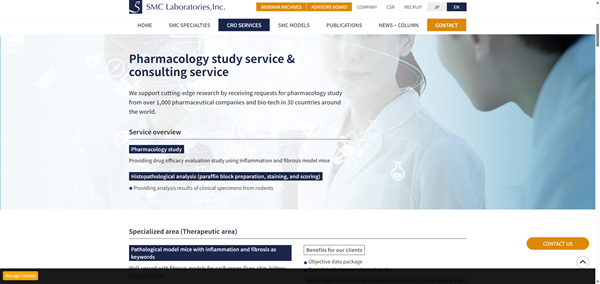
Reference: SMC Laboratories, Inc. official website (https://www.smccro-lab.com/)
SMC Laboratories, Inc.
SMC Laboratories is a specialized non-clinical CRO focused on in vivo pharmacology and efficacy studies using disease-relevant animal models, particularly in fibrosis, inflammation, metabolic diseases, and oncology.
Areas of Expertise
Disease-Relevant Model Portfolio
SMC Laboratories offers models covering the liver, lung, kidney, intestine, and oncology. Its portfolio includes the proprietary STAM™ model for MASH, fibrosis, and hepatocellular carcinoma.
Study Design Based on Target Biology
Study plans are developed around the target biology, mechanism of action, disease stage, and development objective. Pharmacological endpoints can be combined with histopathology, biomarkers, and disease-specific readouts.
Support from Target Validation to Proof of Concept
With experience from more than 1,000 studies for clients in 30 countries, SMC Laboratories supports programs from target validation and candidate selection through in vivo proof-of-concept studies.
Safety StudiesComprehensive Safety Assessment for Preclinical Development
Reference: Charles River Laboratories official website (https://www.criver.com/)
Charles River Laboratories
Charles River provides non-clinical toxicology and safety assessment services for programs ranging from exploratory safety studies to IND-enabling development.
Areas of Expertise
General Toxicology Across Study Designs
Services include single- and repeat-dose toxicology, dose-range finding, and general toxicology studies across multiple species and administration routes.
Non-GLP and GLP Study Support
Charles River supports both non-GLP and GLP studies, allowing sponsors to progress from early safety characterization to studies intended for regulatory submissions.
Integrated IND-Enabling Safety Assessment
Toxicology studies can be integrated with toxicokinetics, clinical pathology, histopathology, and safety pharmacology to support interpretation and IND-enabling safety packages.
Pharmacokinetic (PK/PD) StudiesConnecting Drug Exposure with Pharmacological Response
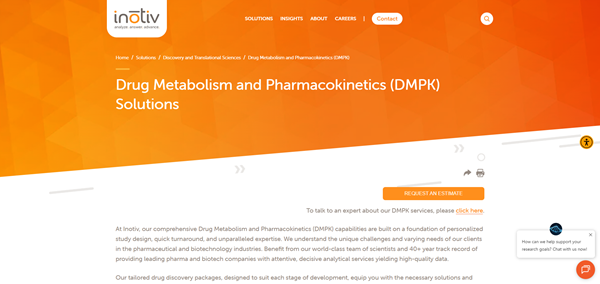
Reference: Inotiv official website (https://www.inotiv.com/)
Inotiv
Inotiv provides integrated PK/PD, DMPK, and bioanalytical services to characterize drug exposure and its relationship with pharmacological response.
Areas of Expertise
Pharmacokinetic Characterization
PK studies characterize exposure, half-life, clearance, and other pharmacokinetic parameters needed to understand how a candidate behaves in the selected model.
Exposure–Response Evaluation
Pharmacokinetic data can be combined with pharmacodynamic endpoints and bioanalysis to evaluate the relationship between drug exposure and pharmacological response.
Integrated DMPK and Development Support
Integrated DMPK, pharmacology, and safety information supports candidate comparison, dose selection, dosing-frequency optimization, and decisions about subsequent preclinical development.

 Japanese