The class, and the label every product in it carries
These products act at the receptor for an intestinal hormone, promoting glucose-dependent insulin secretion, slowing gastric emptying, and acting on central appetite regulation. Products in the class are approved both for glycemic control in type 2 diabetes[S1][S5][S9] and, as separate products with separate names, for weight management,[S4][S7] with one product also approved for obstructive sleep apnea in adults with obesity.[S11] The feature that dominates nonclinical planning is stated at the top of every one of those labels, and is the subject of the note below.
Approved products and how each solves the same problem
Liraglutide
The native hormone is cleared within minutes, so every product in this class is an answer to the question of how to make it last. Liraglutide's label describes attaching a C-16 fatty acid, palmitic acid, with a glutamic acid spacer at the lysine at position 26.[S3] The discovery literature describes reversible albumin binding as the mechanism of protraction used for this compound.[S16] For nonclinical work this matters because albumin binding differs between species, so the half-life measured in one animal does not transfer.
Semaglutide
Semaglutide uses the same principle with different chemistry. Its label states that the main protraction mechanism is albumin binding, facilitated by modification of the position 26 lysine with a hydrophilic spacer and a C18 fatty di-acid.[S8] An oral formulation exists, achieved with an absorption enhancer rather than by changing the peptide. That distinction matters nonclinically: the oral product raises questions about gastrointestinal absorption and local tolerability that the injected product does not, and those are formulation questions rather than pharmacology questions.
Tirzepatide and orforglipron
Tirzepatide acts at two receptors. A peer-reviewed characterization describes it as mimicking the actions of the native hormone at the GIP receptor while showing bias at the GLP-1 receptor, favouring cAMP generation over beta-arrestin recruitment.[S17] Orforglipron is a different proposition again: an orally available non-peptide agonist,[S19] approved as a product for weight management.[S12] Its label states that it binds to and activates the human receptor. This article does not describe orforglipron as biased, because no primary source establishing that was found in preparing it.
The problems specific to this class
Receptor trafficking and signal bias
The receptor undergoes agonist-mediated endocytosis, and the published work on this is explicit that the functional and therapeutic consequences of modulating that trafficking have not been clearly defined.[S18] That uncertainty is worth stating plainly. Signalling bias can be measured in vitro, and the measurement is reproducible; what it means for a product given over years is not established. A nonclinical programme can characterize the bias profile of a candidate, and should not be represented as having demonstrated a long-term consequence of it.
The species question
Receptor distribution and metabolic response differ between rodents and humans, and the diet-induced obese mouse is a simpler condition than obesity accompanied by steatohepatitis and fibrosis. The species issue is not abstract in this class: it produced a documented regulatory outcome, described in the note below, which is the clearest available illustration of what species dependence costs a development programme.
Gastrointestinal effects and heart rate
Nausea and increased resting heart rate arise from the intended pharmacology rather than from an unrelated interaction, so they cannot be engineered away by improving receptor selectivity. Cardiovascular assessment covering blood pressure, heart rate and the electrocardiogram is a standard part of the safety pharmacology core battery,[S15] and in this class it is not a formality: heart rate is where a class effect is expected. Telemetry in conscious animals, rather than a single measurement under anaesthesia, is what makes a sustained change visible.
The nonclinical work
In vitro signalling and receptor dynamics
Binding affinity alone does not describe what a compound does at this receptor. The measurements that separate candidates are cAMP generation, as the readout of G protein activation, and beta-arrestin recruitment, since the ratio between them is what the term bias refers to.[S17] Receptor internalization and recycling are followed with resonance energy transfer methods or high-content imaging. These assays should be run against the human receptor, given the species differences discussed above, and the receptor construct used should be recorded in the report.
Disease models beyond simple weight loss
A diet-induced obese rodent reports weight change and little else. Where the intended indication involves liver disease, a model with steatohepatitis and fibrosis is required, and the histological scoring system used should be stated because scoring is where variability enters. Non-human primate models of obesity and diabetes are used where the receptor pharmacology in rodents is a poor match. Clamp studies quantify insulin sensitivity directly rather than inferring it, and imaging quantifies liver fat without terminating the animal, which allows the same animal to serve as its own control over time.
Pharmacokinetics and tissue distribution
The effects of this class are split between peripheral and central sites, and plasma concentration does not indicate how much reached either. Quantitative whole-body autoradiography and mass spectrometry imaging locate the compound in tissue. For an albumin-bound peptide, free rather than total concentration is the meaningful quantity, since the albumin-bound fraction is a reservoir rather than active material,[S16] and an assay that reports only total concentration will overstate exposure at the receptor.
Functional safety assessment
Telemetry supplies heart rate, blood pressure and electrocardiogram in conscious animals, which is what the safety pharmacology guidance calls for.[S15] Nausea cannot be measured directly in a rodent, and the behavioural surrogates used in its place are indirect; their limitations should be stated rather than glossed. The question that matters for dose escalation is whether the tolerability effect tracks peak concentration or total exposure, because the two imply different titration schemes, and answering it requires the study to sample at enough timepoints to distinguish them.
What to establish with the laboratory
Five things are worth establishing before award. Whether the laboratory runs cAMP and beta-arrestin assays against the human receptor and can report the ratio, not just each value.[S17] Whether its bioanalytical method distinguishes free from albumin-bound compound.[S16] Whether conscious-animal telemetry is available, since anaesthetized measurement will miss the heart rate effect.[S15] Whether its developmental and reproductive study designs include pair-fed controls, given the attribution problem described above.[S22] And what its experience is with the two-year rodent bioassay in this class, since the class labelling outcome is known in advance and the study is run to characterize the finding rather than to avoid it.[S13][S14]
Knudsen LB, Lau J. The Discovery and Development of Liraglutide and Semaglutide. Frontiers in Endocrinology. https://pubmed.ncbi.nlm.nih.gov/ (accessed 2026-09-03)
Willard FS etc. Tirzepatide is an imbalanced and biased dual GIP and GLP-1 receptor agonist. JCI Insight. https://pubmed.ncbi.nlm.nih.gov/ (accessed 2026-09-03)
Jones B etc. Targeting GLP-1 receptor trafficking to improve agonist efficacy. Nature Communications 2018;9:1602. https://pubmed.ncbi.nlm.nih.gov/ (accessed 2026-09-03)
Orforglipron: A Comprehensive Review of an Oral Small-Molecule GLP-1 Receptor Agonist(Review Article). https://pubmed.ncbi.nlm.nih.gov/ (accessed 2026-09-03)
3 Recommended Contract Research Organizations
for Non-Clinical Studies
— by Target goal and Expertise
In non-clinical development, the choice of contract research organization shapes the quality of the data and the time it takes to reach the next decision. Below, three CROs are introduced by the type of study they support: pharmacology (efficacy) studies, safety studies, and pharmacokinetic (PK/PD) studies. Each summary describes the services the company offers so that you can match a provider to your target and development objective.
Pharmacology (Efficacy) StudiesDisease-Relevant Models for Translational Drug Evaluation
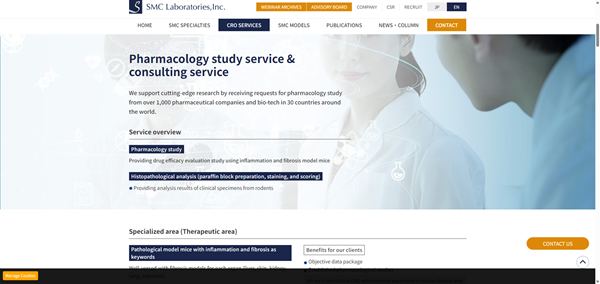
Reference: SMC Laboratories, Inc. official website (https://www.smccro-lab.com/)
SMC Laboratories, Inc.
SMC Laboratories is a specialized non-clinical CRO focused on in vivo pharmacology and efficacy studies using disease-relevant animal models, particularly in fibrosis, inflammation, metabolic diseases, and oncology.
Areas of Expertise
Disease-Relevant Model Portfolio
SMC Laboratories offers models covering the liver, lung, kidney, intestine, and oncology. Its portfolio includes the proprietary STAM™ model for MASH, fibrosis, and hepatocellular carcinoma.
Study Design Based on Target Biology
Study plans are developed around the target biology, mechanism of action, disease stage, and development objective. Pharmacological endpoints can be combined with histopathology, biomarkers, and disease-specific readouts.
Support from Target Validation to Proof of Concept
With experience from more than 1,000 studies for clients in 30 countries, SMC Laboratories supports programs from target validation and candidate selection through in vivo proof-of-concept studies.
Safety StudiesComprehensive Safety Assessment for Preclinical Development
Reference: Charles River Laboratories official website (https://www.criver.com/)
Charles River Laboratories
Charles River provides non-clinical toxicology and safety assessment services for programs ranging from exploratory safety studies to IND-enabling development.
Areas of Expertise
General Toxicology Across Study Designs
Services include single- and repeat-dose toxicology, dose-range finding, and general toxicology studies across multiple species and administration routes.
Non-GLP and GLP Study Support
Charles River supports both non-GLP and GLP studies, allowing sponsors to progress from early safety characterization to studies intended for regulatory submissions.
Integrated IND-Enabling Safety Assessment
Toxicology studies can be integrated with toxicokinetics, clinical pathology, histopathology, and safety pharmacology to support interpretation and IND-enabling safety packages.
Pharmacokinetic (PK/PD) StudiesConnecting Drug Exposure with Pharmacological Response
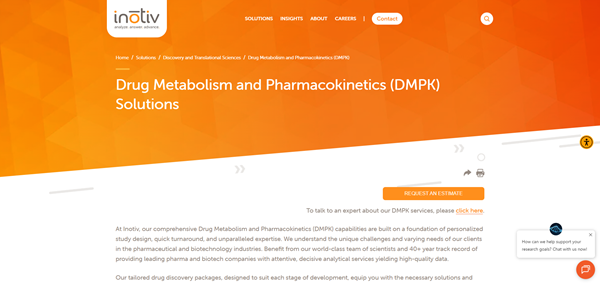
Reference: Inotiv official website (https://www.inotiv.com/)
Inotiv
Inotiv provides integrated PK/PD, DMPK, and bioanalytical services to characterize drug exposure and its relationship with pharmacological response.
Areas of Expertise
Pharmacokinetic Characterization
PK studies characterize exposure, half-life, clearance, and other pharmacokinetic parameters needed to understand how a candidate behaves in the selected model.
Exposure–Response Evaluation
Pharmacokinetic data can be combined with pharmacodynamic endpoints and bioanalysis to evaluate the relationship between drug exposure and pharmacological response.
Integrated DMPK and Development Support
Integrated DMPK, pharmacology, and safety information supports candidate comparison, dose selection, dosing-frequency optimization, and decisions about subsequent preclinical development.

 Japanese