MD Biosciences is a preclinical contract research organization built around pain and the central nervous system, working in rodents and, in rodents and pigs.[S1][S4][S10] Before anything else, a United States sponsor needs to know where the animals are. The company states that its 20,000 square foot research facility opened in Israel in 2021, and it describes the Cambridge, Massachusetts address as a representative office opened jointly by its Israeli and United States entities.[S3] No US research facility was found on the pages reviewed.[S2][S3] The company holds a foreign assurance with the American office that oversees animal welfare in federally funded research, as stated by the company.[S2] The company identifies a 20,000 square foot research facility in Israel and describes the Cambridge address as a representative office, with the commercial relationship handled from Massachusetts.
Services relevant to US drug developers
Pain models
The company lists inflammatory, neuropathic and surgical pain models. Inflammatory models use complete Freund adjuvant and carrageenan; neuropathic models include chemotherapy-induced neuropathy, streptozotocin-induced diabetic neuropathy, sciatic nerve injury and chronic post-ischaemic pain; and surgical models cover post-operative pain, nerve block and neuroma.[S4] Several of these are offered in pigs as well as rodents, including post-operative pain and symptomatic neuroma.[S4][S10] A large-animal neuroma model is the kind of thing that includes postoperative pain and symptomatic neuroma models in pigs, and it matters for programmes where a device or a surgical technique is part of the intervention rather than a compound alone. Behavioural readouts in pain models measure the animal response; they do not measure pain relief in people, and the company does not present them as doing so.
Central nervous system and neuroinflammation
Named central nervous system models cover experimental autoimmune encephalomyelitis for multiple sclerosis, Parkinson disease, ischaemic stroke, cortical trauma, and demyelination and remyelination using cuprizone.[S5] Mechanistic readouts include flow cytometry for cell populations, multiplex cytokine and chemokine assays and immunohistochemistry.[S6] In vivo electrophysiology is offered as a biomarker, with transcranial motor evoked potentials and compound muscle action potentials recorded in the encephalomyelitis model and in peripheral nerve injury.[S9] Cell-based assays using rodent primary neurons are positioned ahead of in vivo work, covering neurodegeneration screening, synaptic imaging and neurite outgrowth.[S13]
Pharmacokinetics, toxicology, pathology and batch testing
Pharmacokinetic and pharmacodynamic work includes dose linearity, central nervous system penetration, tissue distribution and bioanalysis by chromatography with mass spectrometry, and the company states that rodent and pig toxicology studies are described as GLP, without the applicable regulation being named on that page.[S7] Histology is done in house with staff histologists and pathologists, offering routine and immunohistochemical staining, whole-slide digital scanning with automated quantification, and oversized slides for large pig tissue sections.[S8] Wound healing models cover incisional, excisional, burn and diabetic wounds in pigs and rodents.[S11] One further service is quality control testing for clinical batch release, using the encephalomyelitis model, which the company describes as run to the OECD good laboratory practice principles.[S12]
Quality, compliance, and animal welfare (as stated by the company)
Good laboratory practice is claimed for the facility generally and for toxicology studies.[S1][S7] The company's website does not name a specific GLP regulation (FDA 21 CFR Part 58, EPA 40 CFR Part 160/792, or OECD GLP) for its facilities.[S7] GLP compliance is determined study by study under the applicable regulation, so sponsors should confirm in the protocol which regulation their study will follow and that the final report will carry the study director's compliance statement and the quality assurance unit's statement.[R2] One page is more specific, naming the OECD principles for the batch release service.[S12] That distinction matters for a package going to the Food and Drug Administration, since for an FDA submission, confirm with the agency or qualified regulatory counsel which GLP framework and which requirements for studies conducted abroad apply to the proposed study, even though the two are broadly aligned.[R2] A sponsor should establish which applies before the protocol is signed.
The company states that it was accredited by AAALAC International, announced in February 2026, and that it holds a foreign animal welfare assurance with the National Institutes of Health office that oversees laboratory animal welfare, which it describes as enabling support of federally funded research conducted outside the United States.[S2][S3] It also signed an industry declaration on animal housing and use in September 2025, which is a voluntary pledge rather than a regulatory instrument.[S3] No United States Department of Agriculture registration and no reference to an institutional animal care and use committee were found; with no US animal facility found on the pages reviewed, the Department of Agriculture framework may not apply; confirm the applicable requirements for the proposed study.[R4] The accreditation announcement does not say which site it covers. AAALAC International accreditation is a voluntary evaluation of an institution's animal care and use program, re-evaluated every three years,[R3] and USDA registration and an OLAW Animal Welfare Assurance relate to the Animal Welfare Act and the PHS Policy respectively;[R4][R5] none of these establishes GLP compliance, which applies to individual studies.[R2] FDA does not approve or certify laboratories; registration with FDA does not denote approval.[R6] This profile does not evaluate the animal care programme.
Corporate structure
Three entity names appear in the company own material, and the relationship between them is not explained. An announcement in August 2020 states that Kahlo Sciences LLC, trading as MD Biosciences Neuro, assumed all statements of work and master service agreements from MD Biosciences, Inc. for central nervous system services, at the same time as MD Biosciences Innovalora Ltd of Israel and Kahlo Sciences opened the Cambridge offices.[S3] What became of MD Biosciences, Inc. is not stated. No ownership structure, investor or parent company is named anywhere on the site, and no founding year, headcount or revenue figure is published; the only figure given is more than 30 years of experience.[S1][S2] A sponsor should confirm which legal entity will hold the contract and which will hold the study record, since on the company own account those may not be the same one.
Company facts
Operating name
MD Biosciences, also styled MD Biosciences Neuro[S1]
FDA — "Is It Really FDA Approved?" (FDA does not approve health care providers, including laboratories; registration does not denote approval); FDA Compliance Program 7348.808 (GLP inspections of nonclinical laboratories). https://www.fda.gov/consumers/consumer-updates/it-really-fda-approved (accessed 2026-09-03)
3 Recommended Contract Research Organizations
for Non-Clinical Studies
— by Target goal and Expertise
In non-clinical development, the choice of contract research organization shapes the quality of the data and the time it takes to reach the next decision. Below, three CROs are introduced by the type of study they support: pharmacology (efficacy) studies, safety studies, and pharmacokinetic (PK/PD) studies. Each summary describes the services the company offers so that you can match a provider to your target and development objective.
Pharmacology (Efficacy) StudiesDisease-Relevant Models for Translational Drug Evaluation
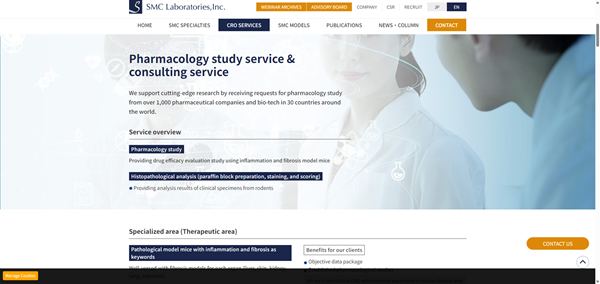
Reference: SMC Laboratories, Inc. official website (https://www.smccro-lab.com/)
SMC Laboratories, Inc.
SMC Laboratories is a specialized non-clinical CRO focused on in vivo pharmacology and efficacy studies using disease-relevant animal models, particularly in fibrosis, inflammation, metabolic diseases, and oncology.
Areas of Expertise
Disease-Relevant Model Portfolio
SMC Laboratories offers models covering the liver, lung, kidney, intestine, and oncology. Its portfolio includes the proprietary STAM™ model for MASH, fibrosis, and hepatocellular carcinoma.
Study Design Based on Target Biology
Study plans are developed around the target biology, mechanism of action, disease stage, and development objective. Pharmacological endpoints can be combined with histopathology, biomarkers, and disease-specific readouts.
Support from Target Validation to Proof of Concept
With experience from more than 1,000 studies for clients in 30 countries, SMC Laboratories supports programs from target validation and candidate selection through in vivo proof-of-concept studies.
Safety StudiesComprehensive Safety Assessment for Preclinical Development
Reference: Charles River Laboratories official website (https://www.criver.com/)
Charles River Laboratories
Charles River provides non-clinical toxicology and safety assessment services for programs ranging from exploratory safety studies to IND-enabling development.
Areas of Expertise
General Toxicology Across Study Designs
Services include single- and repeat-dose toxicology, dose-range finding, and general toxicology studies across multiple species and administration routes.
Non-GLP and GLP Study Support
Charles River supports both non-GLP and GLP studies, allowing sponsors to progress from early safety characterization to studies intended for regulatory submissions.
Integrated IND-Enabling Safety Assessment
Toxicology studies can be integrated with toxicokinetics, clinical pathology, histopathology, and safety pharmacology to support interpretation and IND-enabling safety packages.
Pharmacokinetic (PK/PD) StudiesConnecting Drug Exposure with Pharmacological Response
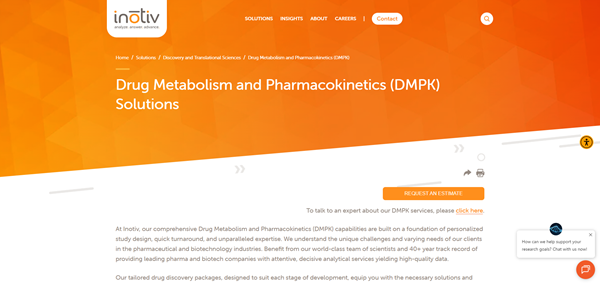
Reference: Inotiv official website (https://www.inotiv.com/)
Inotiv
Inotiv provides integrated PK/PD, DMPK, and bioanalytical services to characterize drug exposure and its relationship with pharmacological response.
Areas of Expertise
Pharmacokinetic Characterization
PK studies characterize exposure, half-life, clearance, and other pharmacokinetic parameters needed to understand how a candidate behaves in the selected model.
Exposure–Response Evaluation
Pharmacokinetic data can be combined with pharmacodynamic endpoints and bioanalysis to evaluate the relationship between drug exposure and pharmacological response.
Integrated DMPK and Development Support
Integrated DMPK, pharmacology, and safety information supports candidate comparison, dose selection, dosing-frequency optimization, and decisions about subsequent preclinical development.

 Japanese