Embryonic stem (ES) cells are pluripotent cells established from the inner cell mass of a blastocyst. A therapeutic product is made by expanding a cell bank and directing differentiation toward a specified cell type, such as a retinal, neural, cardiac, or blood-cell lineage. That manufacturing history makes differentiation state, residual undifferentiated cells, off-target lineages, and genetic stability central product attributes. FDA has specifically considered safety testing and patient monitoring for human ES-cell-derived products through its cellular and gene therapy advisory process.[S3]
Product concepts and US regulatory status
ES-cell-derived retinal pigment epithelium
For a retinal pigment epithelium (RPE) product, the nonclinical plan should match the intended ocular route, dose presentation, delivery device, and anatomical site. Evaluate local retention, migration, survival, proliferative lesions, inflammation, and effects on nearby ocular structures. An ocular site should not be assumed to remove alloimmune or tumorigenicity concerns. No ES-cell-derived product appears on FDA's current list of approved cellular and gene therapy products.[S4]
ES-cell-derived cardiac progenitors and three-dimensional cardiac constructs
For a cardiac progenitor or three-dimensional cardiac construct, characterize differentiation and electrical phenotype before in vivo work. The animal study can then measure retention, tissue response, electrical activity, rhythm, and any proliferative or ectopic tissue at and beyond the administration site. These endpoints test product behavior in the selected system; they do not establish functional recovery in patients.
ES-cell-derived oligodendrocyte progenitor cells
For an oligodendrocyte progenitor product, confirm lineage identity and maturity and quantify residual pluripotent and off-target cells before transplantation. In vivo observations should address graft distribution, survival, proliferation, differentiation, local tissue response, and any ectopic growth. A remyelination endpoint in an animal model is a nonclinical pharmacology result and does not show neurological recovery in patients.
Development questions
Residual undifferentiated cells and tumorigenicity
Residual undifferentiated pluripotent cells can form teratomas, so tumorigenicity is a central nonclinical safety question for an ES-cell-derived product. FDA identifies differentiation status, from undifferentiated or embryonic through terminally differentiated, as a factor in tumorigenicity risk and states that animal tumorigenicity studies should use the intended clinical product rather than analogous animal cells.[S1] The release strategy and in vivo study must therefore be connected: the in vitro assay quantifies residual undifferentiated cells to a stated detection limit, while the animal study evaluates whether the final product forms proliferative lesions over an adequately justified period.
Alloimmune rejection and persistence
An allogeneic ES-cell-derived product may be recognized by the recipient immune system when donor and recipient HLA are not matched. This affects both safety assessment and interpretation of persistence, because xenogeneic or allogeneic rejection can remove human cells before a long-term hazard becomes observable. FDA advises considering immunodeficient animals when they allow longer assessment of a human cell therapy product.[S2] The model should be chosen to answer the stated question, and immune suppression should not be treated as a faithful simulation of clinical immunity.
Differentiation control and off-target lineages
A multistep differentiation process can produce the intended cells, immature intermediates, and off-target lineages in the same lot. Define identity, maturity, purity, viability, and potency attributes, and set methods sensitive enough to detect cell populations relevant to safety. Comparability after a bank, reagent, scale, or process change should include both the desired population and specified impurities rather than relying on an average bulk profile.
A product-specific nonclinical program
1. Residual-cell detection and long-term tumorigenicity
Use orthogonal in vitro methods to detect residual undifferentiated cells in the final product, with a justified limit of detection and recovery study. In vivo tumorigenicity testing should use the intended clinical product, include an appropriate positive control or spiking strategy when feasible, examine the clinical administration site and tissues identified by biodistribution, and continue long enough to detect delayed growth. FDA states that there is no scientific consensus on the best animal model for this endpoint.[S1] A negative study narrows the observed hazard under its conditions; it does not eliminate tumorigenicity risk.
2. Immune context, persistence, and biodistribution
Choose an immune-competent, immunodeficient, or humanized model according to whether the study is intended to examine rejection or to preserve the graft for long-term observation. Imaging can provide longitudinal information, while ddPCR or another validated tissue assay can quantify distribution and persistence. Interpret the methods together, accounting for label persistence after cell death and the nucleic-acid assay's inability to show cell viability. FDA identifies immunodeficient models as an option for longer assessment of human cell therapy products.[S2]
3. Differentiation state and cellular impurities
Single-cell RNA sequencing can map desired, immature, undifferentiated, and off-target cell states in a development lot. Spatial transcriptomics may add location when the product is a sheet, organoid, or other structured construct. These methods are useful for discovery and comparability, but sensitivity depends on sampling depth and analysis thresholds. A rare-cell release assay needs a validated detection limit and should not be replaced automatically by an exploratory single-cell data set.
4. Product function and tissue interaction
Select a functional assay that matches the differentiated cell type, such as barrier or phagocytic activity for RPE, electrophysiology for cardiac or neural cells, or myelination-related endpoints for oligodendrocyte-lineage cells. A three-dimensional model may test local tissue interaction, and an animal disease model may test a defined pharmacology endpoint. Neither establishes efficacy in patients. Function testing should use the final product configuration and be interpreted alongside identity, purity, biodistribution, and pathology.
Questions for a testing laboratory
Ask the laboratory to state its validated detection limit for residual undifferentiated cells, its experience with long-duration graft observation, how it links biodistribution to histopathology, and whether it can test the final clinical product rather than an analogous animal-cell preparation. A living graft cannot be forced into a conventional repeat-dose toxicology template. Study duration, immune background, administration procedure, dose, and tissue collection should follow the product's biology and intended use, consistent with FDA CBER's cell-therapy guidance.[S1][S2] A future licensed ES-cell-derived product would proceed through CBER's Biologics License Application process.[S5]
References
FDA (CBER/OCTGT) — Guidance for Industry: Preclinical Assessment of Investigational Cellular and Gene Therapy Products (Section IV.D.4, Tumorigenicity). https://www.fda.gov/media/87564/download (accessed 2026-09-03)
FDA (CBER/OCTGT) — Guidance for Industry: Preclinical Assessment of Investigational Cellular and Gene Therapy Products (Section IV.B.3, Animal Species/Models). https://www.fda.gov/media/87564/download (accessed 2026-09-03)
FDA (CBER/OCTGT) — Guidance for Industry: Preclinical Assessment of Investigational Cellular and Gene Therapy Products (reference to April 2008 CTGTAC meeting). https://www.fda.gov/media/87564/download (accessed 2026-09-03)
3 Recommended Contract Research Organizations
for Non-Clinical Studies
— by Target goal and Expertise
In non-clinical development, the choice of contract research organization shapes the quality of the data and the time it takes to reach the next decision. Below, three CROs are introduced by the type of study they support: pharmacology (efficacy) studies, safety studies, and pharmacokinetic (PK/PD) studies. Each summary describes the services the company offers so that you can match a provider to your target and development objective.
Pharmacology (Efficacy) StudiesDisease-Relevant Models for Translational Drug Evaluation
Reference: SMC Laboratories, Inc. official website (https://www.smccro-lab.com/)
SMC Laboratories, Inc.
SMC Laboratories is a specialized non-clinical CRO focused on in vivo pharmacology and efficacy studies using disease-relevant animal models, particularly in fibrosis, inflammation, metabolic diseases, and oncology.
Areas of Expertise
Disease-Relevant Model Portfolio
SMC Laboratories offers models covering the liver, lung, kidney, intestine, and oncology. Its portfolio includes the proprietary STAM™ model for MASH, fibrosis, and hepatocellular carcinoma.
Study Design Based on Target Biology
Study plans are developed around the target biology, mechanism of action, disease stage, and development objective. Pharmacological endpoints can be combined with histopathology, biomarkers, and disease-specific readouts.
Support from Target Validation to Proof of Concept
With experience from more than 1,000 studies for clients in 30 countries, SMC Laboratories supports programs from target validation and candidate selection through in vivo proof-of-concept studies.
Safety StudiesComprehensive Safety Assessment for Preclinical Development
Reference: Charles River Laboratories official website (https://www.criver.com/)
Charles River Laboratories
Charles River provides non-clinical toxicology and safety assessment services for programs ranging from exploratory safety studies to IND-enabling development.
Areas of Expertise
General Toxicology Across Study Designs
Services include single- and repeat-dose toxicology, dose-range finding, and general toxicology studies across multiple species and administration routes.
Non-GLP and GLP Study Support
Charles River supports both non-GLP and GLP studies, allowing sponsors to progress from early safety characterization to studies intended for regulatory submissions.
Integrated IND-Enabling Safety Assessment
Toxicology studies can be integrated with toxicokinetics, clinical pathology, histopathology, and safety pharmacology to support interpretation and IND-enabling safety packages.
Pharmacokinetic (PK/PD) StudiesConnecting Drug Exposure with Pharmacological Response
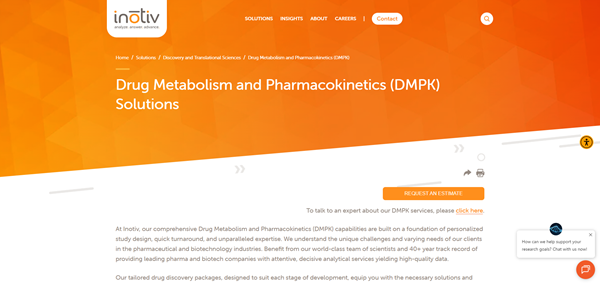
Reference: Inotiv official website (https://www.inotiv.com/)
Inotiv
Inotiv provides integrated PK/PD, DMPK, and bioanalytical services to characterize drug exposure and its relationship with pharmacological response.
Areas of Expertise
Pharmacokinetic Characterization
PK studies characterize exposure, half-life, clearance, and other pharmacokinetic parameters needed to understand how a candidate behaves in the selected model.
Exposure–Response Evaluation
Pharmacokinetic data can be combined with pharmacodynamic endpoints and bioanalysis to evaluate the relationship between drug exposure and pharmacological response.
Integrated DMPK and Development Support
Integrated DMPK, pharmacology, and safety information supports candidate comparison, dose selection, dosing-frequency optimization, and decisions about subsequent preclinical development.

 Japanese