Humanized immune system (HIS) mice combine an immunodeficient mouse host with human hematopoietic cells.[S4][S9] The term covers materially different designs, so a proposal should identify both the host strain and the human-cell source. This article compares those design choices and the limits they impose.
What the humanized compartment does and does not establish
The NSG record describes a severely immunodeficient host carrying Prkdcscid and a null allele of the interleukin-2 receptor common gamma chain; the strain is used to engraft human hematopoietic cells and tissues.[S1] Engraftment lets investigators measure specified human-cell endpoints in a living mouse context. It does not create a complete human immune system, and it does not make efficacy or safety findings predictive of patient outcomes. Reviews of the field emphasize both progress and continuing challenges.[S4][S9]
Verified foundational reviews
The two citations in the Japanese original did not match the verified literature records.[S4][S6] The entries below use the confirmed titles and journals. Their role is to orient study design, not to certify one protocol as standard or clinically predictive.
Platform classification
{'items': ['Verified paper: “Humanized mice for immune system investigation: progress, promise and challenges.”[S4]', 'Shultz LD, Brehm MA, Garcia-Martinez JV, and Greiner DL; Nature Reviews Immunology, 2012.[S4]', 'Related later review: “Humanized mouse models for immuno-oncology research,” Nature Reviews Clinical Oncology, 2023.[S5]']}
Distinguish hu-HSC or CD34+ HSC-engrafted models from hu-PBL or PBMC-humanized models in the protocol. Reviews addressing immuno-oncology and standardization treat them as different systems and identify graft-versus-host disease (GVHD) as a material constraint for PBMC-based designs.[S5][S9] Ask for the cell source, donor identifier, conditioning, engraftment criteria, immune-panel schedule, expected observation window, and GVHD stopping rules.
Scope of a disease-model review
{'items': ['Verified paper: “Humanized Mouse Models of Clinical Disease.”[S6]', 'Walsh NC, Kenney LL, Jangalwe S, Aryee KE, Greiner DL, Brehm MA, and Shultz LD; Annual Review of Pathology, 2017.[S6]']}
The verified Walsh paper is an Annual Review of Pathology article about humanized mouse models of clinical disease.[S6] Its title and bibliographic record do not support the Japanese original’s claim that clinical correlation has been established for checkpoint inhibitors or cell therapies. Use it as a review source, then cite primary studies for any product-specific or outcome-specific assertion.
Cytokine-supported host strains
Some host strains express selected human cytokines to support particular engrafted lineages.[S2] That changes the experimental system and its liabilities; it does not make the mouse physiologically human. Compare the exact transgenes, target cell populations, survival window, and reported adverse phenotypes before choosing a host.
Cytokine-supported HIS mice
{'items': ['NSG-SGM3: NOD.Cg-Prkdcscid Il2rgtm1Wjl Tg(CMV-IL3,CSF2,KITLG)1Eav/MloySzJ, JAX Stock No. 013062.[S2]', 'Corrected citation: Willis et al., Veterinary Pathology, 2024, comparing CD34+ humanization in NOG-EXL and NSG-SGM3 mice.[S7]', 'Review: Stocks et al., “Advances in human myeloid-engrafting NSG-SGM3 and MISTRG mice,” Trends in Immunology, 2025.[S8]']}
The JAX record states that NSG-SGM3 expresses human IL3, CSF2 (GM-CSF), and KITLG (SCF).[S2] A 2024 paper reports improved long-term survival and a less severe myeloid-cell hyperactivation phenotype in CD34+ humanized NOG-EXL mice relative to NSG-SGM3 mice.[S7] Those are comparative findings under the reported conditions, not proof that one host is generally superior. Match the host to the prespecified cell population and observation window.
Platform records and comparison questions
Do not select a platform from a modality label alone. Compare host genotype, engrafted cell type, donor, conditioning, supported lineages, observation window, GVHD criteria, and the assay that answers the development question. The records below establish strain identity; they do not recommend one supplier or platform.
Confirm that the human cytokine transgenes fit the intended lineage and observation window.
NCG
NOD-Prkdcem26Cd52 Il2rgem26Cd22/NjuCrl; identity verified from a 2022 archived Charles River page.[S3]
Reconfirm current supply and nomenclature before ordering.
NOG / NOG-EXL
A 2024 peer-reviewed comparison verifies use of NOG-EXL, but the current official strain designation and stock number were not confirmed.[S7]
Do not insert an unverified stock number; obtain the current supplier record.
Designing for donor variation
Treat the donor as an experimental factor. Record donor identity, source material, processing, release criteria, engraftment threshold, allocation across groups, and whether inference is donor-specific or intended to span donors. A standardization review is available to frame the minimum information that should be reported.[S9] Multiple donors can characterize between-donor variability in the model; they do not prove that the observed range predicts patient responses.
Commissioning checklist
Require the proposal to name the host strain and stock record, human-cell type and donor, conditioning, engraftment and exclusion criteria, immune panel, observation window, GVHD monitoring, primary endpoint, and analysis unit. HIS data establish responses in that combined mouse-host and human-cell system. They do not establish efficacy or safety in patients.
Humanization with CD34-positive hematopoietic stem cells in NOG-EXL mice results in improved long-term survival and less severe myeloid cell hyperactivation phenotype relative to NSG-SGM3 mice. https://europepmc.org/article/MED/38197423 (accessed 2026-09-03)
3 Recommended Contract Research Organizations
for Non-Clinical Studies
— by Target goal and Expertise
In non-clinical development, the choice of contract research organization shapes the quality of the data and the time it takes to reach the next decision. Below, three CROs are introduced by the type of study they support: pharmacology (efficacy) studies, safety studies, and pharmacokinetic (PK/PD) studies. Each summary describes the services the company offers so that you can match a provider to your target and development objective.
Pharmacology (Efficacy) StudiesDisease-Relevant Models for Translational Drug Evaluation
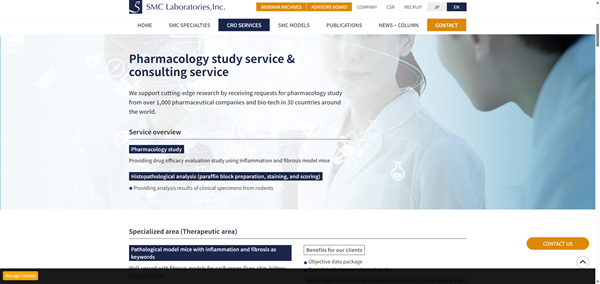
Reference: SMC Laboratories, Inc. official website (https://www.smccro-lab.com/)
SMC Laboratories, Inc.
SMC Laboratories is a specialized non-clinical CRO focused on in vivo pharmacology and efficacy studies using disease-relevant animal models, particularly in fibrosis, inflammation, metabolic diseases, and oncology.
Areas of Expertise
Disease-Relevant Model Portfolio
SMC Laboratories offers models covering the liver, lung, kidney, intestine, and oncology. Its portfolio includes the proprietary STAM™ model for MASH, fibrosis, and hepatocellular carcinoma.
Study Design Based on Target Biology
Study plans are developed around the target biology, mechanism of action, disease stage, and development objective. Pharmacological endpoints can be combined with histopathology, biomarkers, and disease-specific readouts.
Support from Target Validation to Proof of Concept
With experience from more than 1,000 studies for clients in 30 countries, SMC Laboratories supports programs from target validation and candidate selection through in vivo proof-of-concept studies.
Safety StudiesComprehensive Safety Assessment for Preclinical Development
Reference: Charles River Laboratories official website (https://www.criver.com/)
Charles River Laboratories
Charles River provides non-clinical toxicology and safety assessment services for programs ranging from exploratory safety studies to IND-enabling development.
Areas of Expertise
General Toxicology Across Study Designs
Services include single- and repeat-dose toxicology, dose-range finding, and general toxicology studies across multiple species and administration routes.
Non-GLP and GLP Study Support
Charles River supports both non-GLP and GLP studies, allowing sponsors to progress from early safety characterization to studies intended for regulatory submissions.
Integrated IND-Enabling Safety Assessment
Toxicology studies can be integrated with toxicokinetics, clinical pathology, histopathology, and safety pharmacology to support interpretation and IND-enabling safety packages.
Pharmacokinetic (PK/PD) StudiesConnecting Drug Exposure with Pharmacological Response
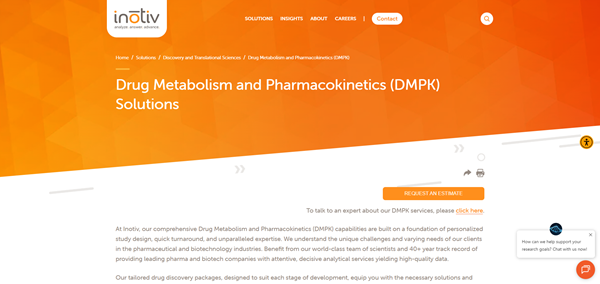
Reference: Inotiv official website (https://www.inotiv.com/)
Inotiv
Inotiv provides integrated PK/PD, DMPK, and bioanalytical services to characterize drug exposure and its relationship with pharmacological response.
Areas of Expertise
Pharmacokinetic Characterization
PK studies characterize exposure, half-life, clearance, and other pharmacokinetic parameters needed to understand how a candidate behaves in the selected model.
Exposure–Response Evaluation
Pharmacokinetic data can be combined with pharmacodynamic endpoints and bioanalysis to evaluate the relationship between drug exposure and pharmacological response.
Integrated DMPK and Development Support
Integrated DMPK, pharmacology, and safety information supports candidate comparison, dose selection, dosing-frequency optimization, and decisions about subsequent preclinical development.

 Japanese