What the regulation asks the nonclinical package to establish
The requirement is stated in one sentence of the regulation: the application must contain adequate information about the pharmacological and toxicological studies of the drug in laboratory animals or in vitro, on the basis of which the sponsor has concluded that it is reasonably safe to conduct the proposed clinical investigations.[S1] The conclusion is the sponsor own, and the studies are what support it. The no observed adverse effect level from the toxicology studies is the usual starting point for setting the first dose in humans. None of this proves that the trial will be safe; it establishes the basis on which the sponsor concluded it was reasonable to start.
The good laboratory practice requirement is more specific than it is usually described. For each nonclinical laboratory study covered by the regulation, the application must include a statement that the study was conducted in compliance with it, or, if it was not, a brief statement of the reason for the noncompliance.[S3] A study conducted outside the regulation is therefore not automatically disqualifying; what is required is the declaration. Compliance itself is determined study by study rather than granted to a facility.[S12]
The studies in a typical package
The regulation names the categories to be summarized: acute, subacute and chronic toxicity; effects on reproduction and the developing fetus; and other tests as appropriate to the product.[S2] What follows describes each in the terms a study proposal will use.
General toxicology
Single-dose and repeat-dose studies characterize systemic effects across a dose range. They produce the no observed adverse effect level and identify which organs are affected, which together set the first dose in humans and determine what is monitored in the trial. The duration required of the repeat-dose studies is tied to the duration of the clinical trial they support.
Safety pharmacology
The core battery covers effects on the central nervous, cardiovascular and respiratory systems, the functions where an acute effect would be most consequential.[S9] These studies are normally conducted under the good laboratory practice regulation.[S12]
Genotoxicity and immunotoxicity
Genotoxicity testing assesses damage to genetic material through a standard combination of assays, beginning with bacterial reverse mutation.[S10] Immunotoxicity testing assesses unintended suppression of, or excessive activation of, the immune system. This article does not state what follows clinically from immune suppression observed in an animal, because no source for that was located in preparing this page.
How the package changes by modality
The standard package assumes a small molecule. For biotechnology-derived products such as therapeutic antibodies, the applicable guidance is ICH S6(R1), and the central design question is species selection: the species used has to be one in which the product is pharmacologically active, which for a species-specific biologic may leave only one option or none.[S7] For pharmaceuticals intended for patients with advanced cancer, a separate guidance applies, under which some studies that would otherwise precede clinical work are instead required at the marketing application stage.[S8] That is a study-by-study difference rather than a general deferral scheme, and which studies it applies to should be confirmed against the guidance.
Sequencing the work
Designing against the applicable guidance from the start avoids studies that have to be repeated because they answered a slightly different question. Planning backwards from the submission rather than forwards from the first study is the other half: report finalization, the integrated summaries the regulation requires,[S2] and assembly of the submission all take time after the last animal is dosed.
What to establish with the laboratory
Four things are worth settling before award. Regulatory experience, meaning submissions this laboratory has supported to the agency and how it handled questions raised afterwards. Animal supply, since non-human primates and minipigs have lead times that can determine the schedule more than the study duration does. Reporting scope, specifically whether the laboratory will deliver in the electronic format required for submission[S6] and whether it will draft the investigator brochure sections that draw on its data. And whether the study director will be available to answer agency questions after the report is issued.
3 Recommended Contract Research Organizations
for Non-Clinical Studies
— by Target goal and Expertise
In non-clinical development, the choice of contract research organization shapes the quality of the data and the time it takes to reach the next decision. Below, three CROs are introduced by the type of study they support: pharmacology (efficacy) studies, safety studies, and pharmacokinetic (PK/PD) studies. Each summary describes the services the company offers so that you can match a provider to your target and development objective.
Pharmacology (Efficacy) StudiesDisease-Relevant Models for Translational Drug Evaluation
Reference: SMC Laboratories, Inc. official website (https://www.smccro-lab.com/)
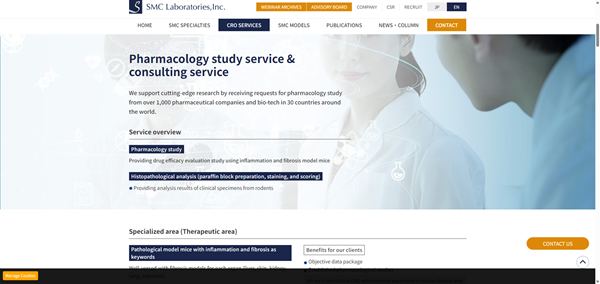
SMC Laboratories, Inc.
SMC Laboratories is a specialized non-clinical CRO focused on in vivo pharmacology and efficacy studies using disease-relevant animal models, particularly in fibrosis, inflammation, metabolic diseases, and oncology.
Areas of Expertise
Disease-Relevant Model Portfolio
SMC Laboratories offers models covering the liver, lung, kidney, intestine, and oncology. Its portfolio includes the proprietary STAM™ model for MASH, fibrosis, and hepatocellular carcinoma.
Study Design Based on Target Biology
Study plans are developed around the target biology, mechanism of action, disease stage, and development objective. Pharmacological endpoints can be combined with histopathology, biomarkers, and disease-specific readouts.
Support from Target Validation to Proof of Concept
With experience from more than 1,000 studies for clients in 30 countries, SMC Laboratories supports programs from target validation and candidate selection through in vivo proof-of-concept studies.
Safety StudiesComprehensive Safety Assessment for Preclinical Development
Reference: Charles River Laboratories official website (https://www.criver.com/)
Charles River Laboratories
Charles River provides non-clinical toxicology and safety assessment services for programs ranging from exploratory safety studies to IND-enabling development.
Areas of Expertise
General Toxicology Across Study Designs
Services include single- and repeat-dose toxicology, dose-range finding, and general toxicology studies across multiple species and administration routes.
Non-GLP and GLP Study Support
Charles River supports both non-GLP and GLP studies, allowing sponsors to progress from early safety characterization to studies intended for regulatory submissions.
Integrated IND-Enabling Safety Assessment
Toxicology studies can be integrated with toxicokinetics, clinical pathology, histopathology, and safety pharmacology to support interpretation and IND-enabling safety packages.
Pharmacokinetic (PK/PD) StudiesConnecting Drug Exposure with Pharmacological Response
Reference: Inotiv official website (https://www.inotiv.com/)
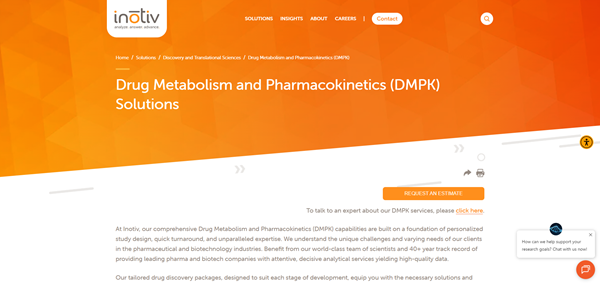
Inotiv
Inotiv provides integrated PK/PD, DMPK, and bioanalytical services to characterize drug exposure and its relationship with pharmacological response.
Areas of Expertise
Pharmacokinetic Characterization
PK studies characterize exposure, half-life, clearance, and other pharmacokinetic parameters needed to understand how a candidate behaves in the selected model.
Exposure–Response Evaluation
Pharmacokinetic data can be combined with pharmacodynamic endpoints and bioanalysis to evaluate the relationship between drug exposure and pharmacological response.
Integrated DMPK and Development Support
Integrated DMPK, pharmacology, and safety information supports candidate comparison, dose selection, dosing-frequency optimization, and decisions about subsequent preclinical development.

 Japanese